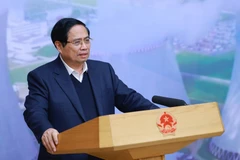
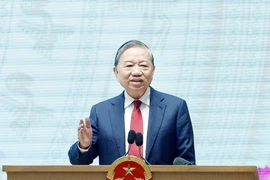
Deputy Prime Minister and Foreign Minister Pham Binh Minh (Photo: VNA)
 Hanoi (VNA) – July 28 this year marks 25 yearsof Vietnam’s official membership in the Association of Southeast Asian Nations(ASEAN). The anniversary is special at the point that Vietnam is shoulderingthe heavy responsibility of the rotary Chair of the bloc for the second time.On this occasion, Politburo member, Deputy Prime Minister and Foreign Minister PhamBinh Minh writes an article entitled “Vietnam’s 25 years of ASEAN membership: Joininghands for a cohesive and responsive community”. Following is a translation ofhis article:
July 28, 2020 marks a quarter of a century of Vietnam beingan official member of ASEAN, and this anniversary coincides with the country’staking on the responsibility of the bloc’s rotary Chair for the second time.
Joining the association in 1995 is one of the most importantmilestones in the history of Vietnam’s foreign relations since the August Revolutionin 1945, as well as in the development of ASEAN itself. The historical event holdsa significant meaning, turning Southeast Asia from a region of confrontation intoone of dialogue, from scepticism into trust, and from division into solidarity.
For ASEAN, accepting Vietnam as its seventh member helpedspeed up the expansion of the bloc to all the 10 regional countries, thus consolidatingpeace and stability in a region that has special geo-political and geo-economicimportance as a centre for links between the Pacific and Indian Oceans.
At the time when Vietnam joined ASEAN, the region had justcome out of the Cold War and its position, role, and economic scale remained modest.The past 25 years have witnessed a vigorous change in the association. The 10 SoutheastAsian nations have now become part of a united community with rising prestige inthe Asia-Pacific and the world as a whole.
On the basis of the Treaty of Amity and Cooperation(TAC) mechanisms and with the formation of the ASEAN Regional Forum (ARF) and the Southeast Asian Nuclear-Weapon-Free Zone Treaty (SEANWFZ), ASEANhas eventually become a region of peace and stability with its position graduallyaffirmed. The formation of the ASEAN Free Trade Area (AFTA) and the signing of freetrade agreements (FTAs) between ASEAN and a series of world key economies have contributedto bringing about prosperity for ASEAN and making it one of the regions with themost dynamic economic development in the world.
ASEAN was the common house of about 650million people in 2019 with a combined GDP of more than 3.2 trillion USD and traderevenue of 2.8 trillion USD.
The ASEAN Community was set up on December31, 2015, making the bloc a community with political cohesion, economic links, andshared social responsibility. Today, ASEAN is considered a success model in regionalcooperation. ASEAN-led forums have drawn many countries and been valued by all worldpowers.
In addition to intra-bloc solidarity and connectivity,ASEAN has proactively expanded its relations with partners and become an importantpartner of major countries inside and outside the region. With its open diplomaticrelations with the 10 dialogue partners, including all powers, the voice of ASEANhas been listened to and its central role further consolidated.
In fact, ASEAN’s central role has been affirmed throughits efforts to boost and lead the ASEAN Regional Forum (ARF), the East Asia Summit(EAS), the ASEAN Defence Ministers’ Meeting (ADMM), and ADMM Plus, as well as throughincreasingly important contributions to resolving the region’s common issues. ASEANhas shown a consistent stance on maintaining peace and stability in the East Seaand the region, such as the 2002 Declaration on the Conduct of Parties in the EastSea (DOC) and negotiations on a Code of Conduct in the East Sea (COC).
For Vietnam, this day 25 years ago is also an importantmilestone marking the country’s very important progress in its regional and internationalintegration. It has integrated more confidently, proactively and actively ever since,and continuously promoted its role as a reliable partner and a responsible memberof the ASEAN Community in particular and the international community in general.
During the integration process, the diplomatic sector hasalways played a pioneering role, opening the door to the world. In bringing thecountry out of blockade and isolation, ASEAN was taken as the firstbreakthrough for Vietnam in its integration. In the subsequent periods,Vietnam’s integration and participation in ASEAN were closely associated withthe country’s renewal and international integration. Vietnam has made great stridesforward in changing its ways of thinking for diplomacy, from the one of “more friends,less enemies”, diversification and multi-lateralisation of international relations,and “shifting from confrontation to dialogues” into that of becoming aproactive, active and responsible member in ASEAN, and now that of proactively,actively and responsibly joining other ASEAN countries to build a strong community.
Vietnam has gradually affirmed itself as an integral partof ASEAN and the Southeast Asian region, attached its development with ASEAN, andwished to shoulder the bloc’s common work. The ASEAN policy has become an importantpart in Vietnam’s foreign policy, which is highlighted in the Party’s documentsand resolutions on external relations, in particular Directive No 25-CT/TW datedAugust 8, 2018 on boosting and elevating multilateral diplomacy to 2030.
Right after becoming a member of ASEANin 1995, Vietnam actively pushed for the joining of the other Southeast Asian countriesinto the bloc, with Laos, Myanmar and Cambodia becoming ASEAN members in 1997 and1999. As a result, the dream of a ten-member ASEAN had come true. As a memberof ASEAN, Vietnam has taken a proactive, active and responsible part in the bloc’swork, including institution building such as the ASEAN Charter (2008); the roadmapto build the ASEAN Community (2009-2015); the 2009, 2015, and 2025 masterplans; and ASEAN Community visions for post-2015, post-2025, and beyond. It hasalso been comprehensively implementing the three pillars of the ASEAN Community.Vietnam successfully organised the sixth ASEAN Summit and took up the Chairmanshipof the 34th ASEAN Standing Committee (ASC) from July 2000 to July 2001 and theChairmanship of the ASEAN this year. The country has spared no efforts in fulfillingits role as the ASEAN Chair 2020. With important initiatives and contributionsmade, such as expanding the EAS and establishing the ADMM mechanism, Vietnam hasactively worked with other member states to maintain the central role of ASEAN inthe emerging regional architecture.
One thing for certain is that the participation inASEAN has brought about significant and practical benefits for Vietnam. Firstly,ASEAN is an important foundation for international integration and creates a favourableinternational environment for nation building and defence. Over the past 25 years,Vietnam has joined other ASEAN member nations in building a Southeast Asia of friendship,cooperation and without wars. In addition to promoting intra-bloc cooperation, Vietnamhas set up strategic partnership and comprehensive partnership frameworks with neighbouringand regional countries, powers, and other important partners. Vietnam’s rising rolein ASEAN has helped it win international support for the safeguard of its securityand development interests, including the East Sea issue.
Secondly, joining ASEAN has helped Vietnam with itsextensive and intensive international integration and pooling resources to servedevelopment and raise general power. The country has actively engaged in theAsia-Pacific Economic Cooperation (APEC), the Asia-Europe Meeting (ASEM), the WorldTrade Organisation (WTO), and new-generation FTAs such as the Comprehensive andProgressive Agreement for Trans-Pacific Partnership (CPTPP) and the EU-Vietnam FreeTrade Agreement (EVFTA), which enables it to push ahead with reforms, expand markets,increase exports, and attract investment and ODA, through which it has boosted economicgrowth for many years.
Thirdly, integrating into ASEAN helped Vietnam graduallyraise its multilateral diplomacy and position in the world. Its successful participationin the bloc has been enabling it to fulfil important multilateral diplomatic missions,such as the non-permanent membership of the UN Security Council (UNSC) for the 2008-2009and 2020-2021 tenures and the host of the APEC Summit in 2006 and 2017, as wellas actively joining in building international rules and cooperation to cope withglobal challenges like climate change and the COVID-19 pandemic.
Fourthly, the participation in ASEAN over the past25 years has helped improve the expertise of Vietnam’s diplomatic officials, especiallythose working in multilateral efforts, with them becoming more confident when reachingout to the globe.
As the ASEAN Chair 2020, Vietnam, together with othermember states, has defined the common theme for the year as “Cohesive and Responsive”so as to push ahead with progress in building the ASEAN Community and promotingthe role of ASEAN in a changing world.
Over the past seven months, Vietnam’s efforts asthe ASEAN Chair have demonstrated its cohesive and responsive spirit. Along withsolidarity and cohesion among ASEAN member nations and the support and close coordinationfrom ASEAN partners, the bloc has ensured the effective implementation of cooperationand connectivity targets for 2020, as well as overcome difficulties and challengesto curb the pandemic and soon address its consequences to boost economic recoveryand development.
The way ASEAN is weathering theunexpected and unprecedented waves caused by the COVID-19 pandemic has attestedan ASEAN cohesive, responsive, stubborn and indomitable to adversities. Morethan ever, Vietnam understands the importance of community thinking andcommunity actions. As Prime Minister Nguyen Xuan Phuc has stressed, separateefforts should be grouped together beyond the national scale into the commonacts of the whole ASEAN Community./.
VNA