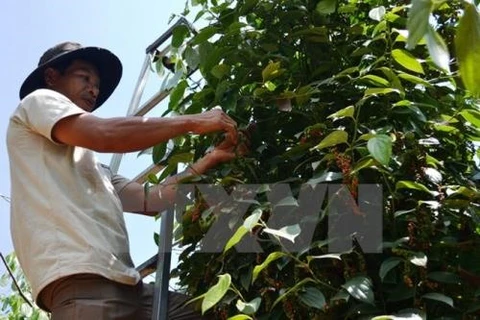
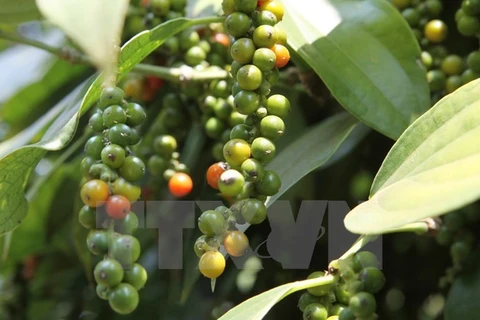
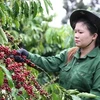
A farmer rakes newly harvested pepper in southern Binh Phuoc province (Source: VNA)
Hanoi (VNA) - Vietnam’s pepper farmers are on pins and needles as pepper prices continue to decline. The industry, once known for its high profit margins, is in crisis due to unsustainable development, lack of strict control over production and unforeseeable speculation.
According to Le Van Duc, Deputy Director of the Crop Production Department under the Ministry of Agriculture and Rural Development (MARD), as world market demand for pepper began to rise at the beginning of the decade, pepper production in Vietnam started growing at an alarming rate. He now predicts that "the bubble is about to burst".
The total production area has increased threefold between 2010 and 2017. Vietnam is now the world leader in pepper production. It exports to 109 countries and territories, mainly to Europe, Asia and America.
However, production in Vietnam is showing signs of deterioration due to diseases, lack of quality control, poor production links and poor value-chain development.
Duc said the situation called for the pepper industry to restructure the sector.
Minister of Agriculture and Rural Development, Nguyen Xuan Cuong, said that if the shortcomings were not corrected, they would affect sustainable pepper development.
According to MARD data, by the end of 2017, the total pepper farming area exceeded the 2020 plan by more than 100,000 hectares, mainly concentrated in the Central Highlands.
Duc said the danger was that although global pepper production had increased by 7 percent year-on-year in 2017, overall demand only increased by 2.4 percent. Considering current supply and demand, the pepper bubble would soon burst.
Nguyen Nam Hai, chairman of the Vietnam Pepper Association (VPA), said that as global consumption did not increase in tandem with supply, world pepper prices had fallen to their lowest levels in recent years. The increase in pepper acreage in Vietnam had also significantly contributed to the decrease in pepper price.
Vietnamese pepper prices are moving in a downward spiral, threatening the whole industry’s survival. The domestic price is only about 65,000 VND (2.90 USD) per kilo, equivalent to an export price of 3,000 USD per tonne.
This was lower than prices between 2013 and early 2017, when global average prices were around 7,000 to 8,000 USD per tonne, according to the International Pepper Community (IPC).
At a conference on sustainable pepper production held in HCM City in January, the consensus was that hasty development of the industry in recent years had caused many irreversible impacts, such as pests and diseases which have led to a reduction in quality, especially in food safety in some growing areas.
Kpui H’Ble, Vice-Chairman of the People’s Committee of Chu Se district in Gia Lai province, one of the country’s largest pepper producing regions, said pepper accounted for 36 percent of total production value from cultivation in her district.
She said that when pepper prices were low, almost everyone was affected.
According to H’Ble, recent sharp increases in pepper prices have led to over-intensive production. In particular, new plantations, inexperienced farmers with a lack of knowledge on sustainable farming, meant pepper bushes were easily infected.
Huynh Quoc Thich, Deputy Director of Dak Lak Department of Agriculture and Rural Development, said many pepper farmers grew their crops on soil with unsuitable mechanical components and slow drainage during the rainy season.
This led to mass mortality risks during flooding and the fast spread of blight - and lack of compliance with technical and health safety in many localities, said Thich.
Cuong suggested that localities focus on reducing production areas not suitable for pepper farming, while explaining to farmers about world pepper production exceeding demand.
Hai said that the only solution was to stop expanding production, stabilising it at 100,000 hectares across the country, with an yearly average output of 180,000 to 200,000 tonnes.
Hoang Phuoc Binh, deputy chairman of Chu Se Pepper Association in Gia Lai province, said that with the current market trend, farmers must repress any urge to speculate.
‘Pepper is a long-term industrial plant, therefore, farmers should leave a gap of four to five years before planting new crops and instead focus on the ones, minimising the use of chemical pest controls to ensure top product quality,’ said Binh.
According to the VPA, pepper product quality and safety is often demanded by importers such as the United States and the European Union.
Nguyen Ngoc Luan, Director of Lam San Agricultural Cooperative in southern Dong Nai province, said that since its establishment in 2014, his cooperatives had been oriented towards clean pepper production for export to the EU. If farmers cultivated clean pepper according to the co-operative’s procedures, they were guaranteed selling prices 10 percent higher than the market, while higher quality organic product was sold 30 to 50 percent higher.
VPA Chairman Hai agreed that the restructuring of the pepper industry must focus on quality and sustainability.-VNA
VNA