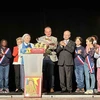
At Quan Su pagoda (Source: VNA)
 Hanoi (VNA) – Though casting a fairly positive light on Vietnam’s irrefutable achievements in ensuring religious and belief freedom, the annual report on global religious freedom issued by the US Department of State on August 10 still contains contents exposing a narrow mindset, biased outlook and a lack of goodwill.
In the report, the US Department of State acknowledged the Vietnamese government’s efforts in ensuring the rights to religious and belief freedom, including the release of the draft Law on Religion and Belief for public feedback.
It also took note of opinions by almost all heads of Vietnamese religious organisations, which said religious freedom is being expanded across the country and the government has increasingly given recognition to religious organisations.
However, it continued to accuse Vietnam of violently treating several religious groups, detaining and prosecuting them, restricting their travel, denying the license of their operations as well as hindering their activities in education and health care.
According to the report, Vietnam’s regulations on religious management allow for limiting religious freedom and for the country’s authorities to continue obstructing the activities of unregistered religious groups.
The points mentioned in the report are not new, and are still a subjective and one-sided feedback. In fact, the vivid religious life and law abiding spirit in ensuring human rights on view in Vietnam are the strongest disclaimers against such allegations.
Firstly, belief and religious freedom in Vietnam has been confirmed in the draft Law on Belief and Religion, which is to replace the Ordinance on Belief and Religion, with additional contents to suit the current reality.
The draft law recognises and specifies that the right to belief and religion is for all “people”, not only “citizens”, while clearly affirming the right to follow or not follow a religion of other individuals.
No one is entitled to violate that right, stresses the document which prohibits the forcing of following or quitting of religions, or the taking advantage of belief and religious freedom to harm the State, citizens or religious organisations’ rights.
Compared to the older legal documents, the bill has shown an open spirit by the State in treating religions. It is vivid and convincing evidence that rejects incorrect arguments that would slander the State of Vietnam by suggesting it is issuing the law to “tighten” the right to belief and religious freedom.
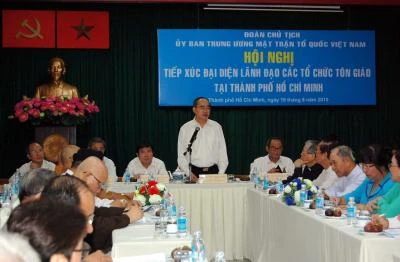
Secondly, the freedom to practice religious rites and join religious activities for followers has been exceptionally respected and observed. In reality, annual religious festivals, including Christmas and the Buddha’s birthday ceremony, have been held solemnly with the participation of hundreds of thousands of followers.
Belief and religious activities are not only considered a spiritual need of followers, which is protected by the law, but are also seen as cultural activities belonging to the whole people. A number of major festivals have become shared events of the community, showing a harmony between life and religions and serve to strengthen Vietnam’s solidarity bloc.
Over the past number of years, international cooperation by religious organisations has been stepped up, with visits conducted by both Vietnamese and foreign religious delegations.
Religious organisations in Vietnam have also received support to organise numerous important activities such as the Vesak celebrations and the Plenary Assembly of the Federation of Asian Bishops’ Conferences.
Vietnam is a multi-racial and multi-religious nation. Rare are countries that have such harmony between major religions like Vietnam.
The Vietnamese State has to date recognised 39 organisations of 14 religions, with 24.3 million followers, or 27 percent of the population, and 27,900 places of worship.
Religious organisations are an important channel that helps put the Party’s guideline and policies and the State’s laws into reality.
A lot of prestigious religious dignitaries have been voted to the National Assembly, People’s Councils at all levels, the Vietnam Fatherland Front and its member organisations, which shows the sound and consistent policies on religion and belief of the Party and State.
The Vietnamese State only punishes organisations and individuals that violate the law, or who take advantage of the freedom of religion and belief to ruin the Party and State, or to undermine the nation’s construction and safeguarding, or the great national unity.
As such, the US Department of State needs to have a more objective insight into Vietnam’s eventful religious and belief practices, in order to make a correct assessment in conformity with the two countries’ increasingly growing relations.-VNA