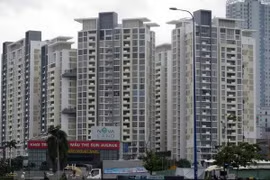
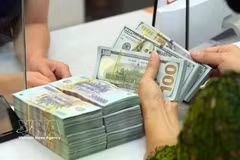
Foreigners receive consultation on buying a house in Vietnam (Photo: baoxaydung.com.vn)
Hanoi (VNS/VNA) - Vietnam's real estate market must solve many difficulties to increasethe number of foreigners buying property in the country, experts said.
“To promote foreigners’ trading of real estate products on the local market, Vietnam should increase the portion of property products available forforeigners in each project,” said Nguyen Hoai An, director of CBRE Vietnam's Hanoi branch.
“It is necessary to complete legal documents, circulars, procedures and supportfor foreigners in buying property products in Vietnam,” she said. “The nationneeds to complete the process of issuing pink books and certificates ofownership for property belonging to foreigners.”
“Meanwhile, banks need to increase support for foreigners in propertytransactions,” she said.
Existing projects that want to attract more foreign customers should developprofessional customer care processes for foreigners, she said.
Foreign buyers have often faced barriers to buying real estate in Vietnam,including the limitation of the law on the foreign ownership portion of eachproperty project, An said.
“For apartment projects, foreigners can only own up to 30 percent of theapartment volume, while for townhouse projects the portion is not to exceed 10percent or 250 units,” An said.
According to Nguyen Manh Ha, former head of the construction ministry’s Housingand Market Management Department and deputy chairman of the Vietnam RealEstate Association, Vietnam has many laws, decrees and circulars related toproperty trading. Foreign buyers often do not know all of the country’s laws.
The State should have a handbook for buyers to provide guidance on all stepsand the state agencies implementing those steps, Ha said. That would make iteasier for foreign buyers to navigate the property purchasing process.
"Vietnam has a legal framework allowing foreigners to buy and ownproperty in the country," An said. "However, the process hasobstacles in the form of the language and laws for implementing legaldocuments."
"In addition, foreign buyers have also had trouble getting support withmoney transfers from banks," she said.
"Most projects of local investors have not had customer support teams tohelp foreign buyers during property transactions, making it hard for foreignersto buy from those projects."
"Moreover, many foreign customers receiving houses or apartments have hadproblems getting certificates of ownership," she said.
Stephen Wyatt, Country Head of JLL Vietnam, agreed and added that some projectsin HCM City reported foreign buyers were interested in their projects but therewere no available units for foreigner buyers due to the legal limits.
“The number of foreign buyers has totalled thousands of units, versus afew hundred recorded before the new law was introduced,” said Wyatt. “However, the issuance of pink books continued to be a challenge forforeign buyers.”
Since the law that allows foreigners to purchase property in Vietnam came intoeffect in 2015, the number of enquiries and transactions from foreignbuyers increased significantly, Wyatt said.
JLL recently carried out an international marketing campaign for residentialprojects in Vietnam and received a considerable amount of interest andfeedback from foreign investors from Singapore, Hong Kong, mainland China, the Republic of Korea and Japan, Wyatt said.
“Vietnam has many opportunities for real estate market development,” he said.“Some positive changes have taken place to the legal structure surroundingresidential transaction activity, which will lure more foreign developers andinvestors into the local market, and to Vietnam's law allowing foreign buyersto purchase and own residential property.”
The rights of foreigners over the property are the same as the rights of thelocals – the property can be leased out, sold, inherited and used ascollateral. In addition, tenure shall be for 50 years and can be renewed foranother 50 years.
A safe and stable political situation and economic growth rate are alsoadvantages for the market. Therefore, foreign real estate investors should beaware of Vietnam as a new market for investment, he said.
Foreign direct investment (FDI) is increasing, contributing to surge in numberof foreigners living and working in Vietnam. Attention to investment inproperty from foreign buyers will continue to increase, according to An.
On the market, the supply and quality of products are continuing to increase,bringing more options for buyers, including those buying for investmentpurposes.
In the near future, foreign buyers will continue to play a role in the marketbecause they are able to buy property at a lower price than in their homecountries.
According to CBRE, at projects that were offered by CBRE on the market, thenumber of foreign buyers in the 2017-18 period more than doubled in comparisonwith the number of transactions in the 2016-17 period. Many of the projects hadsold their full quota of units for foreigners during their first marketoffering.
The Housing and Market Management Department reported that by 2017 there were800 foreigners with certificates of ownership for property in Vietnam.
Meanwhile, there are 400,000 foreigners living and working in Vietnam. Thisnumber will increase in the future as the country integrates further in the globaleconomy, meaning foreigners’ demand for Vietnamese property will continue torise.-VNS/VNA
VNA