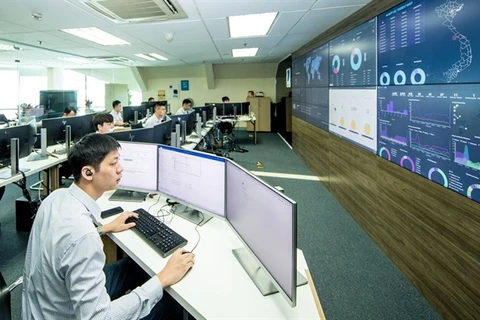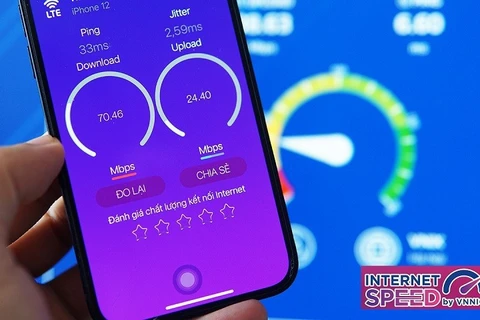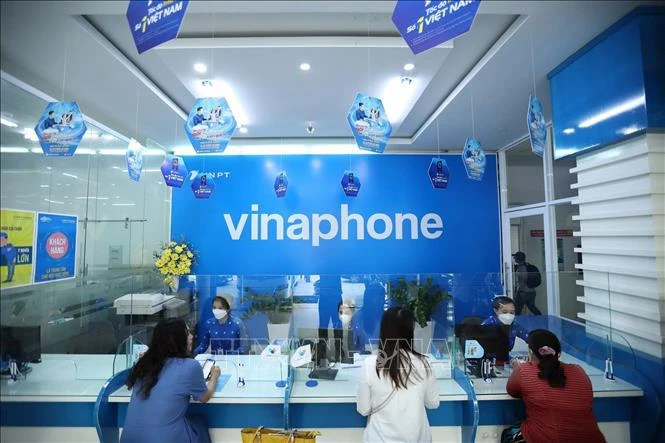
Hanoi (VNA) – The Vietnam Posts and Telecommunications Group (VNPT) is poised to pioneer researching 6G to help the country apply this technology at an early date.
This is part of the firm’s development strategy until 2030 with a vision to 2035, recently approved by Deputy Prime Minister Ho Duc Phoc.
According to the strategy, the general goal is to continue developing the group into a strong, dynamic, efficient, and modern State-run enterprise capable of competing with others in the country and the world and properly delivering public services, thus contributing to socio-economic development, national defence, and security.
The firm is set to turn itself into a technology group focusing on digital infrastructure, digital technology, and digital services while possessing and operating the key platforms and facilities of the national digital infrastructure. It will strive to become a pioneering innovator that masters digital technology and provides a digital ecosystem for every socio-economic aspect.
The VNPT will develop platforms supplying core digital technologies, including the Internet of Things, artificial intelligence, big data, blockchain, and cybersecurity, as an essential service that acts as important soft infrastructure providing services.
It will also research and apply new technologies for realising the broadband internet access network, along with open network technologies, cloud native/cloud edge, network automation/autonomous network, along with wireless network access technologies, according to the strategy.
In addition, the group is set to develop 5G infrastructure on the basis of the 4G network, increase sharing telecoms infrastructure with other telecoms businesses, and pioneer researching 6G to help the country become one of those applying this technology early in the world.
By 2025, it will develop into a key enterprise of the country, successfully transforming from a traditional telecoms business into a technology firm, and mastering some important platforms guiding the national digital transformation.
By 2030, the group is to become a smart, dynamic, and efficient digital technology business that plays an important role in Vietnam’s national digital map while successfully entering regional and international markets.
And by 2035, it will establish itself as a platform for all clients, possess ecosystems of all services, and supply a high-quality, smart, and trustworthy transmission network aligned with leading digital platforms in Vietnam and the region, the strategy notes./.
See more
Vietnam needs tens of thousands of nuclear power workers by 2035
According to the Agency for Radiation and Nuclear Safety under the Ministry of Science and Technology, human resources will be among the decisive factors determining whether the country can successfully implement its nuclear power programme on schedule.
Ho Chi Minh City to complete 1st recruitment drive for top science, technology experts in Q3
To strengthen its competitiveness in attracting global talent, the city has introduced a comprehensive package of incentives, including housing assistance, transportation support, streamlined immigration and work permit procedures, improved research facilities, and favourable working conditions.
Vietnam approves national digital transformation strategy for 2026 - 2030
Vietnam aims to become a developed digital nation where digital transformation is implemented comprehensively across all sectors and serves as the country's principal development model. The strategy envisions a modern system of national governance powered by data and AI, strong domestic capabilities in strategic digital technologies, platforms and products, and firm protection of national digital sovereignty.
Vietnam needs “open technological sovereignty” to strengthen position in AI era: expert
Vietnam possesses significant advantages for deeper participation in the global technology value chain. Its young engineering workforce, strong capacity to absorb new technologies and strategic location have made the country an increasingly attractive destination for technology-related foreign direct investment.
Int’l scientists gather at 2nd advanced school on topological quantum matters in Gia Lai
Jointly organised by the Rencontres du Vietnam (Meeting Vietnam) association and the International Centre for Interdisciplinary Science and Education (ICISE), the five-day event features lectures by leading professors and scientists in quantum physics and materials science, providing participants with a solid theoretical foundation. They are also updated on the latest research advances in quantum topological materials.
Vietnam AI Innovation Challenge 2026 spotlights real-world AI solutions
The Vietnam AI Innovation Challenge 2026 showcased a new generation of AI solutions with the potential to move beyond the lab and into real-world use.
More than 80% of Vietnam's population uses smartphones
The 2025 household living standards survey showed that 87.3% of the population used mobile phones, up 2.5 percentage points from 84.8% in 2024. Of those, 80.3% used smartphones, while the proportion of people using feature phones fell to 8.5%.
Vietnam RWA Summit 2026 highlights need to balance innovation with risk management
A healthy tokenised asset market must be built on reliable data, verifiable identities, transparent information on assets and cash flows, and effective disclosure and supervision mechanisms, an expert has said.
Vietnam seeks safe, regulated development of tokenised asset market
The two-day event, organised by the Vietnam Blockchain Association in partnership with the National Cybersecurity Association and the Vietnam National Real Estate Association, aims to foster policy dialogue, attract investment and position Vietnam as a regional hub for real-world asset (RWA) tokenisation during 2026-2030.
Vietnam pushes stronger basic research to drive innovation, self-reliance
Prof. Dr. Nguyen Van Minh, former rector of the Hanoi National University of Education, said basic research not only generates new knowledge but also fosters innovation and improves the quality of economic growth. Vietnam's growing research capacity has enhanced its regional and international standing while contributing to sustainable development, strategic autonomy, national defence and governance.
Global technology firms partner with Da Nang to develop AI infrastructure
Da Nang is committed to supporting businesses, particularly small- and medium-sized enterprises (SMEs), in digital transformation, AI adoption, and workforce development, with the goal of becoming a hub for innovation and AI development in central Vietnam, said a local official.
Deputy PM outlines five strategic pillars for AI development
Deputy PM Ho Quoc Dung said the current priority is to change the mindset. AI should not be developed in isolation by individual agencies or organisations but through an interconnected ecosystem linking the State, universities and research institutes, and businesses.
Innovation challenge seeks AI-native solutions to real-world problems
Following a rigorous five-week intensive bootcamp led by experts from Google Research, Stanford, and NVIDIA, the teams entered a grueling 48-hour AI hackathon to develop AI-native applications.
Vietnam, IAEA expand cooperation in peaceful nuclear applications
Vietnam is implementing 19 cooperation projects with the IAEA in different areas, including agriculture, healthcare, nuclear safety and security, and physical and chemical sciences. The initiatives demonstrate how nuclear technologies can contribute to socio-economic development.
Vietnam, RoK deepen startup ecosystem connectivity
Both sides agreed that Vietnam-RoK startup cooperation must pivot from fact-finding tours, trade shows and short-term networking towards a hard-nosed partnership model that delivers concrete market access, business partner matchmaking, product validation, technology piloting and investor connectivity.
VinFuture's global science network delivers lasting value for Vietnam
Via conferences, expert dialogues, networking and inspirational talks, VinFuture has brought many of the world's leading scientists to Vietnam not just to share knowledge, but to co-design research, advise on talent pipelines, and build practical solutions for the country’s most urgent problems.
PM orders faster implementation of science, technology, digital transformation agenda
Under Directive No. 29/CT-TTg, the Prime Minister instructed ministers, heads of ministerial-level agencies and provincial and municipal leaders to treat science, technology, innovation and digital transformation as a top political priority, stressing that faster disbursement must go hand in hand with efficiency, transparency and the prevention of waste and corruption.
Science – technology, innovation central to Vietnam’s development strategy
End-to-end electronic processing rates have climbed to 91.7% for outgoing documents and 93.8% for incoming ones, the highest nationwide. The rate of administrative procedures handled entirely online has surged to roughly 97–99% at present from 89.65% as of July 1, 2025
Robot- and AI-driven advances in stroke care introduced at Can Tho conference
Experts are introducing six-dimensional (6D) cerebral vascular imaging for treatment planning, AI-assisted stroke imaging, and robotic intervention and rehabilitation. They are also presenting next-generation neurointerventional devices and personalised treatment strategies to shorten treatment times, improve survival rates, and reduce long-term disability.
Vietnam strengthens position in Asia’s AI trade landscape
HSBC (Hongkong and Shanghai Banking Corporation Limited) identifies Vietnam as the economy that has recorded the fastest improvement in its position within the AI supply chain. The country’s share of global trade in AI-related equipment surged from 1.2% in 2015 to 12.4% in 2025, the strongest increase worldwide during the period.