Illustrative image (Photo: VNA)
 Hanoi (VNA) – Vice Chairman of the Vietnam Real Estate Association (VNREA) Nguyen Manh Ha has stated that there is still room for resort real estate to develop, especially in new markets.
In the north, Hai Phong and Quang Ninh have attracted the most number of resort property developers with their strengths in sea services. Their real estate products are mostly condotels and resorts.
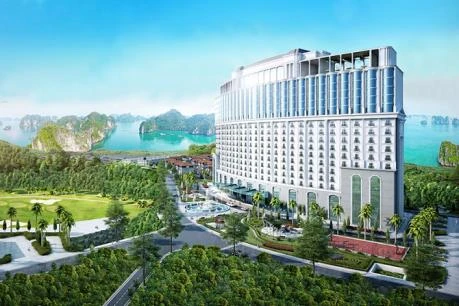
Ha Long city in Quang Ninh province has emerged as a resort paradise with major investors pouring trillions of Vietnamese dong into projects such as Sun Premier Village Ha Long Bay and the FLC Ha Long Bay Golf Club & Luxury Resort. A number of projects are on the waiting list, which is expected to fuel the local tourism real estate market in the near future.
A wave of resort property development has spread to provinces with favourable geographical location and attractive landscapes such as Vinh Phuc, Phu Tho, Hoa Binh, Ninh Binh, among others.
Thanks to internal and inter-provincial transportation connectivity and the high demand for resort services in the south, markets in Long An, Dong Nai, Can Tho, Ba Ria-Vung Tau and Binh Thuan are thriving – with Ba Ria-Vung Tau notably developing a series of large-scale projects.
Major investors such as Tuan Chau, FLC, and Novaland are seeking land for super luxury resorts stretching hundreds of ha. In particular, Novaland plans to develop a resort in Can Tho, another covering nearly 1,800 ha in Mui Ne, and the Nova Hills resort in Phan Thiet.
Commenting on the prospect of resort real estate market, VNREA Chairman Nguyen Tran Nam said this segment needs to be developed to meet accommodation demands. –VNA
In the north, Hai Phong and Quang Ninh have attracted the most number of resort property developers with their strengths in sea services. Their real estate products are mostly condotels and resorts.
Ha Long city in Quang Ninh province has emerged as a resort paradise with major investors pouring trillions of Vietnamese dong into projects such as Sun Premier Village Ha Long Bay and the FLC Ha Long Bay Golf Club & Luxury Resort. A number of projects are on the waiting list, which is expected to fuel the local tourism real estate market in the near future.
A wave of resort property development has spread to provinces with favourable geographical location and attractive landscapes such as Vinh Phuc, Phu Tho, Hoa Binh, Ninh Binh, among others.
Thanks to internal and inter-provincial transportation connectivity and the high demand for resort services in the south, markets in Long An, Dong Nai, Can Tho, Ba Ria-Vung Tau and Binh Thuan are thriving – with Ba Ria-Vung Tau notably developing a series of large-scale projects.
Major investors such as Tuan Chau, FLC, and Novaland are seeking land for super luxury resorts stretching hundreds of ha. In particular, Novaland plans to develop a resort in Can Tho, another covering nearly 1,800 ha in Mui Ne, and the Nova Hills resort in Phan Thiet.
Commenting on the prospect of resort real estate market, VNREA Chairman Nguyen Tran Nam said this segment needs to be developed to meet accommodation demands. –VNA
VNA