Voluntary blood donation a popular movement in Vietnam

April 7 was designated as the “All People’s Voluntary Blood Donation Day” 22 years ago and, ever since, the blood donation movement has developed on a large scale and won over widespread support.
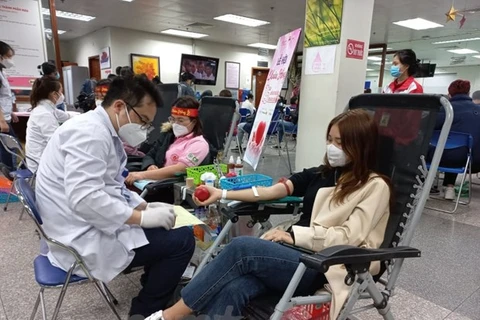
Voluntary blood donation a popular movement in Vietnam ảnh 1People donate blood at an event in Hanoi. (Photo: VNA)
Hanoi (VNA) – April 7 was designated as the “All People’s Voluntary Blood Donation Day” 22years ago and, ever since, the blood donation movement has developed on a large scale and wonover widespread support.

Every year, Vietnam needsabout 2 million blood units for emergency aid, medical treatment, and as reservesfor accidents, disasters, and epidemics.

The voluntary blood donationmovement has developed strongly, attracting the participation of people fromall social strata, from students, civil servants, armed forces personnel,health workers, to religious dignitaries and workers.

Bach Quoc Khanh, Director ofthe National Institute of Hematology and Blood Transfusion (NIHBT), said publicawareness has improved considerably compared to that 5 - 10 years ago. Despite thecomplex COVID-19 situation, whenever the institute faced blood shortages, itonly needed to issue an appeal and thousands of blood donors would come rightthe next day.

Shortages will nolonger be a concern if all healthy people are ready to share their preciousblood, he affirmed.

Khanh noted healthy peoplewho make regular donations are the source of the highest blood quality andsafety as they are always aware of the importance of protecting their health.

Not only helping save others' lives, donors can also gain benefits for themselves.

Regular blood donation,especially at young ages, help reduce the risk of hemochromatosis,thereby lowering the rate of strokes and cardiovascular diseases, according tothe NIHBT.

Besides, donorswill also benefit from free health check-ups and blood tests, be cared forafter donation, and receive some gifts and a blood donation certificate thatwill enable them to receive a maximum of the same volume of blood they have donatedfree of charge when necessary.

The NIHBTexpressed its hope that healthy people will donate blood regularly wheneverthey can since a large number of patients are waiting for it to sustaintheir lives every day and every hour./.
VNA
See more

Staff members of the Hanoi Public Administrative Service Centre handle administrative procedures for local residents. (Photo: VNA)

Hanoi: 95% of administrative procedures to be handled from home

The plan targets that at least 80% of administrative procedures under the city’s authority will be provided as fully online public services, while more than 95% of applications will be received and processed entirely online. By June 30, 2026, about 80% of administrative procedures are expected to be restructured based on integrated data systems, with the figure rising to 95% by the end of the year.

Delegates at the SEAN Future Forum NextGen Workshop 2026 held in Jakarta, Indonesia on March 9 (Photo: VNA)

Vietnam contributes youth perspectives to AFF NextGen initiative

The ambassador expressed confidence that fresh perspectives, innovative thinking and lessons drawn from the workshop will be proposed to AFF 2026, representing the voice of the younger generation in shaping ASEAN’s future in line with their aspirations.

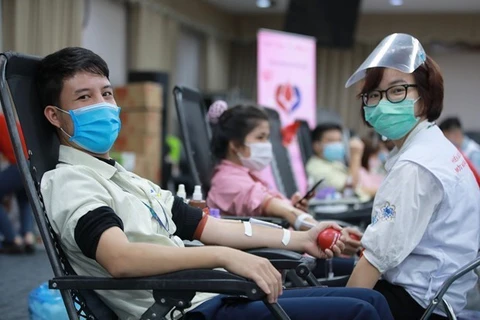
A young volunteer donates blood during the 2026 Red Sunday programme. (Photo: VNA)

Nearly 5,000 people join blood donation campaign in Ho Chi Minh City

According to health authorities, Vietnam collected nearly 1.75 million units of blood in 2025, with 98% from volunteer donors, equivalent to around 1.75% of the population participating in blood donation. Large-scale campaigns such as Red Sunday have played a key role in achieving these results.

More than 30 kilogrammes of various drugs trafficked from Cambodia to HCM City were seized in a police operation in March 2025. (Photo: VNA)

Ho Chi Minh City aims to become drug free by 2030

Every commune, ward or residential area in Ho Chi Minh City is expected to meet official drug-free standards by the end of 2029, while schools, hospitals, government offices, businesses and social organisations across the city are to remain free of drug activity.

Military forces take a resident from a flooded area. Photo: VNA

Da Nang, Oxfam join hands to support flood victims

In the coming time, the Da Nang Red Cross Society will continue to coordinate with Oxfam to implement support activities in Nong Son commune, helping residents overcome difficulties and stabilise their livelihoods.

Training on response to reservoir incidents (Photo: VNA)

Central Civil Defence Fund established to bolster disaster response

The Central Civil Defence Fund is authorised to receive, manage and use voluntary contributions from domestic and foreign entities and individuals, plus transfers from provincial civil defence funds in line with the PM’s decisions and allocations from relevant state financial sources outside the state budget, all earmarked for incident and disaster response and recovery efforts.

Vietnamese women shine in the traditional Ao dai (Photo: VNA)

March shines with elegance of “Ao dai”

In early March, scenes of women in flowing Ao dai taking spring photos by lakes, parks, offices, temples and historical sites have become a familiar sight on the streets of Hanoi. Social media is also filled with images and stories surrounding the elegant attire, which has become a symbolic signal of the season dedicated to honouring women.

Hanoi voters learn about candidates’ biographies and action programmes. (Photo: VNA)

Hanoi thoroughly prepares for NA, People’s Council election

According to the municipal Election Committee, the capital city has established election committees in 126 communes and wards. In addition, 11 electoral boards for National Assembly deputies, 31 electoral boards for the city-level People’s Council, 831 commune-level electoral boards and more than 4,000 polling teams have been set up to serve the election process.