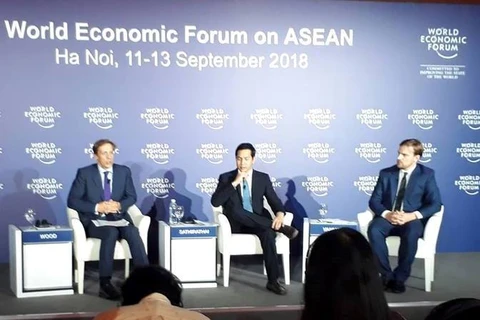
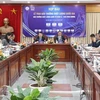
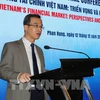
WEF on ASEAN co-chairs share views of forum (Photo: Lam Khanh/ VNA)
 Hanoi (VNA) – A top executive of Plan International on September 12 praised the theme of the ongoing World Economic Forum on ASEAN (WEF on ASEAN), saying it resonates well with her organisation’s priority on young female entrepreneurs.
“We work with young female people to give them skills and opportunities to set up enterprises, so we want to talk with participants here about lack of finance for young female entrepreneurs,” said Anne Birgitte Albrectsen, Chief Executive Officer of Plan International, a development and humanitarian organization that advances children’s rights and equality for girls.
Anne Birgitte Albrectsen is one of the co-chairs of the WEF on ASEAN who shared their view of the forum, which is taking place in Hanoi from September 11-13.
According to Albrectsen, the digital economy is expanding the gender gap. Women have less access to mobile phones. Young girls have less opportunities to enter technology sector and account for only 10 percent of the employees in the sector. They also lack opportunities to become leaders.
Other co-chairs of the WEF on ASEAN include Sri Mulyani Indrawati, Minister of Finance of Indonesia; Kang Kyung-Wha, Minister of Foreign Affairs of the Republic of Korea; Nazir Razak, Chairman of the CIMB Group Holdings, Malaysia; Nguyen Manh Hung, Vietnamese Acting Minister of Information and Communications; and Kevin Sneader, Global Managing Partner, McKinsey and Company, Hong Kong China.
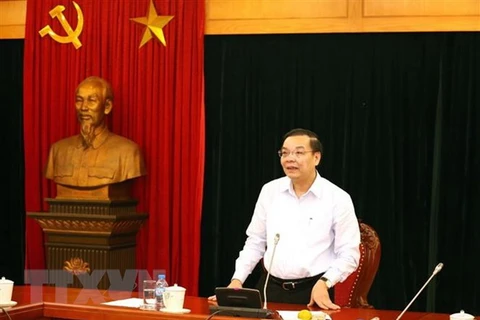
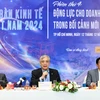
 Nguyen Manh Hung, Vietnamese Acting Minister of Information and Communication (Middle) at press conference (Photo: Lam Khanh/ VNA)
 The WEF on ASEAN provides a platform for government and business leaders to share policy ideas and initiatives for the region’s key issues.
The forum is a chance for participants to share their stories, case studies, experience and initiatives for ASEAN, said Nguyen Manh Hung, Vietnamese Acting Minister of Information and Communications, other co-chair of the event.
“I want to share the idea of developing one ASEAN, meaning a flat ASEAN, where all people have equal opportunities,” Hung said.
He suggested establishing an ASEAN University of Information and Communication Technology (ICT), saying ICT is the key sector in the fourth industrial revolution (4IR).
The Acting Minister also put forward an initiative to set up a regional cyber security information centre and expressed his hope that the initiatives will be discussed during the forum.
“Our life depends very much on the internet. Our prosperity also depends on the internet. Therefore, cyber security is the most important for us in the 4IR,” he said.
According to Hung developing nations, including Vietnam, have more chances to take the advantages of the fourth industrial revolution. He explained that developing countries have less facility of the previous revolutions, meaning they have less burdens and can move faster. They have not so much solid legal framework, therefore they are more flexible to develop new policies to adapt and accept changes.
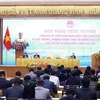
 WEF on ASEAN co-chairs share views of forum (Photo: Lam Khanh/ VNA)
 During a press conference, held in Hanoi on September 12 as part of activities in the ongoing WEF on ASEAN, other co-chairs also shared their topics of interest in infrastructure building, labour force development, taxation, among others.
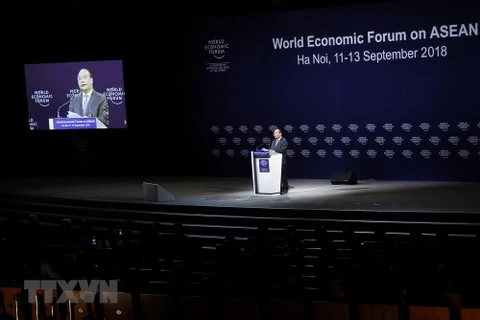
The WEF ASEAN 2018, themed “ASEAN 4.0: Entrepreneurship and the Fourth Industrial Revolution” attracted the participation of more than 1,000 delegates from 43 countries and region.
Among the delegates are the prime ministers of Cambodia, Laos, Malaysia, Singapore, and Sri Lanka, the president of Indonesia and Myanmar's State Counselor Aung San Suu Kyi.
In 2010, Vietnam hosted the World Economic Forum on East Asia for the first time.
The WEF was established in 1971 as a non-profit foundation and is headquartered in Geneva. The forum engages political, business, and other leaders to shape global, regional, and industry agendas.
Founded in 1967, ASEAN groups together Brunei, Cambodia, Indonesia, Laos, Malaysia, Myanmar, the Philippines, Singapore, Thailand and Vietnam. -VNA