Tonnes of plastic waste at Sa Huynh saltwater lagoon in Quang Ngai province. (Photo: VNA)
 Hanoi (VNA) – According to national statistics, an average of about 1.8 million tonnes of plastic waste is generated annually in Vietnam, of which 90% is buried, filled or incinerated, and only 10% recycled. Meanwhile, 90% of scrap collectors and scavengers are women, a job that exposes them to a toxic environment that negatively affects their health.
As an organisation representing women’s rights and legal benefits, the Vietnam Women’s Union (VWU) has determined that for environmental protection, recycling plastic waste is one of the major tasks which has been implemented via campaigns to reduce the use of plastics and single-use plastic products in daily life.
The project, entitled “Scaling up a Socialised Model of Waste Management in Five Cities”, is supported by the United Nations Development Programme (UNDP) and the Norwegian Government. It focuses on women’s role in plastic waste management in five cities and provinces, namely Da Nang, Quang Ninh, Binh Dinh, Binh Thuan, and Binh Duong. The project intends to verify the importance of women's role in public awareness on waste and plastics recycling.
Nguyen Thi Minh Huong, Vice President of the Vietnam Women’s Union, said that women are disproportionately affected by negative environmental impact, especially impoverished women who often have limited access to land rights, education, and essential support services related to agriculture and finance. This vulnerability places them at a higher risk.
However, from another perspective, women also play a pivotal role in environmental conservation. They can act as agents of change, raising awareness among other family members about consumption and waste management.
From the perspective of producers, consumers, or managers, they all play an important role in preserving and protecting the environment, and protecting public health, Huong emphasised.
Among the country’s national development strategies and sectoral development policies, gender and environment in general, women and environment in particular are one of the cross-cutting issues and important goals.
In work and daily life, women are more exposed to the environment than men, with a more sensitive biological nature than men. Women are more influenced by the environment, especially when it is polluted and degrading.
On the other hands, many studies and practical evidence have shown that women often bear the primary responsibility for daily household tasks, which significantly influences consumption, classification, and disposal of plastic waste within the family.
Women play a vital role in household management, raising children, and imparting consumption habits such as not wasting water, reducing electricity consumption, limiting the use of single-use plastic products and using plastic containers. They simultaneously raise awareness about energy conservation practices, sustainable product usage, minimising use of disposable goods, and managing waste from factories, agricultural fields, and households.
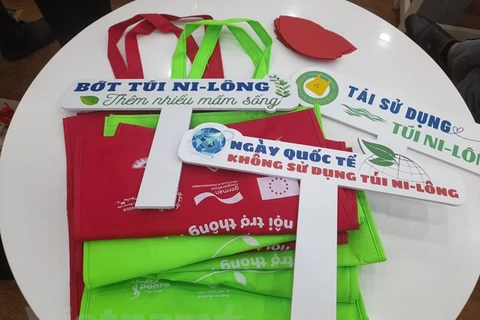
The VWU endeavours to promote its members, women who are business owners to increase reusable plastic bags, use more environmentally friendly products and minimise the use of single-use plastic bags in production, business, and services, They have also worked to build a model to respond to the movement in accordance with local practical conditions.
The union has also encouraged women to proactively participate in environmental protection in the locality, and take part in the implementation of policies and laws on environment protection, anti-plastic waste and propose projects, programmes, and solutions to raise awareness on environmental protection among local residents.
Nguyen Thi Nhat Hoai, an expert of the Vietnam National Plastic Action Partnership (NPAP), revealed that in a NPAP’s report on “Gender equality and social inclusion in the plastic value chain in Vietnam”, women form the majority in daily domestic works and they are more effected by the use of plastic products.
According to UNDP Deputy Resident Representative Patrick Haverman, women play a crucial role in formal and informal sectors of the collection, sorting, and recycling of plastic within households and communities. It is thus critical that authorities and communities take women’s roles into account during policy formulation.
Policymakers need to do more research, and collect data on plastics, gender, and social inclusion issues to avoid adverse impact on women, migrants, and other vulnerable groups when implementing the Extended Producer Responsibility (EPR) policies and other relevant policies, he said.
Shawn Steil, Ambassador of Canada to Vietnam, said the Government of Canada is working with its partners around the world to reduce plastic waste and pollution.
Canada’s programming focuses on supporting women’s rights and livelihoods that complement efforts to transition to a more sustainable and circular plastics economy.
A circular economy approach is needed to tackle how we produce, use, and dispose of plastics, and coming to grips with the growing challenges related to human health, gender equality, and social inclusion, the ambassador said./.