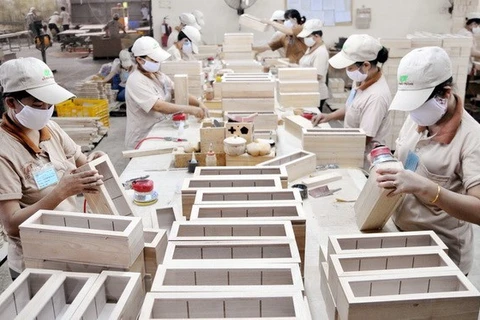
Illustrative image (Source: VNA)
 HCM City (VNS/VNA) - Many wood processing firms have managed to operate despite the COVID-19 pandemic and many have even chalked out measures to take advantage of the opportunities on offer when the pandemic is over.
Vu Hai Bang, CEO of Woodsland, one of the country’s leading furniture exporters, said his company had received notice from US and EU customers to delay or stop delivery as soon as their governments announced measures such as border closure and social distancing.
But luckily, it got new orders from customers who had been buying from Malaysia, he said.
Vietnam has better controlled the pandemic than other countries in the region, and so businesses have been functioning normally despite the social distancing, he added.
Huynh Quang Thanh, Chairman and CEO of Hiep Long Fine Furniture Company in Binh Duong province, said thanks to diversifying its markets and exporting to North America, the Middle East, Japan and other places, his company continued to do business despite the tough times.
Nguyen Quoc Khanh, Chairman of the Handicraft and Wood Industry Association of HCM City (HAWA) and of AA Corporation, said despite the disease outbreak, he did not close his factory, only partially reduced production capacity.
The company also actively informed customers that it remained in production, and this would make them think of it first when the pandemic is over, he said.
"I think businesses in the industry should be optimistic and ready for the recovery," he said.
During the social isolation period, demand for indoor furniture, decorative items and handicrafts increased because people were staying at home, he explained.
When the US and EU relax social distancing and stores reopen, the demand for furniture would increase sharply, he said.
“This will be an opportunity for us to change export product lines. Many Chinese enterprises have closed since the beginning of the year. They will take some time to resume operations.
“In the long run, businesses must redo business strategies and organise trade promotion activities online.”
Nguyen Chanh Phuong, HAWA’s vice chairman and general secretary, said diversification of market segments is very important.
"We have worked with our Korean partners to find opportunities in this market," he said.
President of the Vietnam Timber and Forest Product Association Do Xuan Lap said firms need to make production and business plans, “consolidate” factories, identify suitable distribution solutions, and rebuild disrupted supply chains.
Khanh said: "The opportunity after the pandemic is real. But the opportunities will only be available to businesses that are well prepared. There are two key factors that enterprises must implement, digital transformation and market diversification.”
Phan Thanh Son, business development director of FPT Information System, said the world after the pandemic would not be the same as before. This will be a different world where people sell online, produce online, design online, distribute and market online, and even traditional supply chains would shift to online supply networks.
Vo Tri Thanh, former deputy director of the Central Institute for Economic Management, said COVID-19 is changing the way people live, shop and do businesses.
Businesses must change their production and trading strategies to adapt to an uncertain and risky world, and they must learn how to manage risks and uncertainty, he said./.
VNA