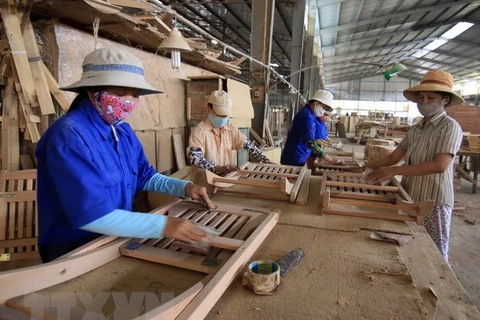
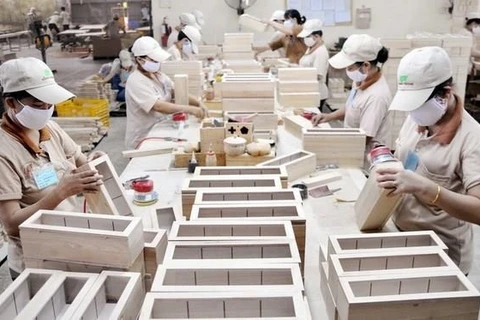
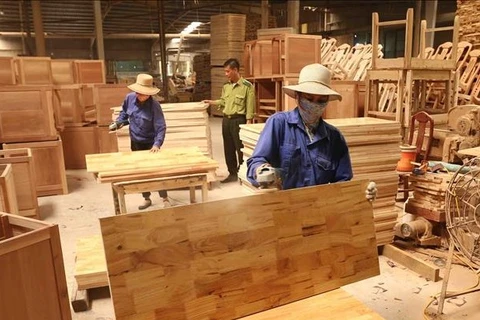
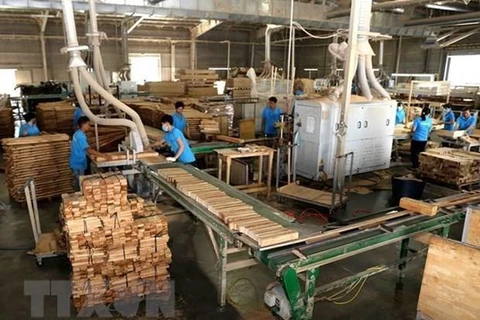
Illustrative image (Photo: Internet)
 HCM City (VNS/VNA) - Exports of wood and wood products in the first four months of the year were worth nearly 3.2 billion USD, a year-on-year increase of 6 percent, according to the General Department of Customs.
Though the COVID-19 pandemic has had a negative impact on the wooden processing industry, thanks to Vietnam’s effective control of the outbreak and competitors in Southeast Asia, the EU and the US having to stop production, businesses have found new markets, Le Minh Thien, chairman of the Binh Dinh Timber and Forest Products Association, said.
Besides, an improvement in the country’s business and investment environment has helped boost the industry’s manufacturing and export activities, he said.
Do Xuan Lap, chairman of the Vietnam Timber and Forest Product Association (VIFORES), said thanks to its efficient pandemic control, Vietnam has become an attractive investment destination for many wood processing companies with turnover in the billions of dollars.
The country expects the wood processing industry’s exports to top 12.5 billion USD this year, up 10 percent from last year, according to VIFORES.
Of this, 8.68 billion USD will come from timber exports and 2.99 billion USD from wood products exports, with other forest products accounting for the rest.
So far this year, exports to the US have seen a sharp rise, while there has been robust growth in shipments to Japan, the UK, Canada, Germany and the Netherlands, the Ministry of Industry and Trade’s department of import-export said.
With Japan and Canada also being members of the Comprehensive and Progressive Agreement for Trans-Pacific Partnership (CPTPP), it said Vietnamese firms are starting to take advantage of the reduced tariffs under the trade deal to penetrate these markets.
With the EU-Vietnam Free Trade Agreement (EVFTA) set to take effect this year, Vietnamese firms can also look forward to similar tariff cuts by and increased exports to the EU, already one of Việt Nam’s major markets.
The country’s top 10 markets are the US, Japan, China, the Republic of Korea, the UK, Germany, Canada, Australia, France, and the Netherlands.
Vietnam mainly exports dressing tables and kitchens and bathroom furniture to the US and EU. Exports of outdoor and office furniture account for only 40 percent of the total, and so there is great potential to increase them in future, Deputy Minister of Agriculture and Rural Development Ha Cong Tuan said.
The industry must restructure the whole production chain, from varieties of trees to promoting sustainable forest management, and implement its commitments under the EU-Vietnam Voluntary Partnership Agreement on Forest Law Enforcement, Governance and Trade (VPA-FLEGT) to ensure its exports of timber and wooden products come from legal sources, he said.
Design and branding are thus important factors in improving the competitiveness of Vietnam’s furniture and other wooden products, he added.
Wooden and furniture products are mainly produced in southern and central provinces like Binh Duong, Dong Nai, Long An, Tay Ninh, and Binh Dinh./.
Though the COVID-19 pandemic has had a negative impact on the wooden processing industry, thanks to Vietnam’s effective control of the outbreak and competitors in Southeast Asia, the EU and the US having to stop production, businesses have found new markets, Le Minh Thien, chairman of the Binh Dinh Timber and Forest Products Association, said.
Besides, an improvement in the country’s business and investment environment has helped boost the industry’s manufacturing and export activities, he said.
Do Xuan Lap, chairman of the Vietnam Timber and Forest Product Association (VIFORES), said thanks to its efficient pandemic control, Vietnam has become an attractive investment destination for many wood processing companies with turnover in the billions of dollars.
The country expects the wood processing industry’s exports to top 12.5 billion USD this year, up 10 percent from last year, according to VIFORES.
Of this, 8.68 billion USD will come from timber exports and 2.99 billion USD from wood products exports, with other forest products accounting for the rest.
So far this year, exports to the US have seen a sharp rise, while there has been robust growth in shipments to Japan, the UK, Canada, Germany and the Netherlands, the Ministry of Industry and Trade’s department of import-export said.
With Japan and Canada also being members of the Comprehensive and Progressive Agreement for Trans-Pacific Partnership (CPTPP), it said Vietnamese firms are starting to take advantage of the reduced tariffs under the trade deal to penetrate these markets.
With the EU-Vietnam Free Trade Agreement (EVFTA) set to take effect this year, Vietnamese firms can also look forward to similar tariff cuts by and increased exports to the EU, already one of Việt Nam’s major markets.
The country’s top 10 markets are the US, Japan, China, the Republic of Korea, the UK, Germany, Canada, Australia, France, and the Netherlands.
Vietnam mainly exports dressing tables and kitchens and bathroom furniture to the US and EU. Exports of outdoor and office furniture account for only 40 percent of the total, and so there is great potential to increase them in future, Deputy Minister of Agriculture and Rural Development Ha Cong Tuan said.
The industry must restructure the whole production chain, from varieties of trees to promoting sustainable forest management, and implement its commitments under the EU-Vietnam Voluntary Partnership Agreement on Forest Law Enforcement, Governance and Trade (VPA-FLEGT) to ensure its exports of timber and wooden products come from legal sources, he said.
Design and branding are thus important factors in improving the competitiveness of Vietnam’s furniture and other wooden products, he added.
Wooden and furniture products are mainly produced in southern and central provinces like Binh Duong, Dong Nai, Long An, Tay Ninh, and Binh Dinh./.
VNA