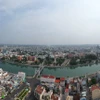
Martin Rama, Delhi-based chief economist for South Asia at the WorldBank, recently published a photo book titled Hanoi - Promenade thatincludes images of the city during the period he worked here between2002 and 2010. He talks with the English language daily Vietnam Newsabout the book.
*What was the inspiration for the book?
Ifell for the city the first time I visited, in 1998. I was privilegedenough to live in a beautiful French villa on Tran Hung Dao street, inthe middle of what used to be the French Quarter.
This is alsohow I gradually focused my attention on different aspects of the city. Iwould go home after my walks and try to read about what I had seen orask Vietnamese friends about it.
At some point, it became clearto me that I had enough visuals and information to put togethercompelling stories about Hanoi: stories combining texts and images, butalso academic rigour and personal experience. That is how the idea ofwriting the book emerged, sometime in 2007.
It also becameapparent to me that the topics did not have an obvious connection witheach other. Some were about architecture, others about society, andothers just about emotions prompted by Hanoi.
Suddenly I thoughtthat these apparently disconnected chapters were like ingredients in abowl of pho: all different from each other, but yielding a unique tastewhen combined. And what could be more Hanoian than a bowl of pho?
*Why did you organise them as you did?
Iwanted to recreate the vibrant, at times chaotic atmosphere of Hanoi.In fact, one of the chapters of the book is entitled Chaos! When goingfor walks I would jump from one thing to another, from Frencharchitecture to Soviet style buildings, from vibrant business to quietprayer...
I decided to reproduce this randomness of impressionsby having chapters that are not organised by topic or period. I foundthat just ordering the chapters alphabetically (in English) could createthat element of surprise, of bumping from one thing to another.
Thebook title itself tries to convey this randomness of the walkingexperience. "Promenade" is a French word that describes a walk without adestination.
*When I found your book at Manzi Art Space, I wasparticularly impressed with the KTT (Khu Tap The or Collective LivingQuarters) chapter. Could you tell me about your visits to KTT in thecity?
KTTs are an integral part of Hanoi. With very limitedspace, even shared kitchens and bathrooms, they force their residents tobe creative and build all sorts of improvised additions to theirapartments.
The result is a sort of participatory architecturethat looks really messy, even a bit sad, but is very distinctive ofHanoi. At the same time, those who live in KTTs are very well integratedin the fabric of Hanoi's society. They are civil servants, orjournalists, or military personnel. And many KTTs are extraordinarilywell located, in some of the most desirable central spots of the city.
Iwanted to tell the story of the KTTs, and the contribution they make tothe character of Hanoi, as people are talking about replacing thecrumbling buildings with modern high rises.
*Which chapter took the longest to complete?
Iwould typically spend a couple of months thinking about each one. Iwould start with an idea, then pictures, then text. Most often, I wouldend up having too much text and would have to discipline myself to makeit shorter and crisper. But that was a good thing, as it prevented mefrom being too talkative.
*Are you working on any similar projects now?
Ikeep coming back to Hanoi regularly and I do have a personal project inVietnam, one that follows up on the book. Its goal is to think morerigorously about urban development policies that can reconcilemodernisation with preserving the city's character. But I will tell youmore about this project once I get it off the ground.-VNA
*What was the inspiration for the book?
Ifell for the city the first time I visited, in 1998. I was privilegedenough to live in a beautiful French villa on Tran Hung Dao street, inthe middle of what used to be the French Quarter.
This is alsohow I gradually focused my attention on different aspects of the city. Iwould go home after my walks and try to read about what I had seen orask Vietnamese friends about it.
At some point, it became clearto me that I had enough visuals and information to put togethercompelling stories about Hanoi: stories combining texts and images, butalso academic rigour and personal experience. That is how the idea ofwriting the book emerged, sometime in 2007.
It also becameapparent to me that the topics did not have an obvious connection witheach other. Some were about architecture, others about society, andothers just about emotions prompted by Hanoi.
Suddenly I thoughtthat these apparently disconnected chapters were like ingredients in abowl of pho: all different from each other, but yielding a unique tastewhen combined. And what could be more Hanoian than a bowl of pho?
*Why did you organise them as you did?
Iwanted to recreate the vibrant, at times chaotic atmosphere of Hanoi.In fact, one of the chapters of the book is entitled Chaos! When goingfor walks I would jump from one thing to another, from Frencharchitecture to Soviet style buildings, from vibrant business to quietprayer...
I decided to reproduce this randomness of impressionsby having chapters that are not organised by topic or period. I foundthat just ordering the chapters alphabetically (in English) could createthat element of surprise, of bumping from one thing to another.
Thebook title itself tries to convey this randomness of the walkingexperience. "Promenade" is a French word that describes a walk without adestination.
*When I found your book at Manzi Art Space, I wasparticularly impressed with the KTT (Khu Tap The or Collective LivingQuarters) chapter. Could you tell me about your visits to KTT in thecity?
KTTs are an integral part of Hanoi. With very limitedspace, even shared kitchens and bathrooms, they force their residents tobe creative and build all sorts of improvised additions to theirapartments.
The result is a sort of participatory architecturethat looks really messy, even a bit sad, but is very distinctive ofHanoi. At the same time, those who live in KTTs are very well integratedin the fabric of Hanoi's society. They are civil servants, orjournalists, or military personnel. And many KTTs are extraordinarilywell located, in some of the most desirable central spots of the city.
Iwanted to tell the story of the KTTs, and the contribution they make tothe character of Hanoi, as people are talking about replacing thecrumbling buildings with modern high rises.
*Which chapter took the longest to complete?
Iwould typically spend a couple of months thinking about each one. Iwould start with an idea, then pictures, then text. Most often, I wouldend up having too much text and would have to discipline myself to makeit shorter and crisper. But that was a good thing, as it prevented mefrom being too talkative.
*Are you working on any similar projects now?
Ikeep coming back to Hanoi regularly and I do have a personal project inVietnam, one that follows up on the book. Its goal is to think morerigorously about urban development policies that can reconcilemodernisation with preserving the city's character. But I will tell youmore about this project once I get it off the ground.-VNA