Yen Bai: Mong New Year customs respect god of forests

The Forest Festival in Na Hau commune, a unique ceremony that involves praying for good fortune, is a contributor to not only the preservation of material and spiritual values of the Mong ethnic group but also to forest protection.
Yen Bai: Mong New Year customs respect god of forests ảnh 1A ritual of the Forest Festival in Na Hau commune of Van Yen district, Yen Bai province (Photo: VNA)

Hanoi (VNA) – To Mong ethnic people in Na Hau commune of Van Yen district, the northern mountainous province of Yen Bai, forests are a source of life, a source of livelihood, a shelter, and also a source of spiritual support for 484 households with 2,490 people here.

They believe that the God of Forests is the guardian of their villages, granting bumper crops and protecting them from all natural disasters and epidemics. Therefore, the belief and custom of worshipping the God of Forests have been passed down from generation to generation. To locals, the forests are not only a resource and an environment but also the origin of culture.

Traditionally, Mong people in Na Hau commune hold the forest worship festival, also called the Forest Festival, on the last day of the first lunar month in a year. Via their biggest and most important traditional festival, local residents pray to the God of Forests for wealth and prosperity.

The festival begins with the procession of offerings to the prohibited forest. Its unique and solemn ritual that takes place at the entrance of the forest and under the shade of an ancient tree. The offerings to the God of Forests include a cock, a hen, a black pig, wine, incense, and handmade paper.

At an auspicious hour chosen by the group, the village shaman offers incense and prayers to invite the God of Forests to enjoy the offerings, protect locals, and grant good weather and bumper crops to locals.

In 2023, the forest worship festival in Na Hau commune was held on February 18 and 19, which were the 28th and 29th days of the first month in the Year of the Cat.

Yen Bai: Mong New Year customs respect god of forests ảnh 2A ritual of the Forest Festival in Na Hau commune (Photo: VNA)

Rituals are followed by festivities with a wide range of traditional cultural activities. Typical products of Mong people are also sold at a traditional fair as part of the festival.

After the festival, villages in Na Hau commune practice a forest prohibition for three days to express gratitude to the God of Forests. On these days, people are banned from cutting trees, bringing home fresh foliage, harvesting bulbs or bamboo shoots, digging land, letting cattle wander, hanging clothes outdoors, grinding corn, or pounding rice.

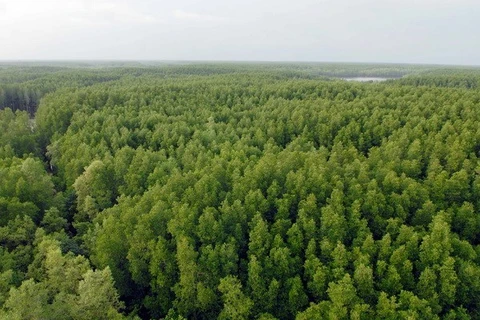
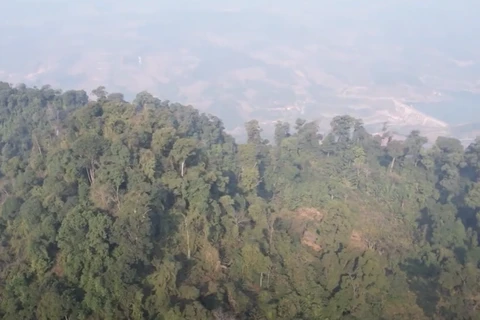
Na Hau is a particularly disadvantaged commune located in the core of the Na Hau Nature Reserve. The over-16,000ha reserve spreads across the communes of Na Hau, Dai Son, Mo Vang, and Phong Du Thuong of Van Yen district, Yen Bai province.

It is home to a rich forest ecosystem typical for the northern mountainous region of Vietnam, with a great diversity of rare fauna and flora species.

With the belief that protecting forests, forests will protect them in return, local Mong people have included the protection of forests, especially their sacred ones, in their village conventions for hundreds of years.

According to village conventions, the sacred forests must not be intruded, and no one is permitted to undertake banned practices there. Any who commits violations will be punished. As a result, the sacred forests in villages of Na Hau commune have been conserved throughout history./.
VNA

See more

The illustrated book “100 Dieu tu hao Viet Nam” (Photo: nhandan.vn)

Book introduces 100 remarkable facts about Vietnam

The illustrated book “100 Dieu tu hao Viet Nam” (100 Proud Facts about Vietnam) compiles 100 highlights of Vietnam’s legacy across 11 major themes, including heroic history, cultural beauty, literature and the arts, medicine, education, architecture, science, cuisine and community values.

Children perform Xoan folk singing at the cultural camp. (Photo: VNA)

Hung Kings festival opens with vibrant cultural, tourism activities in Phu Tho

Beyond its role as a sacred national commemoration, the event helps promote cultural values, strengthen national unity and enhance cultural exchanges. A notable feature is the flexible organisation in 18 commune and ward clusters, encouraging the localities' participation and enriching the festival’s content.

A corner of the Book Street in Hanoi (Photo: VNA)

Hanoi celebrates Reading Culture Day with book street activities

Organised by the Book Street’s management board in collaboration with publishers and distributors, the programme will brings together 14 publishing and distribution units across 15 booths, offering readers access to a rich and diverse selection of book titles spanning literature, children’s books, life skills, economics, history, science-technology and education, among others.

Vietnam’s Consul General in Osaka Nguyen Truong Son speaks at the 9th Vietnam cultural festival in Osaka on April 19, 2026. (Photo: VNA)

Vietnam cultural festival in Osaka draws tens of thousands of attendees

Saito Naoki, Mayor of Ikuno Ward – where the event took place, expressed his pleasure at the rapid growth of the Vietnamese community in the area. He praised such cultural festivals for helping Vietnamese residents maintain their traditions while fostering mutual understanding and closer ties with Japanese locals.

Urawadee Sriphiromya, Thai Ambassador to Vietnam (third from left); Camila Polo Florez, Colombodian Ambassador to Vietnam (C); and Saadi Salama, Ambassador of Palestine to Vietnam (fifth from left), experience indigenous coffee culture in a coffee garden in Dak Lak. (Photo: doanhnghiepkinhtexanh.vn)

World Coffee Heritage Forum: A dialogue connecting coffee culture, knowledge

The recognition of "The knowledge of coffee cultivation and processing in Dak Lak” as a National Intangible Cultural Heritage marks an important milestone. It affirms the value of indigenous knowledge, creative labour, and the harmonious connection between local livelihoods, culture and nature in the Central Highlands.

The artwork "Harvest Day" by Doan Thi Thu Huong. (Photo: cand.com.vn)

Vietnam to join Venice Art Biennale with first national showcase

As Vietnam makes its debut at the Biennale, the exhibition “Vietnam: Art in a Global Flow” does not seek to assert its position through scale or grand statements, but rather opens up a space for meaningful artistic dialogue - an invitation to listen to subtle voices, contemplate in stillness, and reflect on the capacity to nurture sustained creative energy in a dynamic and ever-evolving art world.

Viet Youth Readiness Hub debuts at the event (Photo: VNA)

Vietnamese Canadian youth hub launched to fight mother tongue erosion

The Viet Youth Readiness Hub is seen as a dedicated platform to connect, support, and empower Vietnamese-Canadian youth. It aims to emerge as a central force to host social events, advance heritage education, foster exchange and integration among young Vietnamese in Canada.

At the event “Vietnamese Language in the heart of Kyushu, Japan” (Photo: VNA)

Vietnamese in Japan revive mother tongue among young generations

While the number of Vietnamese-origin children in Japan is surging, opportunities to actually speak Vietnamese in daily life are vanishing fast. Many children can understand the language but default to Japanese in response, gradually relegating their mother tongue to a secondary role, sometimes even treating it as a “second foreign language” inside their own houses.

A tribute to Hung Kings in Ho Chi Minh City (Photo: VNA)

Hung Kings’ Commemoration Day 2026 to spread sacred values, foster national unity

Following the merger of Phu Tho, Vinh Phuc, and Hoa Binh provinces into the new Phu Tho province last year, the Hung Kings Temple Festival has taken on heightened significance. It now serves not only as a tribute to the ancestral homeland but also a unified cultural platform that extends sacred ancestral values to Vietnamese communities at home and abroad.

A traditional art performance at Bach Ma temple in Hanoi (Photo: VNA)

Traditional arts hold untapped economic power

Traditional arts embody deep aesthetic values, worldviews, and national identity, shaping the country’s distinctive “aesthetic identity” and foundational cultural tastes

A performance at the opening ceremony of the Hung Kings Temple Festival and the 2026 Ancestral Land Culture and Tourism Week on late April 17 (Photo: VNA)

Hung Kings Temple Festival, associated tourism week kick off

The annual festival serves as a major national cultural event, offering an opportunity for people across Vietnam and overseas Vietnamese communities to pay tribute to their ancestors, express gratitude, and strengthen the great national solidarity.