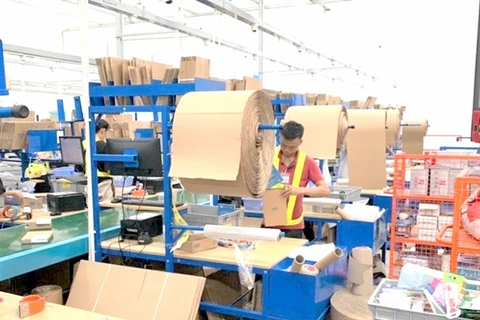
A collection of bags are recycled from old package and canvas. investment in zero waste programmes would create numerous, good, green jobs, while reducing pollution and improving community health (Photo: VNA)
 The Global Alliance for Incinerator Alternatives (GAIA) said its new study shows that cities that invest in zero waste programmes and policies create numerous, good and green jobs, in addition to known benefits like reducing pollution and improving community health.
The report comes as municipal governments across the world are making investment decisions to increase climate resilience and rebuild local economies damaged by the COVID-19 crisis.
It said the new paper is an analysis of 36 studies spanning 16 countries that examined the job creation potential of various waste management strategies such as repair or reuse, recycling, composting, incineration and landfill. The research makes clear that what’s good for the environment is also good for the economy.
Zero waste strategies score highest on environmental benefits and create the most jobs of any waste management approach. For example, reuse creates more than 200 times as many jobs as landfills and incinerators, while recycling creates about 70 times as many jobs as landfills and incinerators.
Remanufacturing creates almost 30 times as many jobs as landfills and incinerators, the report found.
Zero waste is a comprehensive waste management approach that prioritises waste reduction and material recovery, with the ultimate aim of creating a circular economy and shrinking waste disposal to zero. In contrast, disposal-based systems rely on incineration (waste to energy) and landfills to handle the majority of the waste stream, resulting in higher economic costs and environmental consequences.
The Vietnam Zero Waste Alliance has made big efforts to inspire zero waste in the country, piloting several models of zero waste communities, zero waste schools and zero waste events. The models show about 80 percent of solid waste in Vietnam can be diverted from landfills or incinerators (Vietnam Audit Report 2018 –2020). This will create new employment opportunities for waste pickers in the composting and reuse sectors, where working conditions will be better than in the landfills.
Zero waste systems not only create more jobs, they create better jobs. Studies show jobs in zero waste go beyond basic manual labour, provide higher wages, offer more permanent positions and improve quality of life.
Quach Thi Xuan, co-ordinator of Vietnam Zero Waste Alliance, said: “If zero waste is comprehensively applied citywide, HCM City can solve its waste crisis sustainably, its landfill will last for longer, and operations of waste treatment plants will be more effective because wastes are sorted at source. With 9,500 tonnes of waste per day, equivalent to about 3 million tonnes per year, a zero-waste approach could create over 18,000 green jobs.”
Report co-author Dr Neil Tangri, Science and Policy Director at GAIA, said: “With the world still reeling from the pandemic, job creation is a top priority. Zero waste offers a strategy to create good jobs and reduce pollution, without breaking the bank. It’s a triple win for the economy, the environment, and the city."
Two communes – Cam Thanh in Hoi An City and Tan Hiep of the Cham Islands – were the two first communities in Vietnam to launch the zero-waste model in promoting waste classification and recycling, and plastic waste reduction and composting among the community.
The projects help residents in the two communes reduce the waste they release daily from 75 to 80 percent./.
VNA