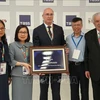
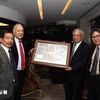
British professor Duncan Haldane (Photo courtesy of Duncan Haldane)
Hanoi (VNA) - British professor Duncan Haldane, winner of the 2016 Nobel Prize in Physics, is on a working trip to Vietnam. He found the time to meet with Vietnam News Agency reporters to talk about scientific research.
This is the first time the professor has been in Vietnam, where he was invited to take part in and deliver a keynote address at an international workshop on topological quantum electrons interacting.
The workshop is part of the 18th “Meet Vietnam” programme, which is taking place at the International Centre for Interdisciplinary Science and Education (ICISE) in Quy Nhon city, Binh Dinh province, which Professor Haldane found to be a nice place.
With a mild and witty manner, he said conducting scientific research is a “long” path with many difficulties, hardships, and even loneliness, but is also quite interesting.
To be successful, the professor, who is teaching at Princeton University in the US, said young scientists must have a passion for learning and for science.
He is pursuing the path of research first of all because of his own passion for science. Like many others, Professor Haldane did not set out to win the Nobel Prize, even though it is the dream of scientists around the world. So, when he heard he was one of three scientists to receive the 2016 Nobel Prize in Physics, he was very surprised and even a bit “shocked”.
Besides passion, scientific researchers must also have good preparation, be serious in study and training, and be thoughtful and methodical in research. In other words, they have to be hard-working and dedicated.
“With good preparation, when the opportunity comes, you can recognise it and seize it,” he said.
Luck is also a contributing factor to success. This is true in life in general and in the field of scientific research in particular. Luck, he said, can be understood as having the opportunity to meet, work with, or have the support and guidance of experienced people and leading scientists. And luck is also reflected in “asking the right question to find the right answer”, or, in other words, choosing the right direction in research.
Another thing the professor appreciates is the “fire infusing” role of teachers, especially high-school teachers.
If teachers can inspire students to learn and conduct scientific research, this is a very important start, he said. It can influence a student for life. There are many famous scientists who were lucky to learn with teachers who know how to instil a passion for science while students are still in school, the Nobel Prize laureate said.
 British professor Duncan Haldane (Photo courtesy of Duncan Haldane)
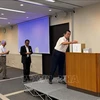
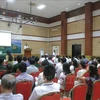
During his time at the ICISE, Professor Haldane spent time talking with local students, who had a lot of interesting questions for him. He noted a passion for science among young Vietnamese.
Regarding the policy for scientific development in Vietnam, he said the establishment of ICISE is a good example. This model is already available in countries like France. It creates the right conditions for scientists in general, including Vietnamese scientists, to have the opportunity to contact and exchange with each other. This is important for research and development, especially nowadays.
The professor also noted that more Vietnamese people should become involved in events at ICISE, as they will help them have more opportunities to meet with international scientists.
To promote science, including basic science, Vietnam could learn from the experience of other countries, Professor Haldane said.
It could also send students to countries with advanced science and technology. The process of studying abroad not only gives them knowledge but also helps them establish contact with a network of scientists, which will be very useful for them later.
After these students return home, they should be provided with “attractive” positions, Professor Haldane said.
For those who choose to stay abroad after finishing their studies, as they have the opportunity to further develop their research, it is possible to cooperate with them after they reach a higher level. They will then cooperate with domestic researchers, supporting the development of domestic science and technology in another way.
Vietnam should also invest in establishing advanced scientific research and application facilities, he said. This would create the conditions for scientific researchers, including those returning from abroad, to pursue the path of scientific research./.