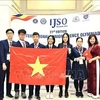
According to Yang Feng, Secretary of the Party Committee of the School of International Education at Guangxi Normal University, the university has trained more than 5,000 Vietnamese students from the 1990s to the end of 2025.
Deputy Prime Minister Ho Quoc Dung stressed that the regulatory framework is already in place, and the main issue lies in compliance. He ordered ministries, agencies, and localities to assign responsibilities and ramp up inspections and oversight.
This year marks the rollout of the “Student Startup Support Programme for 2026 – 2035”, approved under Decision No. 336/QD-TTg, which places emphasis on practical outcomes, real products, real testing, real partnerships, and measurable impact.
The circular establishes a unified benchmark for foreign language proficiency across the national education system, providing a foundation for curriculum design, teaching, testing, assessment, and certification. It is expected to help learners better map out their language development pathways while enabling educational institutions to improve training quality and strengthen articulation between different levels of education.
Hai Phong aims to maintain its leading position nationwide in education quality, while ensuring learning outcomes approach regional and international standards, particularly in technology, AI, and English proficiency.
With the Vietnamese community in the RoK now topping 350,000 and still growing, keeping the language alive must become a long-term team effort, not something left only to individual families.
Deputy Prime Minister Pham Thi Thanh Tra assigned tasks to relevant ministries and agencies concerning the collection and forensic examination of samples from remains and relatives, the issuance of decisions confirming identities, the implementation of related policies and entitlements, and the maintenance of periodic reporting mechanisms.
Today’s readers are not short of information; what matters is the ability to receive, filter and compare it with credible sources. When information is unverified, it is essential to remain cautious, avoiding it hastily, and certainly refrain from sharing it impulsively.
The Vietnam Regional Conference 2026, opened in the southern province of Tay Ninh on April 14, has underscored the need to harmonise green growth and preservation of indigenous cultural values, setting a key direction for sustainable tourism development.
Accelerating disbursement for the national target programmes is therefore not merely a financial requirement, but a crucial step towards inclusive development, improved livelihoods and better living standards, ensuring that no one is left behind.
The fugitives are Di (also known as Siu Di), born in 1941, and Dinh Yum (also known as Dinh Jum or Ba Koih), born in 1963, from Ba Na ethnic minority group in Gia Lai province, and hold Vietnamese nationality. They have been charged under Clause 1, Article 116 of the Penal Code for undermining the national unity policy.
The province's delegation of National Assembly deputies, in coordination with relevant agencies, presented 600 gifts across 11 communes, including 100 in Tap Son commune and 50 in each of the others. The programme, worth 300 million VND (11,300 USD), was funded by Agribank’s Vinh Long branch.
Since 2016, the Party organisation, administration, and people of Hanoi have contributed more than 430 billion VND (16.3 million USD) to the fund, including over 76 billion VND raised in 2025 alone.
The national job exchange platform was launched on April 14 at vieclam.gov.vn, expected to enhance connections between job seekers and employers, contributing to a modern, transparent, flexible, and efficient labour market while improving employment services, ensuring social welfare, and supporting sustainable socio-economic development.
Many overseas Vietnamese families, despite prioritising education and living standards, may face gaps in parent-child connection due to language and cultural differences. Therefore, the Talent Incubation Centre (HITA) in the Czech Republic seeks to foster deeper understanding within families, helping young people build confidence and character from within.
The province is promoting smart school governance and developing a digital learning ecosystem that enable students to access modern knowledge and learning tools locally.
Vice Chairman of the provincial People’s Committee Ngo Cong Thuc stressed that the province is intensifying comprehensive leadership and direction to ensure progress and quality in addressing shortcomings identified by the European Commission (EC).
In an appeal letter, VFF Central Committee President Bui Thi Minh Hoai highlighted the tradition of national solidarity and compassion, noting that individuals and organisations have consistently provided timely support to those in need both domestically and internationally.
Beyond cultural significance, the programme translated policies on ethnic and religious affairs into concrete actions, helping to improve livelihoods and reinforce close ties between the armed forces and the people.
The event went beyond a religious practice to reflect a shared sense of responsibility toward the homeland, particularly in safeguarding national sovereignty and territorial integrity, while conveying a positive message advocating peace, stability, and development in the region and the world.