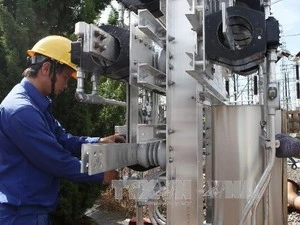
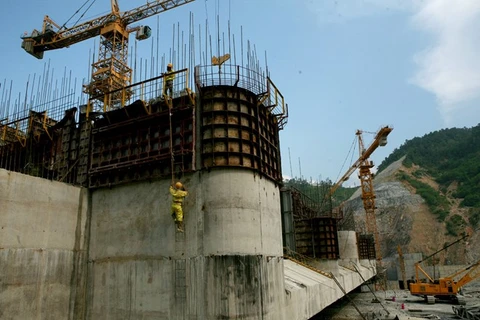
Part of the extra high voltage 500kV transmission line that runs through the south central province of Quang Nam.(Photo: VNA)
 Hanoi (VNS/VNA) - May 27 this year will mark 25 years since Vietnam’s first 500kV power transmission line was switched on, connecting the north and south of the country with an uninterrupted electricity supply.
Dubbed the ‘backbone’ of the national power grid, the power line is one of Vietnam’s most significant technological feats, given how construction workers and technicians raced against time and finished nearly 1,500km of cables through 14 provinces and cities in a mere two years.
In the early 1990s, the southern region suffered from a serious electricity deficiency – on average, a day of uninterrupted power would be followed by a two or three-day long outage, at a time where the country had started to push for a free-market economic policy following the adoption of 'Doi moi' (renewal) in 1986.
The situation was not only unimaginable by today’s standards but also a challenging puzzle for the country’s authorities as the southern region’s resources was not being put to use with such an unstable power supply.
At the same time, the northern region was recording an excess of electricity: a number of large-scale hydropower projects including Hoa Binh and thermopower plants in Uong Bi or Pha Lai were not even running at full capacity due to low demand.
The then Ministry of Energy, tasked with coming up with a solution to this conundrum, proposed a plan to transport electricity produced in the north to the south via an extra-high voltage 500kV power line that could bring 2 billion kWh a year to HCM City, the southern economic centre.
Despite skepticism from both inside and outside the country over the feasibility, efficiency and ambitious construction time of the project, then Prime Minister Vo Van Kiet signed off on the project in February 1992 and the 544 million USD project commenced in early April the same year.
During the 700 days of construction, some locations looked to be so remote it would be impossible to transport equipment and materials to implement the project, including the Hai Van Pass and the highly dangerous Lo Xo Pass in Kon Tum province, but it was eventually done thanks to thousands of local people carrying sacks of cement and steel up the mountains and hundreds of others providing logistics for the entire operation.
The hard work of dozens of thousands of workers and technicians finally paid off in May 27, 1994, when the 500kV substation in Pleiku in the central highlands province of Gia Lai powered up the two grids in the north and south for the first time in history.
To get the system up and running was already a major achievement, but maintaining a system of this scale was a constant battle against the elements and sometimes, people.
Before the second circuit of the 500kv power transmission system went into operation in 2005, all of the power was carried by the first circuit for 10 years, and it frequently ran at full capacity and overloading was not uncommon.
Ho Cong, deputy director of the Power Transmission Company No 3, which oversees the power grid in nine central highlands and south-central provinces under the State-run Vietnam Electricity (EVN), said maintenance and operation of the power line in this region was even harder, due to the complex combination of terrain from treacherous jungle-covered mountains to deep rivers.
“And then there are downpours in the rainy season, which trigger flash floods and landslides. In the dry season, the heat, the scorching sunlight and ferocious dust storms are insufferable. We need to stay on high alert at times as the risk of fire [from vegetation] near the power line is constant,” Cong told the Vietnam News Agency.
The power line also passes through several plantations of rubber, coffee and pepper, as well as as forests of pine and cajuputs, which have a habit of falling – especially during the monsoon – and risk disrupting the supply for the entire southern region.
“Another challenge for us is that in the Central Highlands, with the power line running through areas mostly populated by ethnic minority groups of Ba Na, E De, Xe Dang, who practice slash-and-burn farming, so it took us a lot of time to educate them on the need to do it safely with a controlled buffer zone to avoid the risk of fire to the power line,” Cong said.
Besides, in several locations, there are still outdated devices and equipment that need to be replaced or upgraded.
The power sector in central highland and south-central provinces also frequently need to upgrade the power system to accommodate hydropower plants sprouting up in the uplands in subsequent years.
He noted that in the quarter of the decade since the power transmission system was built, the technology landscape had changed significantly and there had emerged several solutions – including the new control system Supervisory Control and Data Acquisition, thermographic cameras that could help remotely raise alarms over possible risks, devices to help locate precisely the point of disruption on the length of the line – but the professional skills and knowledge of engineers and technicians still mattered.
If the first 500kV circuit could be considered an epic example of the Vietnamese people’s strong will, then the second and third circuits and the efforts of all those involved in making sure electricity runs uninterrupted – all done by Vietnamese – could be seen as a multi-generational extension of that epic effort, Cong said.-VNS/VNA
VNA