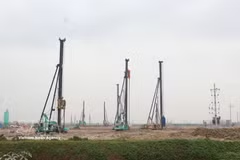
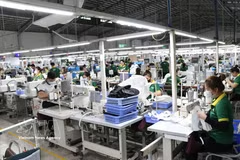
The Thang Long Industrial Park in Hanoi (Illustrative photo: VNA)
Hanoi (VNA) – Vietnam’s economy is forecast to expand 1.8 percentin 2020 amid the coronavirus and bounce back in next year, while economiesacross developing Asia will contract this year for the first time in nearly sixdecades but recovery will resume next year, according to a recent reportreleased by the Asian Development Bank (ADB).
ADB economic expert Nguyen Minh Cuong said that Vietnam’s economy is expected togrow 1.8 percent in 2020 amid the COVID-19 pandemic and bounce back to 6.3percent in 2021.
Lower domestic consumption and weak global demand caused by COVID-19 have hurtVietnam’s economy more than expected, he said.
However, according to Cuong, the country is recovering faster than most of similareconomies in the region, thanks to benefits from the involvement in bilateraland multilateral trade agreements.
In addition, positive signals of global trade, investment and production trendswill influence the Vietnamese economy in the near future, Cuong said.
The Asian Development Outlook (ADO) 2020 Update forecasts -0.7 percent grossdomestic product (GDP) growth for developing Asia this year, marking its firstnegative economic growth since the early 1960s. Growth will rally to 6.8percent in 2021, it says.
About three-quarters of the region’s economies are expected to post negativegrowth in 2020.
The inflation forecast for developing Asia is revised downwards to 2.9 percentthis year from 3.2 percent forecast in April, due to continued low oil pricesand weak demand.
Inflation for 2021 is expected to ease further to 2.3 percent.
Most economies in the Asia and Pacific region can expect a difficult growthpath for the rest of 2020, said ADB Chief Economist Yasuyuki Sawada.
The economic threat posed by the COVID-19 pandemic remains potent, as extendedfirst waves or recurring outbreaks could prompt further containment measures,he noted.
He went on to say that consistent and coordinated steps to address thepandemic, with policy priorities focusing on protecting lives and livelihoodsof people who are already most vulnerable, and ensuring the safe return to workand restart of business activities, will continue to be crucial to ensure theregion’s eventual recovery is inclusive and sustainable.
To mitigate the risk, governments in the region have delivered wide-rangingpolicy responses, including policy support packages — mainly income support — amountingto 3.6 trillion USD, equivalent to about 15 percent of regional GDP.
China is one of the few economies in the region bucking the downturn. It isexpected to grow by 1.8 percent this year and 7.7 percent in 2021, withsuccessful public health measures providing a platform for growth.
In India, where lockdowns have stalled consumer and business spending, GDPcontracted by a record 23.9 percent in the first quarter of its fiscal year (FY)and is forecast to shrink 9 percent in FY2020 before recovering by 8 percent inthe next one.
Sub-regions of developing Asia are expected to post negative growth this year,except East Asia which is forecast to expand by 1.3 percent and recoverstrongly to 7 percent in 2021.
Some economies heavily reliant on trade and tourism, particularly in thePacific and South Asia, face double-digit contractions this year. Forecastssuggest that most of developing Asia will recover next year, except for someeconomies in the Pacific including the Cook Islands, the Federated States ofMicronesia, the Marshall Islands, Palau, Samoa, and Tonga./.
VNA