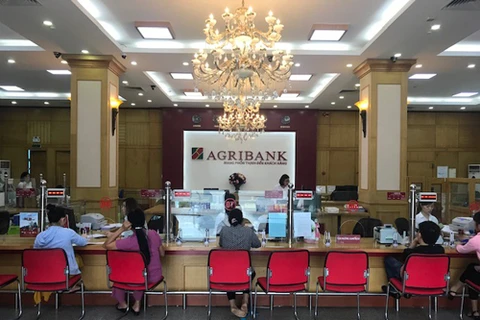
Agribank’s preferential policies have made it possible for businesses and farmers to increase investment in high-tech agriculture. (Photo: Agribank)
 Hanoi (VNA) – In the hope of making contributions to the growth of a clean and high-value agricultural sector, the Vietnam Bank for Agriculture and Rural Development (Agribank) has taken an active role in providing capital, consultations and other support to farmers in promoting technology. This move is seen as crucial for the sector to develop in a sustainable and effective direction.
Obvious trend
Agricultural development based on innovations in science and technology is considered as one of the key solutions to challenges as the sector grows. Insiders believe the superiority of biotechnology, greenhouse technology, drip irrigation technology, sensor technology, automation, and the Internet of things is helping the sector save production costs, increase productivity, and improve the quality of farm produce, thus actively contributing to environmental protection. Experts and scientists agreed that this is an important measure to make breakthrough progress in agricultural development, assisting agricultural restructuring and enhancing farmers’ lives.
A report from the Ministry of Science and Technology (MoST) showed that science and technology advances have contributed over 30% to the added values in overall agricultural production, and 38% to the production of plant and livestock varieties, while considerably reducing the loss in agricultural production (to under 10% in rice production).
The level of mechanisation at the stage of tillage for annual crops (such as rice, sugarcane, maize and vegetables) has reached about 94%, while that in the rice harvest stage has been 50%, and even 90% in delta localities.
Many high-tech agricultural enterprises and farms have been mastering technologies and reducing product costs, while replicating technological processes transferred to producers in all fields, thus increasing labour productivity and economic efficiency by 15-30%, and promoting agricultural production in an industrial manner.
According to the MoST, thanks to science and technology, the productivity in the production of some livestock and plants in Vietnam is higher compared to that in other countries in the region and the world. Specifically, Vietnam ranks first among ASEAN countries in rice productivity (more than one-and-a-half times higher than Thailand). On the global scale, the country comes second in coffee production only after Brazil, first in pepper production, second in rubber after India, and first in tra fish with a production of 500 tonnes per hecrares.
Right time, right way
Amid changing mindset in modern agriculture, open mechanism and ready workforce, the engagement of Agribank in providing loans for high-tech agriculture in that context is timely, helping provide full resources for the growth of a sustainable agriculture.
However, despite favourable conditions for its development, high-tech agricultural industry has difficulties. The high-tech agricultural model requires relatively large production scale and adequate investment in infrastructure and technologies, while investment capital poured into the sectors is modest.
In order to promote the credit demands of businesses and farmers, Agribank has applied lending interest rates at 0.5% to 1.5% on customers depending on specific cases.
Along with that, customers who borrow money under Agribank's high-tech and clean agriculture development programme will receive free money transfers within the bank’s system, and a 50% reduction of Agribank's current prescribed fee for money transfers outside the bank’s system.
 Nguyen Thi Phuong, Deputy General Director of Agribank at the signing ceremony on investment in safe agriculture. (Photo: Agribank)
 At the same time, Agribank has actively improved its lending process and methods, aiming to reduce cost for businesses and make it easier for them to access credit. Alongside, the project to shorten the appraisal time for projects and loan plans and raise the lending norms for customers, coordinate with local authorities to remove loans for customers to access loans immediately. Since its inception, efforts have been taken to shorten verification time for projects and investment plan, and raise the loan limit for customers. The bank has also coordinated with local authorities to remove obstacles facing customers in getting loans right from the project establishment.
From November 2016 when the Prime Minister launched the programme to strengthen loans for high-tech agriculture to November 30, 2022, Agribank contributed over 30 trillion VND (1.27 billion USD) to the programme with an outstanding loan reaching over 5 trillion VND (212.02 million USD) for nearly 4,000 customers, including nearly 100 corporate customers and 3,900 individual ones.
Among large-scale projects that Agribank has invested in include factories to process fruits, vegetable and food for export in An Giang and Vinh Long provinces, with a capital of more than 4.1 trillion VND; shrimp fry and shrimp production, and dairy cow breeding projects in Ninh Thuan, with more than 3.7 trillion VND; and clean animal feed production project in Ha Nam with a loan of nearly 5 trillion VND.
The bank has also engaged in developing vegetable, flower and fruit production models in Lam Dong; a vegetable and fruit processing project in Ninh Binh; animal feed production, pig and chicken breeding projects in Binh Phuong and Thanh Hoa; and passion fruit, safe fruits and vegetable production projects in Dak Nong and Kon Tum. The efforts have been fruitful, continuing to affirm Agribank’s role in high-tech agriculture investment and development.
For sustainable agricultural development
Defining agriculture and rural development as prioritised fields for credit provision, in the time to come, Agribank plans to increase loans for major areas in association with products meeting the criteria of the OCOP (One Commune-One Product) Programme – one of the important standards for Vietnamese farm produce.
Having OCOP products will help rural residents increase their income, contributing to eliminating backward farming habits and heading to a market-oriented economy. It will also help to improve the reputation of cooperative products and trademarks, opening a new, modern development direction with higher productivity in production and trade of traditional products. It will also enable them to reach larger markets. This is expected to help restructure the organisation of rural financial and economic structure.
In its orientations, along with providing direct credit capital to production households, Agribank will supply loans for the production of finished products and the development of value chains in agricultural and commodity production associated with the development of OCOP products
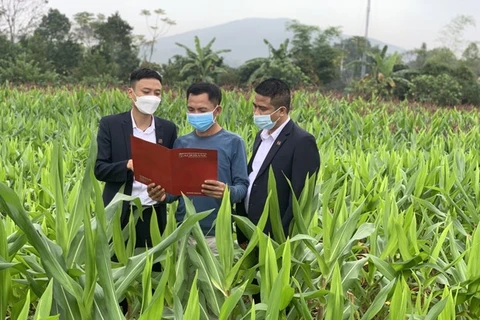
 A high-tech clean farm of a farmer accessing credit from Agribank. (Photo: Agribank)
 The bank will also focus on applying the Environmental, Social, and Governance (ESG) criteria during its operations, replicating the model of safe agricultural production, thereby, changing consumers' perception of the quality and safety of Vietnamese agricultural products.
At the same time, in order to meet the diverse demand of customers in payment transactions, Agribank has applied many policies to strengthen human resources and technology systems, while focusing on developing diverse mobile payment services suitable to conditions in all regions of the country.
Meanwhile, Agribank's cross-border payment services are being expanded to many banks and partners, diversifying preferential mechanisms, thus better supporting businesses and people, especially those engaging in exporting high-tech agricultural products.
With a network of transactions covering many countries, Agribank's payment services are fast and convenient, acting as an extension arm bringing Vietnamese agricultural products closer to the world. The activity serves to create fundamental changes in agricultural production and promoting the growth of many industries and services, contributing to boosting socio-economic development in localities and improving people's living conditions.
With its roles and high sense of responsibility, Agribank is committed to always accompanying the business community and farmers to build a modern and advanced Vietnamese agriculture. This is part of the banks’ efforts to meet the expectation of society, as well as the responsibility, rights and development motivation for the bank itself in the period of innovation and integration./.
| For businesses, cooperatives and cooperative alliances borrowing loans under the high-tech agricultural production model, Agribank has the following guarantee mechanisms: Customers with production and business projects and plans in hi-tech agricultural parks or hi-tech agricultural zones will be considered by the Agribank branch in localities where they base to receive loans without collateral with a value equivalent up to 70% of the value of the project or plan. Hi-tech agricultural enterprises will be considered by the Agribank branch in localities where they are based to receive loans without collateral with a value equivalent up to 80% of the value of the production and business projects applying high-tech systems. |