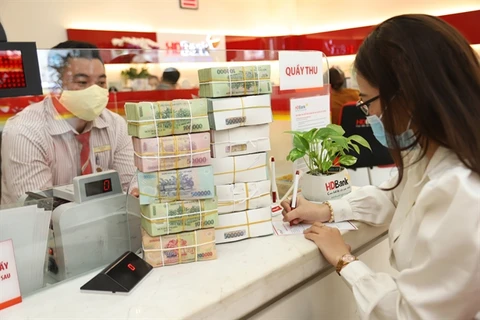
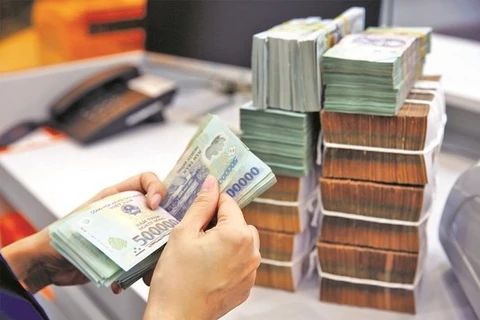
Moody’s upgrades ratings of 12 Vietnamese banks

Moody's Investors Service has raised ratings of 12 Vietnamese banks following its upgrade of Vietnam's sovereign rating to Ba2 from Ba3.
Moody’s upgrades ratings of 12 Vietnamese banks ảnh 1Logos of some Vietnamese banks (Source: vietnambiz.vn)
Hanoi (VNA) - Moody's Investors Service has raisedratings of 12 Vietnamese banks following its upgrade of Vietnam's sovereignrating to Ba2 from Ba3.

Moody's has upgraded the long-term local (LC) and foreigncurrency (FC) deposit and issuer ratings of eight banks by one notch (Vietcombank,BIDV, OCB, SeABank, TPBank, Agribank, VIB, VietinBank) and the LC and FCCounterparty Risk Ratings and Counterparty Risk Assessment of seven banks byone notch of BIDV, Agribank, VietinBank, ABBank, LienVietPostBank, SHB, MSB.

The rating actions on the banks follow the firm’s upgrade ofVietnam's sovereign rating to Ba2 from Ba3 on September 6, and change of thesovereign rating outlook to stable from positive on the same date.

Moody's said Vietnam's credit strength is a key input in itsdeposit and debt ratings for financial institutions in the country. The upgradein bank's ratings reflects the government’s stronger ability to provide supportfor banks in times of stress.

Besides, Moody's has also changed the rating outlooks ofAgribank, BIDV, OCB, SeABank, TPBank, VIB, Vietcombank and Vietinbank to stablefrom positive. The rating outlook of ABBank, LienVietPostBank and MSB remains stable while that of SHB stays positive.

Amid the complex internationalsituation leading to over 30 rating downgrades globally over the past eightmonths, Vietnam is the only country in the Asia-Pacific and one of the four in the world to record a rating upgrade by Moody'ssince the beginning of 2022.

The Ministry ofFinance said the upgrade of Vietnam’s sovereignrating to Ba2 shows the Moody’s recognition of the country’s increasing economicstrength and better resilience to external macroeconomic shocks compared toothers with the same rating./.
VNA

See more

According to the Vietnam Coffee Cocoa Association (Vicofa), Vietnam exported nearly 1.7 million tonnes of coffee in the first eight months of 2026, earning more than 6 billion USD. (Photo: VNA)

Vietnamese coffee exports poised for strong finish toward year-end

According to the Vietnam Coffee Cocoa Association (Vicofa), Vietnam exported nearly 1.7 million tonnes of coffee in the first eight months, earning more than 6 billion USD. Export volume rose by over 10% year on year, while export value fell by 11.2% due to lower export prices.

Ciputra is one of the landmark projects representing the presence of Indonesian investment in Vietnam since the first wave of FDI. (Photo: bietthu-ciputra.vn)

Foreign capital seeks stronger foothold in Vietnam through M&A

Foreign investors carried out 1,815 capital contribution and share purchase transactions in Vietnam in the first seven months of 2026, with total capital exceeding 6.5 billion USD. While the number of transactions fell 8.4% year-on-year, their value rose 61.6%.

At the Vietnam- Myanmar Business Forum in Hanoi on September 6 (Photo: VNA)

Myanmar President pledges to facilitate Vietnamese investment

Myanmar calls for Vietnam's cooperation in digital infrastructure development, cybersecurity, digital transformation, public services, information technology, and digital payment systems, as well as in fostering an innovation-driven business environment.

Using AI to search and process legal information (Photo: VNA)

Legal profession reshaped in age of artificial intelligence

In Ho Chi Minh City, digital transformation in the legal profession is not simply about introducing more technology into professional practice. It must also create ways of working that ensure technology serves people, while lawyers retain control and responsibility for the quality of legal services. This is particularly important in a metropolis with a large-scale economy and diverse legal needs.

Activities in Chan May Bay, part of the Chan May–Lang Co Economic Zone in Hue city. (Photo: VNA)

Hue steps up investment drive in Chan May–Lang Co Economic Zone

Covering more than 27,000ha, the Chan May–Lang Co Economic Zone is emerging as a key economic, urban, industrial and eco-tourism centre in southeastern Hue, with functional areas dedicated to seaports, industry, non-tariff activities, urban development and tourism.

The Ministry of National Defence's inter-agency inspection team visits La Gi Fish Port in Phuoc Hoi ward, Lam Dong province. (Photo: VNA)

Lam Dong's IUU fishing prevention efforts inspected

According to the Lam Dong provincial IUU Fishing Prevention Steering Committee, all 8,177 fishing vessels measuring at least 6 metres in length have been registered and updated in the national fisheries database VNFishbase.

A member of Minh Quang Cooperative in Hung Yen province works on a farm. (Photo: VNA)

Vietnam aims to link half of farm cooperatives with enterprises by 2030

The Ministry of Agriculture and Environment will promote links between cooperatives, enterprises, science and technology organisations and other economic entities along with carrying out programmes to develop concentrated agricultural, forestry and fisheries raw material areas and enhance value chain production.

The night-time economy is increasingly seen as an important avenue for Vietnam’s tourism sector to extend visitors’ stays (Photo: VNA)

Revitalising growth momentum for night-time economy

The night-time economy has moved beyond being merely an add-on service to become a new growth driver for tourism. Night-time activities can “awaken” familiar heritage spaces and breathe new life into them. Art, light and music experiences after dark can create distinctive attractions while meeting the desire of middle- and high-end visitors to explore cultural depth.

A livestream session promotes green-skinned pomelos grown in Cho Lach commune, Vinh Long province. (Photo: VNA)

E-commerce reshapes rules of game

Once fixed fees, payment fees, infrastructure charges and service packages are included, sellers may have to spend around 24.5-27.6% of their revenue on platforms. The figure shows that the era of easy selling and low costs in e-commerce has officially come to an end.