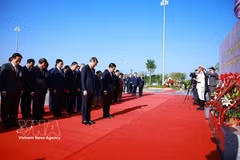
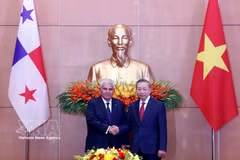
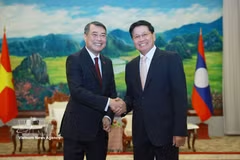
Vietnamese Party and State leaders pose for a group photo with leaders of AIPO member parliaments at the opening of AIPO-23 in Hanoi on September 9, 2002 (Photo: VNA)
Hanoi (VNA) - Over the last four decades,the ASEAN Inter-Parliamentary Assembly (AIPA) hasbecome one of the most outstanding inter-parliamentary models in Asia and asymbol of solidarity, cooperation, and unity in diversity within the ASEANCommunity.
According to former Vice Chairman ofthe National Assembly’s Committee for External Relations Ngo Anh Dung, AIPA wasinitially the ASEAN Inter-Parliamentary Organisation (AIPO), whichwas formed on September 2, 1977 in Manila, the Philippines, with five members: Indonesia,Malaysia, the Philippines, Singapore, and Thailand.
The establishment of AIPO aimed at promotingcollaboration among legislative bodies of regional countries as well as thesharing of information and experience in law-building, thus enhancing mutualunderstanding, friendship, solidarity, and unity among members.
In 2006, along with the changing ofits name as AIPA, the organisation supplemented and adjusted its Charter, completingthe organisation of a Jakarta-based Secretariat and strengthening thesupervision of the implementation of resolutions through the yearly reportingmechanism.
Commenting on the efficiency of AIPAin fostering cooperation among member parliaments for reaching ASEAN goals,especially over the last decade, Chairman of the NA's Committee for External Relations Nguyen Van Giau saidthat all activities of the Assembly have been associated with ASEAN’s yearlyagenda.
ASEAN Chair Statements, which coverissues from the Political-Security Community, the Economic Community, and the Socio-CulturalCommunity, have served as the foundation for AIPA’s activities, he said.
He noted that AIPA member parliamentshave accompanied ASEAN members’ governments in realising resolutions anddeclarations approved by ASEAN countries.
Giau stressed the significance of womenparliamentarians in AIPA activities, contributing ideals in areas such aspolitics and socio-economy and ensuring gender equality and the rights of womenand children.
Along with ASEAN, AIPA has played a majorrole in strengthening solidarity and mutual understanding and trust amongpeople in regional countries while positively supporting governments ineffectively implementing trans-national cooperation, encouraging themaintenance of national identity, and assisting in improvements to the capacityof member parliaments, he said.
AIPA has also walked shoulder-to-shoulderwith regional countries in dealing with major challenges such as the consequencesof the global financial crisis, sustainable development, regional security,development gaps, and trans-national crime, Giau said.
Through general assemblies, AIPA hasissued a host of resolutions regarding important issues, in particular politics,security, and trust building.
AIPA has helped foster regionalintegration through the enhancement of cooperation among inter-governmental andinter-parliamentary institutions and the promotion of global peace andinternational law.
Amid complex developments in theregion and world, AIPA has released resolutions calling for stronger engagementfrom Southeast Asian parliaments in coping with security and political issues inthe region. Parliaments have played an important role in ASEAN cooperation forthe construction and development of the ASEAN Community, Giau noted.
In the field of economy, AIPA has paidmuch attention to bolstering cooperation among ASEAN countries and between thegrouping and its partners. AIPA has also approved resolutions highlighting theneed to narrow the development gap among ASEAN member countries as well asbetween the bloc and other regions.
AIPA has supported the implementationof the Blueprint of the ASEAN Economic Community (AEC) and suggested that ASEAN makeperiodical assessments of implementation in line with the AEC Vision 2025.
Regarding the implementation of the UNSustainable Development Goals (SDGs), AIPA parliamentarians have stressed theneed for ASEAN member countries to ensure that economic development is accompaniedby the sustainable development of natural resources, minimisation of the negativeimpact of climate change, food and energy security, and environmentalprotection and biodiversity.
AIPA has also helped increase regional cooperation ineducation, culture, and healthcare, while enhancing the role of women in ASEAN,protecting children’s rights, and contributing to resolving issues in the environment,labour, immigration, poverty, and drugs.
AIPA has also contributed to creating consensus amongmember countries in applying poverty reduction measures, promoting the observationof migrant workers, strengthening discussions on education and vocationaltraining, preventing child labour, fighting drug trafficking and the spread ofepidemics and trans-national crime, and cooperating in environmental protectionand increasing cooperation in culture and tourism within ASEAN. AIPA has alsoincreased the role of women in all areas and at all levels.
It has supported ASEAN member countries’ governmentsin building the ASEAN Community on all three pillars: politics-security,economy, and socio-culture.
Giau said that Vietnam's admission to the organisation in1995 was a historical milestone in the Vietnamese parliament’s relations with itscounterparts in regional countries.
Vietnam has actively engaged in AIPAactivities since then, including hosting the 23rd and 31st AIPA General Assemblies in 2002 and 2010, respectively, as well as thematicmeetings and committee-level meetings, he said./.
VNA