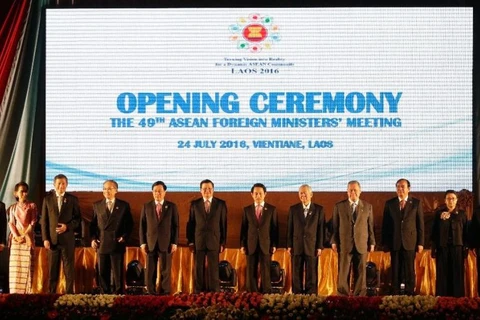
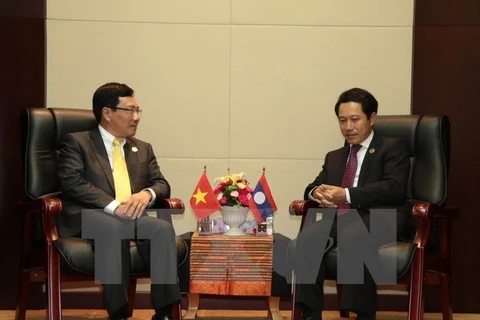
At the meeting (Source: VNA)
 Vientiane (VNA) - The 49th ASEAN Foreign Ministers’ Meeting (AMM 49) took place in Laos’s capital city of Vientiane on July 24 with the participation of 10 Foreign Ministers from ASEAN member countries and the ASEAN Secretary General.
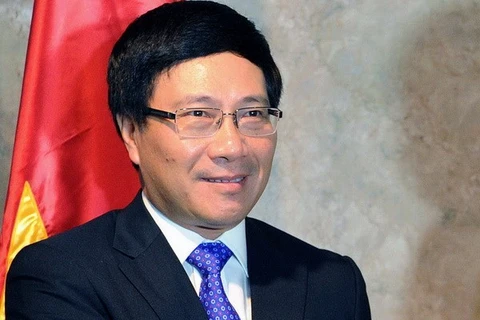
The Vietnamese delegation to the meeting was led by Deputy Prime Minister and Foreign Minister Pham Binh Minh.
Themed “ Turning Vision into Reality for a Dynamic ASEAN Community” , the ministers discussed five major contents, including measures to strengthen solidarity, unity and the central role of ASEAN; implementing the ASEAN Community Vision 2025; cooperation between ASEAN and partners as well as regional and international situation.
The foreign ministers stressed that the bloc should give top priority to strengthening solidarity and unity as it is the prerequisite for the success of ASEAN Community building process, a foundation for ASEAN to assert and prove its role, responsibility and voice in dealing with strategic issues relating to peace, security and regional stability, helping to enhance the bloc’s image and prestige.
They also lauded the progress in both three pillars in the implementation of the ASEAN Community Vision 2025, as well as in carrying out the ASEAN Political-Security Community Blueprint 2025, with 140 out of the total 290 action lines underway, including the establishment of the Military Medicine Centre and the organisation of maneuvers on natural disaster aid, maritime security, anti-terrorism and peace-keeping under the framework of the ASEAN Defence Minister’s Meeting Plus (ADMM+).
Regarding economic affairs, the meeting applauded new action plans set for 2016-2025 in investment, trade facilitation, transport, small and medium sized enterprises, tourism, technological science and agro-forestry.
The ministers underscored the significance of the ASEAN Socio-Cultural Community in improving regional livelihoods and building ASEAN identity. They hailed stellar achievements made by the member states, including the adoption and implementation of ASEAN action plans on labour, education, the environment, healthcare and natural calamity management, as well as the building of ASEAN guidelines for corporate social responsibility on labour and green economy sustainable development.
ASEAN member countries pledged to continue efforts to efficiently carry out the ASEAN Community Vision 2025 and master plans towards a more close-knit and people-centred ASEAN Community.
Speaking highly of the combination of ASEAN Community Vision 2025 and the United Nations 2030 Agenda for sustainable development, the ministers agreed to identify top prioritised sectors and map out routes to boost similar components in those two documents. They also agreed to hold a special meeting on sustainable development during the ASEAN Foreign Ministers Meeting in New York in September.
The conference laid stress on the importance of narrowing development gap and promoting connectivity to building ASEAN Community as well as helping CLMV countries make better integration. Thus, they pledged to carry out effectively the Master Plan on ASEAN Connectivity to 2025 and the third phase of the ASEAN Connectivity Initiative working plan after the documents are approved in September.
The ministers agreed to enhance the efficiency of ASEAN appratus’ operation, particularly in defining roles and functions of its agencies and intensifying coordination in interdisciplinary issues. ASEAN senior officials and the Committee of Permanent Representatives to ASEAN (CPR) are requested to study the possibility to revise the ASEAN Charter to ensure ASEAN will better satisfy requirements in the new situation.
Discussing ASEAN’s external relations, ministers hailed the progress of ASEAN ties with partners, with 86 partners appointing ambassadors to ASEAN and 50 ASEAN committees established in third countries.
They agreed that ASEAN would continue its foreign policy of openness, enhancing cooperation with partners, contributing to dealing with challenges and assisting ASEAN in realising the 2025 Vision and narrowing development gap.
The ministers agreed to grant the Sectoral Dialogue Partner status to Switzerland and the Development Partner status to Germany.
Countries underscored the importance of ensuring ASEAN ties with partners must be based on mutual respect and benefit, maintaining ASEAN’s central role in building regional architecture that suits the region’s specific conditions and interests in line with ASEAN-led mechanisms such as ASEAN+1, ASEAN+3, the East Asia Summit, ASEAN Regional Forum and the ASEAN Defence Ministerial Meeting Plus.
On regional and global issues, ministers discussed issues of common concern, including the Korean peninsula, the Middle East, the East Sea and emerging challenges such as terrorism, human trafficking, migration, trans-national crime, maritime security, climate change and natural disasters.
Countries pledged to further promote the building and sharing of standards in relations among regional countries, including the Treaty of Amity and Cooperation of Southeast Asia (TAC), the Southeast Asian Nuclear Weapon Free Zone Treaty and the Declaration on the Conduct of Parties in the East Sea (DOC).
On the occasion, the ministers adopted a declaration on the 40 th anniversary of the TAC that upholds the value and importance of the treaty as well as its goals and principle of the TAC. They accepted Chile, Iran, Morocco and Egypt’s requests to join the TAC.
Ministers devoted time to the East Sea issue, affirming the East Sea’s importance to regional peace, stability and cooperation. They continued to expresse concern over the recent complicated developments in the East Sea, including the construction and militarisation which have exacerbated tension and eroded trust, hurting peace, security and stability in the region.
Many ministers stressed that in the current context, ASEAN needs to uphold solidarity, unity and central role, contribute to maintaining peace and stability, call for self-restraint and create an environment conducive to the peaceful settlement of disputes, they said.
The East Sea issue is the test to ASEAN’s unity and central role, they said.
Issues regarding the arbitration procedures established at Appendix VII of the 1982 United Nations Convention on the Law of the Sea (UNCLOS) were also put on the table.
Participants reiterated their consistent stance on the peaceful settlement of disputes in line with international law, including the 1982 UNCLOS, stressed the importance of upholding international law, legal and diplomatic processes, and called for self-restraint and refraining from the use or threat to use forces, non-militarisation, preventing actions that complicate the situation and increase tension, towards achieving practical progresses in the implementation of the DOC and the building of the Code of Conduct in the East Sea.
At the meeting, Vietnam’s Deputy Prime Minister and Foreign Minister Pham Binh Minh appreciated efforts made by Laos in its role as ASEAN chairman and affirmed Vietnam and other ASEAN member countries will closely cooperate with Laos to fulfil this responsibility.
The Deputy PM underlined the importance of ensuring ASEAN’s solidarity, unity and central role as well as the sense of the community and the harmonious combination of national interests and that of the ASEAN. He also recommended the increase of exchanges and coordination of ASEAN’s viewpoint on regional and international issues.
The Deputy PM affirmed Vietnam commits to actively participating in and contributing effectively to the implementation of ASEAN Community Vision 2025. He suggested assessing quality as well as difficulties in implementing action lines so as to timely draw up appropriate solutions or make suitable adjustment.
On the implementation of the ASEAN Political-Security Community Blueprint 2025, Minh proposed focusing on increasing the capability to tackle traditional and non-traditional security challenges, operating “early warning” and “quick response” mechanisms, promoting preventive and trust-building diplomatic measures, build rules and code of behaviours in order to prevent and control potential conflict risks.
The Deputy PM spoke highly of the progress in building the Initiative for ASEAN Integration (IAI) Working Plan, the third stage, on narrowing the development gap and the Master Plan on ASEAN Connectivity 2025, describing them as important contents supporting the process of building the ASEAN Community. He affirmed that Vietnam, as chairman of the 2017 IAI Working Group, will push forward the effective implementation of the IAI Working Plan in order to improve the capability of Cambodia, Laos, Myanmar and Vietnam in the formation of ASEAN Community.
According to Minh, the connectivity plan should focus on developing sustainable infrastructure, digital innovation, facilitating labour movement, while ASEAN’s relevant agencies should soon complete documents on promoting and protecting rights of migrant labourers.
Regarding ASEAN’s external relations, the Deputy PM placed importance on relationships with partners in the framework of ASEAN+1, and suggested driving result-oriented cooperation via effectively carrying out agreements. He called on partners to assist ASEAN in executing the ASEAN Community Vision 2025 and endorse the central role of ASEAN in the region. He The Deputy PM stressed that ASEAN needs to uphold its central role in shaping a multi-layer, multi-process, multi-sector and law-based regional structure.
Talking about regional and international issues, Minh emphasized that while peace, cooperation, development continue to be the main trend, not a few complicated challenges have surfaced with unpredictable consequences such as war and conflict in the Middle East and Africa, terrorism, migration, climate change, unrest in South Asia and tension in the Korean Peninsula.
The Deputy PM stressed the importance of timely addressing climate change and managing disasters, and called for specific measures and a road map to be build to carry out the ASEAN Vision 2025 on the Management of Natural Disasters and the Declaration One ASEAN, One Response. He said cooperation should be enhanced in priority fields regarding building early warning system, providing natural disaster and humanitarian aid, sustainably managing and preserving natural resources, especially marine resources and forest and water in Mekong River.
The Deputy PM emphasised the multifaceted importance of the East Sea towards countries inside and outside the region and shared concerns over recent complex happenings along with their impacts on the region’s peace, security and stability. He reiterated ASEAN’s important role in promoting peace, stability and cooperation between countries in the region, creating favourable environment for countries to resolve peacefully disputes in line with international law and the 1982 United National Convention on the Law of the Sea. He also underlined the significance of ASEAN maintaining the existing common viewpoint and called on countries to restrain themselves, not to pursue militarization, respect legal and diplomatic procedures, abide to the Declaration of Conduct of Parties on the East Sea (DOC) and work for the early formation of the Code of Conduct.
On July 25, ten ASEAN+1 meetings with partners, including China, Japan, the Republic of Korea, the US, India, Australia, New Zealand, Russia, the European Union and Canada, will be held.-VNA