Ample room remains for Vietnam – Singapore trade

In addition to boosting exports, Vietnamese businesses are also advised to consider investing in Singapore to export to third markets.

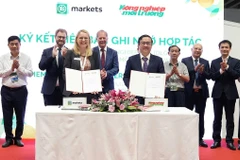
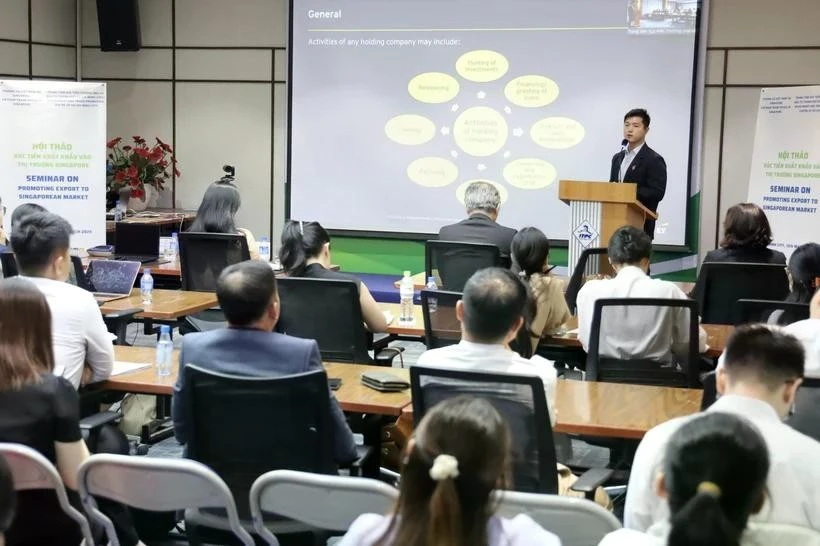
The seminar is held by the Investment and Trade Promotion Centre of HCM City (ITPC) and the Vietnam Trade Office in Singapore. (Photo: VNA)

HCM City (VNA) – Vietnam and Singapore see an ample room to enhance their economic cooperation, particularly in trade, heard a seminar held in Ho Chi Minh City on March 13.

Speaking at the event held by the Investment and Trade Promotion Centre of HCM City (ITPC) and the Vietnam Trade Office in Singapore, ITPC Deputy Director Ho Thi Quyen noted that over the past decade, the Vietnam – Singapore strategic partnership has developed robustly in both depth and width.

Economic, trade, and investment cooperation has consistently been a bright spot in the bilateral relationship. In 2024, their import and export turnover reached 10.5 billion USD. Of this, Vietnam's exports to Singapore amounted to nearly 5.2 billion USD while imports from the latter exceeded 5.3 billion USD. Singapore is currently Vietnam's fourth largest trading partner in ASEAN, following Thailand, Indonesia, and Malaysia.

Quyen said that Vietnam and Singapore are two complementary economies, and also members of the Comprehensive and Progressive Agreement for Trans-Pacific Partnership (CPTPP) and the Regional Comprehensive Economic Partnership (RCEP). These frameworks facilitate cooperation for common development.

Particularly, HCM City's goals of achieving robust growth and becoming a smart city as well as a leading digital economy and digital society hub in Southeast Asia are similar to those of Singapore, which is the largest foreign investor in the city at present.

ITPC Deputy Director Ho Thi Quyen speaks at the seminar. (Photo: VNA)

ITPC Deputy Director Ho Thi Quyen speaks at the seminar. (Photo: VNA)

Cao Xuan Thang, head of the Vietnam Trade Office in Singapore, highlighted that Singapore is the world's most expensive market. With a population of just over 6 million, it is home to more than 427,000 millionaires. It is known as a regional trade hub, not only importing for domestic consumption but also serving as a transit point for goods globally.

Out of the 400–500 billion SGD (299–374 billion USD) worth of goods imported into Singapore each year, about 60% is re-exported to third countries. However, the city state's imports from Vietnam stand at only around 8–9 billion SGD per year, indicating significant potential for increased exports to this market.

Thang said in addition to industrial products, Singapore also imports a substantial amount of rice and aquatic products. Vietnamese rice is highly regarded for its quality but also priced high. Meanwhile, Vietnamese companies' large-scale trade promotion activities are still limited, resulting in Vietnamese rice primarily distributed under Singaporean brands.

Similarly, aquatic products of Vietnam are popular and meet the consumption needs of various ethnic groups. To increase their export market share, businesses should prioritise products with Halal certification, invest adequately in packaging, and provide sufficient product information.

Singapore is a demanding market with strict quality requirements and intense price competition. Food products will undergo sampling and quality control before entering the market, he added.

Thang noted that with a small population, high ethnic diversity, and being considered a global trade centre, Singapore is often chosen as a trial market for new products and services. Therefore, Vietnamese businesses can leverage the export opportunity by meeting Singapore's standards, actively participating in trade promotion and business matching programmes, and using e-commerce to enhance their brand recognition.

Meanwhile, Wesley Chua from the Singapore Business Association in Vietnam suggested that in addition to boosting exports, Vietnamese businesses should also consider investing in Singapore to export to third markets. Singapore is a preferred location for many international companies to start up and establish headquarters in due to its developed infrastructure, abundant financial resources, clear tax policies, and low risk.

He said Singapore's economy acts as a gateway for growth and expansion into new markets and regions. Products manufactured in this country can easily reach global customers through the network of free trade agreements of which Singapore is a member. Vietnamese businesses can capitalise on Singapore’s existing advantages to enhance their creativity and improve export efficiency in the future./.
VNA

See more

The yarn factory of Unitex Textile and Dyeing Company Limited applies new technology to optimise operations using an automated model. (Photo: VNA)

Resolution 68: International lessons for private sector development

A common feature in many successful economies is a fundamental shift in the perception of private enterprises. In countries such as Singapore, Germany, Republic of Korea (RoK) and China, private firms are viewed not mainly as entities requiring strict control but as development partners and key forces generating growth, jobs and innovation.

The production line of Regza Electronics Vietnam Co., Ltd. located in Dong Nai province. (Photo: VNA)

Vietnam’s overseas investment rises 2.3-fold in first two months

During the period, 36 new overseas projects were granted investment certificates with total registered capital from Vietnamese investors reaching 532.4 million USD, up 2.3 times compared to the same period last year. In addition, three projects adjusted their capital with an additional 7.8 million USD, 1.5 times higher than a year earlier.

Workers of PTSC Thanh Hoa check the system for crude oil imports. Vietnam saw strong increase in fuel imports in the first two months of this year. (Photo" VNA)

Vietnam records strong increase in fuel imports in two months

Statistics of Vietnam Customs showed that Vietnam spent more than 1.44 billion USD importing 2.18 million tonnes of petroleum products in the first two months of this year, representing a sharp increase of 31.4% and 43%, respectively, over the same period last year.

Prime Minister Pham Minh Chinh visits a macadamia cultivation model in Huoi Tao B village, Pu Nhi commune, Dien Bien province on March 8. (Photo: VNA)

PM requests boosting agricultural development in Northwestern region

PM Chinh encouraged local residents to explore additional crops and livestock suitable for intercropping in order to maximise land use efficiency. Farmers were also urged to strengthen cooperation with one another and with businesses by joining cooperatives, consolidating land resources and working together to expand production and improve incomes.

Farmers in the Mekong Delta province of An Giang harvest rice grown under the project 'Sustainable Development of One Million Hectares of High-Quality, Low-Emission Rice Associated with Green Growth in the Mekong Delta by 2030.' (Photo: VNA)

Promoting high-quality rice exports amid mounting challenges

According to the Ministry of Agriculture and Environment (MAE), an estimated 600,000 tonnes of rice worth 370 million USD was exported in January, up 12.4% in volume and 16.9% in value year-on-year. The average export price reached 616.6 USD per tonne, up 4%.

Fuel supply in Hanoi remains stable. (Photo: VNA)

Fuel prices rise sharply from 3 pm on March 7

Since the beginning of this year, domestic fuel prices have undergone 11 adjustments. During this period, both RON95 and E5 RON92 experienced four decreases and seven increases, while diesel oil two falls and nine hikes.

Customers buy and sell fuel at a Petrolimex petrol station. (Photo: VNA)

Capital’s fuel market remains stable after March 5 price adjustment

Operations at several petrol stations across Hanoi have run normally. Along major routes, petrol stations remained open and continued to serve customers as usual. The number of vehicles refueling showed no major changes compared to the days before the price adjustment. Sales activities continued without interruption, and there were no long queues or supply disruptions.

Thang Long II Industrial Park in Hung Yen province. (Photo: VNA)

Green industrial parks draw FDI to northern Vietnam

From 2026, the industrial real estate market in the northern region is forecast to enter a new growth phase as strategic infrastructure projects near completion, supply expands, and green industrial parks become a decisive factor for foreign direct investment (FDI).

Border guards from Thanh Hai Border Guard Station patrol fishing vessels entering Phu Hai port in Phu Thuy ward, Lam Dong province. (Photo: VNA)

Lam Dong orders swift action to address IUU fishing gaps

Vice Chairman of the provincial People’s Committee Le Trong Yen has directed heads of relevant departments, sectors and localities to strictly implement directives and newly issued regulations on IUU prevention, while strengthening public awareness efforts so fishermen and businesses better understand and comply with the rules.