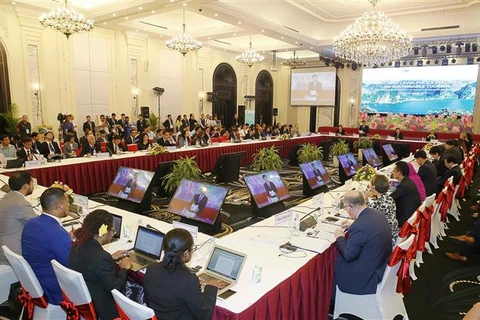
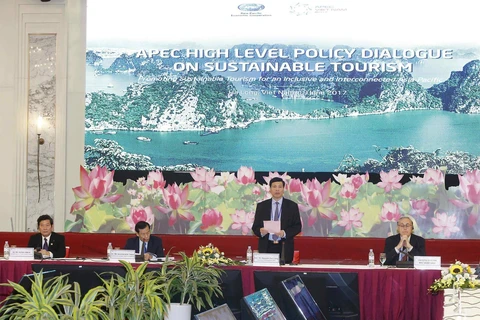
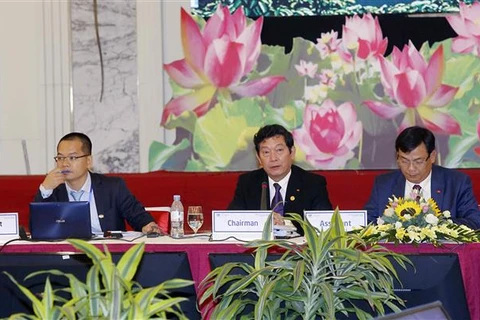
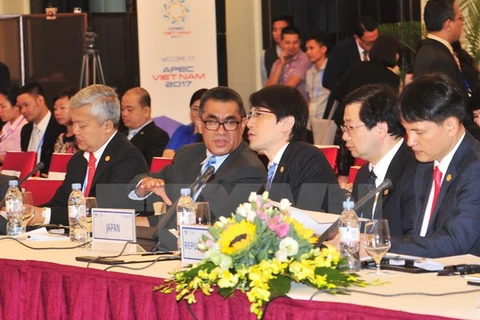
Delegates of the APEC High Level Policy Dialogue on Sustainable Tourism pose together. (Photo: VNA)
 Quang Ninh (VNA) – APEC tourism ministers has reiterated the significant role of tourism, and particularly high value tourists, in stimulating economic growth and fostering connectivity in a statement adopted at the APEC High Level Policy Dialogue on Sustainable Tourism held in Quang Ninh province on June 19.
The following is the full text of the statement.
2017 APEC HIGH LEVEL STATEMENT
Promoting Sustainable Tourism for an Inclusive and Interconnected Asia-Pacific
“We, APEC Tourism Ministers and senior representatives, met at the APEC High Level Policy Dialogue on Sustainable Tourism in Ha Long, Vietnam on June 19, 2017. The Dialogue, held in conjunction with, and support of the United Nations 2017 International Year of Sustainable Tourism for Development, was chaired by H.E. Nguyen Ngoc Thien, Minister of Culture, Sports and Tourism of Vietnam.
Under the APEC 2017 theme "Creating New Dynamism, Fostering a Shared Future”, we focused our deliberations on “promoting sustainable tourism for an inclusive and interconnected Asia-Pacific” with a view to further enhancing APEC cooperation on sustainable and inclusive development in the region.
We welcome the implementation of the Lima Declaration on Connecting Asia-Pacific Tourism through Travel Facilitation, the APEC Travel Facilitation Initiative and the APEC Connectivity Blue Print for 2015 - 2025. We support a more connected Asia-Pacific region that facilitates efficient and secure travel in order to reach the target of 800 million international tourist arrivals in APEC economies by 2025 advocated at the 8th APEC Tourism Ministers’ Meeting in 2014. We note with satisfaction that in 2016, APEC destinations received 415 million international tourists – an increase of 24 million tourists or 6.1% from 2015, according to the United Nations World Tourism Organization.
We appreciate the dedication of the Tourism Working Group (TWG) to effectively implement the APEC TWG Strategic Plan 2015 - 2019 (ATSP), especially in the four priority areas: (i) Promote better understanding and recognition of tourism as an engine for economic growth and prosperity in the APEC region; (ii) Ensure sustainable and inclusive growth in the travel and tourism sector by encouraging socially and culturally responsible tourism; (iii) Promote labor, skills development and certification through increased cooperation in order to develop the tourism workforce in the region; and (iv) Promote competitiveness and regional economic integration through policy alignment and structural reform.
We reiterate the significant role of tourism, and particularly high value tourists, in stimulating economic growth and fostering connectivity. In 2016 travel and tourism directly contributed USD 1.3 trillion to the APEC region's GDP, supported 67 million jobs directly and contributed 6.1% of the region’s exports. Moreover, every 10% increase in tourist arrivals in APEC economies is associated with a 1.2% increase in exports and a 0.8% increase in imports in the destination economy. Travel and tourism stimulates entrepreneurship and the growth of MSMEs, supporting economic diversification and creating jobs across sectors. Tourism generally has a positive effect on poverty reduction and] inclusive growth by creating jobs and entrepreneurial opportunities across a wide spectrum of skills and producing a positive impact on the development of remote areas.
The Asia-Pacific is at a crucial juncture of transformation amidst a fast changing global landscape. The digital age and the 4th Industrial Revolution are having an unprecedented impact on the way people live, work, travel and recreate. As APEC is starting to shape its post-2020 vision, we underscore the significance of sustainable tourism as an important driver for regional economic integration and sustainable, innovative and inclusive growth. Sustainable tourism helps strengthen connectivity, including to sub-regions and remote areas; promote economic, financial and social inclusion; address environmental degradation and pollution; conserve and manage natural resources and biodiversity; improve waste management; and promote investment and cultural exchange.
In this connection, we strongly support the principles and proposed actions that follow:
- Acknowledge that sustainable tourism development is a continuous process that requires constant impact monitoring, introduction of preventive or corrective measures when necessary, and full consideration of its current and future economic, social and environmental implications, while addressing the needs of visitors, the industry, the environment and host communities.
- Foster regional and domestic tourism policies that support the Sustainable Development Goals (SDGs), particularly Goals 8, 12 and 14 on inclusive and sustainable economic growth, sustainable consumption and production, and sustainable use of oceans, seas and marine environment noting that sustainable tourism can contribute to all SDGs due to its cross-cutting nature.
- Encourage viable, long-term economic contributions of travel and tourism in providing socio-economic benefits to all stakeholders, including stable employment, income-earning opportunities and social services to host communities, and contribute to poverty alleviation.
- Respect socio-cultural authenticity of host communities, conserve their built and living cultural heritage and traditional values, and contribute to inter-cultural understanding and tolerance.
- Make optimal use of environmental resources that constitute a key element in tourism development, maintaining essential ecological processes and helping to conserve natural features and resources, and biodiversity.
- Encourage a consumer-led demand for sustainable tourism practices and products, promote public-private partnership as a key instrument to develop sustainable tourism infrastructure and services, and foster local communities and private sector participation in the tourism value chains.
- Create competitive and enabling environments for all tourism-related enterprises, and particularly MSMEs, who are more likely to hire locally and generate jobs that are less skill-intensive, thus helping to promote inclusiveness in the tourism sector. MSMEs can also help promote innovation in tourism when provided with access to adequate finance, skills and global markets.
- Conduct further studies to enable APEC economies to adapt to, and capitalize on, the changes made by the new advanced technologies for smart, sustainable and inclusive tourism development, especially in tourism human resource development and tourism management.
- Encourage the TWG to: (1) focus on economic, financial and social sustainability and inclusion in its future work, as travel and tourism is uniquely able to provide opportunities across APEC economies; (2) leverage connectivity to increase inclusive growth by allowing tourism to reach more geographic areas within economies; (3) consider the establishment of a network of sustainable, inclusive and integrated tourism destinations among APEC member economies; (4) work with other APEC fora and relevant international and regional organizations to share best practices and foster synergies in promoting sustainable tourism growth; and (5) highlight best practices of APEC economies in measurement and monitoring methodologies that are undertaken to enhance sustainable tourism.
- Encourage the TWG to explore and develop further policy directions to promote sustainable tourism to enhance the awareness of the benefits of sustainable tourism among businesses, host communities and tourists.
- Recognize sustainable tourism as a relevant and important area of cooperation in APEC's current and future agenda, and encourage the TWG to work closely with other APEC fora during the development of an APEC post-2020 vision.
We seek APEC Leaders’ consideration to include in their 2017 Declaration a statement on the importance of sustainable tourism as a driver for regional economic integration, sustainable and inclusive economic growth, and an important means for promoting further business development and job creation, economic, financial and social inclusion, enhancing connectivity with a view to building a peaceful, stable, dynamic, resilient, inclusive and seamless Asia-Pacific community for the people and businesses.
We stress the importance of pursuing closer collaboration with relevant international and regional organizations related to sustainable tourism development, particularly the United Nations World Tourism Organization, Association of Southeast Asian Nations, and the International Air Transport Association.
We appreciate the efforts and contribution of the APEC Secretariat, the TWG Lead Shepherd and Deputy Lead Shepherd in ensuring the success of the Dialogue. We sincerely thank Viet Nam for the warm hospitality and arrangements for the Dialogue. We look forward to the 10th APEC Tourism Ministerial Meeting hosted by Papua New Guinea in 2018”.-VNA
The following is the full text of the statement.
2017 APEC HIGH LEVEL STATEMENT
Promoting Sustainable Tourism for an Inclusive and Interconnected Asia-Pacific
“We, APEC Tourism Ministers and senior representatives, met at the APEC High Level Policy Dialogue on Sustainable Tourism in Ha Long, Vietnam on June 19, 2017. The Dialogue, held in conjunction with, and support of the United Nations 2017 International Year of Sustainable Tourism for Development, was chaired by H.E. Nguyen Ngoc Thien, Minister of Culture, Sports and Tourism of Vietnam.
Under the APEC 2017 theme "Creating New Dynamism, Fostering a Shared Future”, we focused our deliberations on “promoting sustainable tourism for an inclusive and interconnected Asia-Pacific” with a view to further enhancing APEC cooperation on sustainable and inclusive development in the region.
We welcome the implementation of the Lima Declaration on Connecting Asia-Pacific Tourism through Travel Facilitation, the APEC Travel Facilitation Initiative and the APEC Connectivity Blue Print for 2015 - 2025. We support a more connected Asia-Pacific region that facilitates efficient and secure travel in order to reach the target of 800 million international tourist arrivals in APEC economies by 2025 advocated at the 8th APEC Tourism Ministers’ Meeting in 2014. We note with satisfaction that in 2016, APEC destinations received 415 million international tourists – an increase of 24 million tourists or 6.1% from 2015, according to the United Nations World Tourism Organization.
We appreciate the dedication of the Tourism Working Group (TWG) to effectively implement the APEC TWG Strategic Plan 2015 - 2019 (ATSP), especially in the four priority areas: (i) Promote better understanding and recognition of tourism as an engine for economic growth and prosperity in the APEC region; (ii) Ensure sustainable and inclusive growth in the travel and tourism sector by encouraging socially and culturally responsible tourism; (iii) Promote labor, skills development and certification through increased cooperation in order to develop the tourism workforce in the region; and (iv) Promote competitiveness and regional economic integration through policy alignment and structural reform.
We reiterate the significant role of tourism, and particularly high value tourists, in stimulating economic growth and fostering connectivity. In 2016 travel and tourism directly contributed USD 1.3 trillion to the APEC region's GDP, supported 67 million jobs directly and contributed 6.1% of the region’s exports. Moreover, every 10% increase in tourist arrivals in APEC economies is associated with a 1.2% increase in exports and a 0.8% increase in imports in the destination economy. Travel and tourism stimulates entrepreneurship and the growth of MSMEs, supporting economic diversification and creating jobs across sectors. Tourism generally has a positive effect on poverty reduction and] inclusive growth by creating jobs and entrepreneurial opportunities across a wide spectrum of skills and producing a positive impact on the development of remote areas.
The Asia-Pacific is at a crucial juncture of transformation amidst a fast changing global landscape. The digital age and the 4th Industrial Revolution are having an unprecedented impact on the way people live, work, travel and recreate. As APEC is starting to shape its post-2020 vision, we underscore the significance of sustainable tourism as an important driver for regional economic integration and sustainable, innovative and inclusive growth. Sustainable tourism helps strengthen connectivity, including to sub-regions and remote areas; promote economic, financial and social inclusion; address environmental degradation and pollution; conserve and manage natural resources and biodiversity; improve waste management; and promote investment and cultural exchange.
In this connection, we strongly support the principles and proposed actions that follow:
- Acknowledge that sustainable tourism development is a continuous process that requires constant impact monitoring, introduction of preventive or corrective measures when necessary, and full consideration of its current and future economic, social and environmental implications, while addressing the needs of visitors, the industry, the environment and host communities.
- Foster regional and domestic tourism policies that support the Sustainable Development Goals (SDGs), particularly Goals 8, 12 and 14 on inclusive and sustainable economic growth, sustainable consumption and production, and sustainable use of oceans, seas and marine environment noting that sustainable tourism can contribute to all SDGs due to its cross-cutting nature.
- Encourage viable, long-term economic contributions of travel and tourism in providing socio-economic benefits to all stakeholders, including stable employment, income-earning opportunities and social services to host communities, and contribute to poverty alleviation.
- Respect socio-cultural authenticity of host communities, conserve their built and living cultural heritage and traditional values, and contribute to inter-cultural understanding and tolerance.
- Make optimal use of environmental resources that constitute a key element in tourism development, maintaining essential ecological processes and helping to conserve natural features and resources, and biodiversity.
- Encourage a consumer-led demand for sustainable tourism practices and products, promote public-private partnership as a key instrument to develop sustainable tourism infrastructure and services, and foster local communities and private sector participation in the tourism value chains.
- Create competitive and enabling environments for all tourism-related enterprises, and particularly MSMEs, who are more likely to hire locally and generate jobs that are less skill-intensive, thus helping to promote inclusiveness in the tourism sector. MSMEs can also help promote innovation in tourism when provided with access to adequate finance, skills and global markets.
- Conduct further studies to enable APEC economies to adapt to, and capitalize on, the changes made by the new advanced technologies for smart, sustainable and inclusive tourism development, especially in tourism human resource development and tourism management.
- Encourage the TWG to: (1) focus on economic, financial and social sustainability and inclusion in its future work, as travel and tourism is uniquely able to provide opportunities across APEC economies; (2) leverage connectivity to increase inclusive growth by allowing tourism to reach more geographic areas within economies; (3) consider the establishment of a network of sustainable, inclusive and integrated tourism destinations among APEC member economies; (4) work with other APEC fora and relevant international and regional organizations to share best practices and foster synergies in promoting sustainable tourism growth; and (5) highlight best practices of APEC economies in measurement and monitoring methodologies that are undertaken to enhance sustainable tourism.
- Encourage the TWG to explore and develop further policy directions to promote sustainable tourism to enhance the awareness of the benefits of sustainable tourism among businesses, host communities and tourists.
- Recognize sustainable tourism as a relevant and important area of cooperation in APEC's current and future agenda, and encourage the TWG to work closely with other APEC fora during the development of an APEC post-2020 vision.
We seek APEC Leaders’ consideration to include in their 2017 Declaration a statement on the importance of sustainable tourism as a driver for regional economic integration, sustainable and inclusive economic growth, and an important means for promoting further business development and job creation, economic, financial and social inclusion, enhancing connectivity with a view to building a peaceful, stable, dynamic, resilient, inclusive and seamless Asia-Pacific community for the people and businesses.
We stress the importance of pursuing closer collaboration with relevant international and regional organizations related to sustainable tourism development, particularly the United Nations World Tourism Organization, Association of Southeast Asian Nations, and the International Air Transport Association.
We appreciate the efforts and contribution of the APEC Secretariat, the TWG Lead Shepherd and Deputy Lead Shepherd in ensuring the success of the Dialogue. We sincerely thank Viet Nam for the warm hospitality and arrangements for the Dialogue. We look forward to the 10th APEC Tourism Ministerial Meeting hosted by Papua New Guinea in 2018”.-VNA
VNA