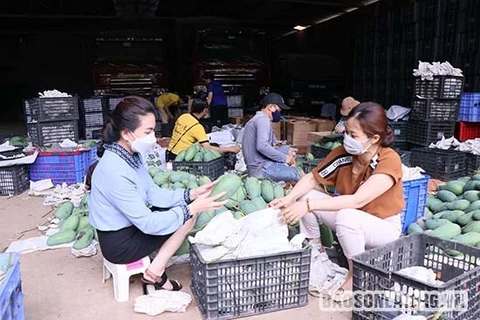
An organic dragon fruit production model in Thanh Phu Long commune in Long An province’s Chau Thanh district. (Photo: VNA)
 Hanoi (VNA) – The potential for organic agricultural development in Vietnam is still great and the opportunity for organic agricultural products from Vietnam to enter Australia is very promising in the near future, said Nguyen Van Kien, Director of Canberra-based Mekong Organics Company.
Mekong Organics has been selected by the Australia government to implement a project to promote the development of organic agricultural technology, certification and trade between Vietnam and Australia within the framework of the Australia-Vietnam Enhanced Economic Engagement Grant (AVEG) pilot programme.
Kien, who is also a senior lecturer at the Australian National University and has worked for 20 years at Vietnam's An Giang University, said that by accessing reports of many new scientific studies on the organic agricultural industry he realised that the potential for organic agriculture in Vietnam is still very large, with the current growth trend of the organic industry in the world, especially in the US, Europe, Canada and Australia markets.
Vietnam's Mekong Delta has many advantages to shift to ecological and organic agriculture to be on par with leading agriculture in the region and the world, he told the Vietnam News Agency (VNA).
The shift from low-quality to high-quality agricultural production was very urgent to improve farmers' incomes as well as the environment for communities, and adapt to climate change, he said.
According to Tim Marshal, General Director of TM Organics Company, and Chairman of the Organic Certification Authority of the National Association of Sustainable Agriculture Australia, the market for organic agricultural products in Australia reached 2.5 billion AUD (equivalent to nearly 2 billion USD) in 2019.
This market has been constantly growing, with a wide variety of products such as processed and beauty products, and garments appearing more and more in farmers' markets, supermarkets, restaurants and cafes.
However, domestic production in Australia has not yet met the needs of consumers.
Due to lower supply than demand in the organic agricultural product market in Australia, Kien said that the potential for organic agricultural products from Vietnam to enter this market is quite high in the coming years, especially processed products such as sauces, jams, canned fruits, dried or frozen vegetables.
While processed products can be easily imported into Australia, it is difficult for raw products because they had to meet very high biosecurity requirements for imported agricultural products, he added.
Kien said the project will focus on a training course for 200 learners who are businessmen, students, farmers and lectures on production and processing and trade in organic agricultural products based on experience from Australia.
During the course which will be organised in November this year, the learners will be able to access Australia's organic standards, biosafety standards when exporting to this country, and information on the organic agricultural market.
The orginisation of a forum between Australia and Vietnam will also be included, he said, adding that it will provide a opportunity for farmers and businesses of the two countries to introduce organic products./.