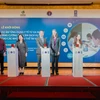
Australia’s Ambassador to Vietnam Andrew Goledzinowski (centre), UNICEF Representative in Vietnam Rana Flowers (left), and Deputy Director of the National Institute of Hygiene and Epidemiology Duong Thi Hong (right) stand next to one of the five refrigerated trucks given to Vietnam through Australia’s partnership with UNICEF and the Ministry of Health. (Photo courtesy of the Australian Embassy in Vietnam)
 The delivery was made through an agreement with UNICEF and in partnership with the Vietnamese Ministry of Health.
Three million adult Pfizer vaccine doses arrived in September in Hanoi and Ho Chi Minh City. A further 1.2 million pediatric doses arrived on October 24 in Hanoi.
Australia has now shared more than 26 million COVID-19 vaccine doses with Vietnam.
The five refrigerated trucks will be stationed at the National Institute of Hygiene and Epidemiology (NIHE) in Hanoi, Pasteur Institute in HCM City, Pasteur Institute in Nha Trang and the Central Highlands Institute of Hygiene and Epidemiology in Dak Lak.
These vehicles are essential to the COVID-19 vaccine rollout and routine immunisation programme as they ensure that vaccines are transported efficiently and safely across the country.
Australia’s comprehensive package, which supports Vietnam’s COVID-19 control, provides healthcare worker training, communications campaigns and outreach sessions to remote and hard-to-reach areas so that the most vulnerable populations are not left behind.
Australian Ambassador Goledzinowski holds up a box of refrigerated Pfizer COVID-19 vaccines, delivered to Hanoi through Australia and UNICEF’s partnership.
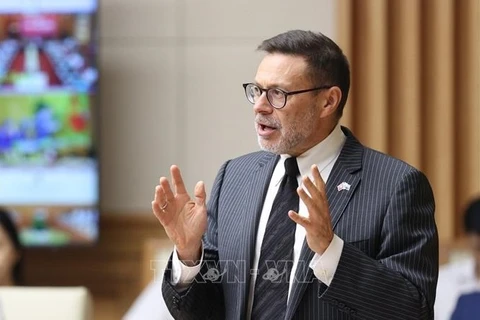
Australian Ambassador to Vietnam Andrew Goledzinowski welcomed the recent deliveries, highlighting Australia’s ongoing support for Vietnam’s COVID-19 response.
He said: “Australia has been proud to partner with Vietnam since 2021 in support of the national COVID-19 vaccination campaign.
“It’s great to see these recent deliveries – the vaccine doses will help boost the national COVID-19 vaccine campaign, and the trucks will support the vaccine rollout and contribute to broader health system strengthening efforts.”
Rana Flowers, UNICEF Representative in Vietnam, said: “From the outset of the pandemic, UNICEF has prioritised ensuring safe vaccine storage and transportation, particularly to the harder-to-reach areas of Vietnam.
“The trucks and the additional vaccines, particularly for children, are most welcome and timely and contribute greatly to the ongoing efforts to keep Vietnam safe from the COVID-19 outbreaks.
“UNICEF will continue to support Vietnam to ensure an adequate supply of vaccines, vaccination equipment and other medical equipment to respond to the fight against the pandemic and to ensure catch-up and continuity of routine vaccines for children.”/.
VNA