Australia wants to set up comprehensive strategic partnership with Vietnam: FM

The Australian Government continues to give high priority to Vietnam in its foreign policy, considering the Southeast Asian country one of its key partners in the Indo-Pacific region, and hopes to soon advance the bilateral relationship to the level of comprehensive strategic partnership, said a senior diplomat.
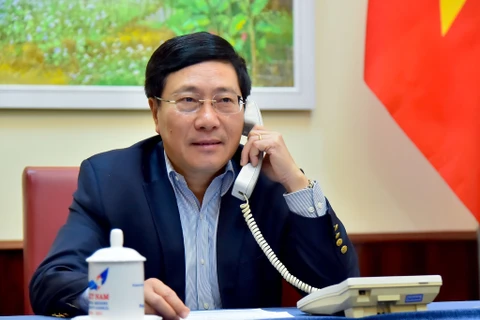
Australia wants to set up comprehensive strategic partnership with Vietnam: FM ảnh 1Deputy Prime Minister and Minister of Foreign Affairs Pham Binh Minh, and Australian Minister for Foreign Affairs Marise Payne co-chair the second Vietnam-Australia Foreign Ministers' Meeting. (Photo: VNA)

Hanoi (VNA) -
The Australian Government continues to give high priority toVietnam in its foreign policy, considering the Southeast Asian country one of its key partnersin the Indo-Pacific region, and hopes to soon advance the bilateral relationship to the level of comprehensive strategic partnership, said a senior diplomat.

Theremarks were made by Australian Minister for Foreign Affairs MarisePayne during the second Vietnam-Australia Foreign Ministers’ Meeting, co-chairedby herself and Vietnamese Deputy Prime Minister and Minister of Foreign Affairs Pham Binh Minh onNovember 5.

During the online meeting, the two officials agreed to discuss suitablemeasures and mechanisms in order to resume flights between the two countrieswhen possible.

They also consented to enhance bilateral cooperation and mutual support at regionaland international mechanisms and forums such as the UN, ASEAN/EAS, and theMekong Sub-region.

Minh appreciated Australia’s commitments to supporting and cooperatingwith Vietnam in all fields, including natural disaster response and the pandemicfight, while enhancing economic ties and development cooperation.

He also welcomed the country’s plan to establish the Australia-Vietnamcentre in the Southeast Asian nation as well as its assistance in helping Vietnam to participate in UN peacekeeping operations.

Minh suggested the two foreign ministries maintain the pace of cooperationthrough all-level meetings and the implementation of cooperation mechanismsbetween the two countries and the ministries in particular.

Regarding the East Sea issue, the two sides shared the same view on thesignificance of strengthening cooperation, maintaining peace, stability,security, safety and freedom of navigation and aviation, and peacefullysettling disputes in line with international law, including the 1982 UnitedNations Convention on the Law of the Sea (UNCLOS).

Payne congratulated Vietnam on its success in containing the COVID-19 pandemic andmaintaining socio-economic development, and conveyed the AustralianGovernment’s sympathies over the losses caused by the prolonged floods in the centralregion.

Australia always stands side-by-side with Vietnam and is ready to assistthe country in addressing the consequences of natural disasters and to step up cooperationin the fight against the COVID-19 pandemic, she stressed.

Payne agreed with Minh’s proposal to boost partnerships in major areas torecover the economies in the post-pandemic period, saying that Australia will providetechnical support to Vietnam in agriculture and market access.

Australia will also encourage its businesses to increase investment inVietnam in areas of mutual concern, such as telecommunications, infrastructure,agriculture, high-technology, finance-banking, and mining and energy, alongwith increasing its official development assistance (ODA) to the country, the minister said.

Congratulating Vietnam on its achievements in its capacity as ASEANChair 2020, Payne pledged that Australia will actively participate and closelycoordinate with Vietnam to ensure the success of the East Asia Summit (EAS),the ASEAN-Australia Summit, and the Regional Comprehensive Economic Partnership(RCEP) Summit.

At the end of the meeting, the two sides inked an action programme on implementing the Vietnam-Australia strategic partnership for 2020-2023.

The foreign ministers’ meeting is a new mechanism established after the twocountries elevated their relationship to a strategic partnership in March 2018during a visit to Australia by Prime Minister Nguyen Xuan Phuc./.
VNA
See more

Professor Zhu Chenming, Honorary Director of the South Asia–Southeast Asia Research Institute under the Yunnan Academy of Social Sciences. (Photo: VNA)

14th National Party Congress: Bridging the past and the future

Zhu said the congress plays a crucial role in shaping Vietnam’s future development, as it discusses development pathways and policy directions to achieve targets set for 2030 and realise the long-term vision towards 2045. The convening of the congress is truly a major political event in the life of the Vietnamese people.

Dr. Kin Phea, Director of the International Relations Institute under the Royal Academy of Cambodia (RAC). (Photo: VNA)

Vietnam’s progress tied to Communist Party of Vietnam leadership: Cambodian expert

In his presentation at a recent seminar hosted by the Vietnamese Embassy in Cambodia, Dr. Kin Phea described the the 14th National Congress of the CPV as a historic and momentous event, saying that with three strategic breakthroughs and six key tasks set for the country’s new revolutionary period, the Congress is seen as a landmark ushering in a new era - the era of the nation’s rise.

General Secretary of the Communist Party of India (CPI) Doraisamy Raja (Photo: VNA)

Vietnam advances creative, adaptive socialism for new era: Indian Communist Party leader

The 14th National Congress of the CPV comes at a critical juncture, as the world faces profound upheavals marked by escalating geopolitical tensions, economic instability, and deep structural crises within global capitalism. Against this backdrop, Vietnam’s decision to pursue a new growth model driven by science, innovation, and digital transformation reflects strategic vision, confidence, and a clear grasp of the requirements of the times.

Deputy Minister of Foreign Affairs Le Thi Thu Hang welcomes journalists and updates them on a number of achievements Vietnam has attained in recent years. (Photo: Ministry of Foreign Affairs)

Deputy Foreign Minister meets int’l journalists covering 14th National Party Congress

Deputy Minister of Foreign Affairs Le Thi Thu Hang said the 14th Congress holds special historical significance, marking a major turning point in the country’s development, as it not only reviews and assesses the achievements of 40 years of Doi moi (Renewal), but also defines goals, vision, and major policy decisions to lead Vietnam into a new era of development.

Professor Carl Thayer from the Australian Defence Force Academy, University of New South Wales (Photo: VNA)

Australian expert shows expectations on Vietnamese Party’s groundbreaking decisions

The 14th congress takes place in a context in which Vietnam recognises the need to adjust its “Doi moi” economic development model. Accordingly, one of the key tasks of the coming period is the use of science and technology, innovation, and digital transformation as the main driving forces for the country’s rapid and sustainable development.

President of the Vietnamese Students’ Association in Australia Huynh Tan Dat (Photo: VNA)

Australian partners, OVs voice strong support for 14th National Party Congress

In a congratulatory message sent to the Communist Party of Vietnam, the Communist Party of Australia described the Congress as a momentous event for the Vietnamese Party, State and people to chart the country’s socialist development path in a new era. Among its key tasks, the Congress will review 40 years of Doi Moi (renewal), 35 years of following the Platform on National Construction, and five years of carrying out the 13th National Party Congress’s resolution.

Secretary of the municipal Party Committee Nguyen Duy Ngoc (Photo: VNA)

Hanoi sets pace in translating 14th National Party Congress’s vision into action

With the strong political determination of the entire system and the united support of the people, Hanoi is set to steadily realise its goal of becoming a “cultured, civilised, modern, happy” capital, achieving sustainable and comprehensive development, emerging as a livable and globally connected city, worthy of its role as the nation’s leading engine.

The intersection of Ring Road 3 and Tran Duy Hung Street (Hanoi) has taken on a new look in celebration of the 14th National Party Congress. (Photo: VNA)

📝OP-ED: 14th National Party Congress – That of long-term vision, substantive breakthroughs

The Congress is an occasion to assess the country’s development situation during each term, review leadership outcomes, and draw valuable lessons of both theoretical and practical significance. It is also where the Party gives full play to collective intellect, the spirit of solidarity, renewal, and creativity in order to set out policies and orientations for national development in the subsequent period.

Minister of Justice Nguyen Hai Ninh (Photo: VNA)

Resolution 66 - a clear call to action for profound institutional reform: Minister

Minister of Justice Nguyen Hai Ninh described the Politburo's Resolution 66 as a foundational political driver for a series of strategic, unprecedented lawmaking decisions. It has shifted away from the old mindset of banning what cannot be easily managed, transforming institutional framework into a source of competitive strength and unlocking new development pathways. Notably, the resolution's target of largely eliminating legal and regulatory bottlenecks by the end of 2025 has already been met.

Le Ngoc Quang, member of the Party Central Committee, Secretary of the Da Nang Party Committee, and head of the city’s Party delegation to the 14th National Party Congress. (Photo: VNA)

14th National Party Congress: Da Nang eyes development toward civilised, modern city

In socio-economic development, the city gradually overcame its most difficult period, recovering and regaining relatively solid growth momentum. The economic structure continued to shift in line with the established orientation. Notably, the reorganisation of administrative units and the streamlining of the organisational apparatus, coupled with the implementation of the two-tier local government model, has been carried out seriously, methodically, and on schedule.

Banners and slogans line the streets of Hanoi in celebration of the 14th National Congress of the Communist Party of Vietnam. (Photo: VNA)

Collection of feedback on draft Party documents truly promotes democracy: official

Pham Tat Thang, member of the Party Central Committee, Vice Chairman of the Party Central Committee’s Commission for Information, Education, and Mass Mobilisation, and standing deputy head of the Central Steering Committee in charge of grasping the public situation and social opinion regarding party congresses at all levels, as well as the draft documents of the 14th National Party Congress, said that those documents not only review the five-year development journey and define the key directions, objectives, tasks, and solutions for the upcoming term, but also shape strategic thinking, vision, and development orientations for the country toward the middle of the 21st century.

The 14th National Congress of the Communist Party of Vietnam takes place in Hanoi from January 19-25, 2026 (Photo: VNA)

14th National Party Congress secures full confidence from Vietnamese abroad

A common thread in these views is strong agreement on the achievements under the 13th National Party Congress, coupled with the hope that the 14th Congress will continue to sketch out a long-term development vision, select a capable and insightful leadership and adopt breakthrough policies to steer Vietnam toward rapid, sustainable growth and enhanced global standing amid a volatile world.