Authority gives guidelines to foil activities against national solidarity

By using the good to suppress the bad, promoting construction as a prevention measure and using positive information to overwhelm the negative, Vietnam can foil activities aimed at dividing the great national solidarity bloc and inciting "secession" and "autonomy" in ethnic minority-inhabited areas that are being accelerated by hostile and reactionary forces, stated Major General Hau Van Ly, Deputy Director of the Domestic Security Department under the Ministry of Public Security.

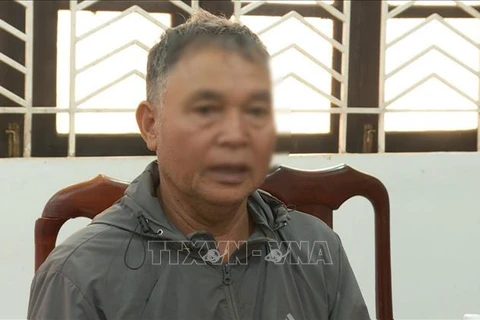
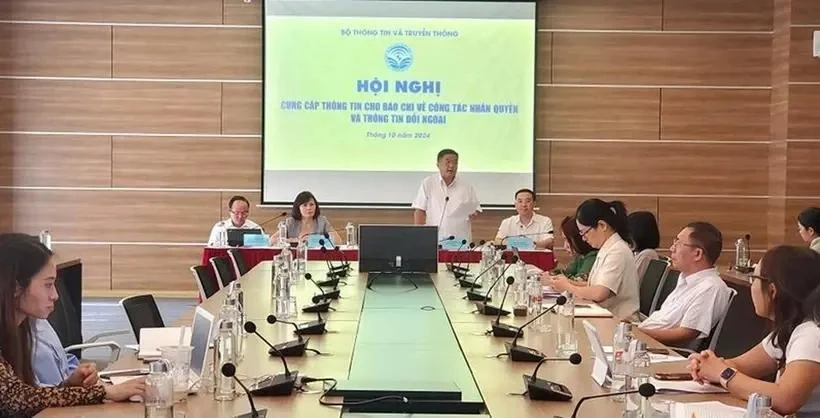
Major General Hau Van Ly, Deputy Director of the Domestic Security Department under the Ministry of Public Security addresses the press conference on October 24 (Photo: VNA)

Hanoi (VNA) – By using the good to suppress the bad, promoting construction as a prevention measure and using positive information to overwhelm the negative, Vietnam can foil activities aimed at dividing the great national solidarity bloc and inciting "secession" and "autonomy" in ethnic minority-inhabited areas that are being accelerated by hostile and reactionary forces, stated Major General Hau Van Ly, Deputy Director of the Domestic Security Department under the Ministry of Public Security.

Speaking at a press conference on October 24, Ly said that over the years, propaganda activities to harm the national solidarity and incite secession and autonomy have been carried out regularly and continuously by hostile and reactionary forces.

The common objectives of these activities are not only driving a wedge and stirring disunity among ethnic minority groups, and between ethnic minorities and the Government, but also causing confusion among part of the ethnic minority groups to inject new "evil cults" and religions to them, disrupting political and social life, and destabilising local security and order.

At the same time, the activities also aim to cause difficulties for the implementation of policies and orientations on socio-economic development, and security and defence in the areas, harming the effectiveness of state management measures of local authorities, said Ly.

The official underlined the need for authorised agencies and as well as local administrations to focus on popularising the socio-economic development achievements and positive changes in rural and ethnic minority-inhabited areas, along with policies and law regarding socio-economic development and ethnic minority affairs, ensuring that ethnic minority communities understand the great attention, priority, and favourable conditions that the Party and State have given to narrowing down development gap, promoting equality and national and religious solidarity, and reinforcing the communities’ confidence in the Party, State, and local administrations.

Ly also highlighted the need to honour outstanding models and good examples set by those from ethnic minority groups in the movement to protect the national security and socio-economic development.

At the same time, it is necessary to expose the nature, plots, methods, and tricks of reactionary individuals and organisations targeting ethnic minority groups, as well as evil and illegal organisations under the cover of religions in ethnic minority areas, preventing ethnic communities from being misled, deceived, or enticed to participate in these organisations, said Ly, stressing the need to refute the arguments that divide national unity and incite secession and autonomy by hostile and reactionary forces./.
VNA

See more

A view of Place Ho Chi Minh in Persan, France. (Photo: VNA)

Place preserving memories of President Ho Chi Minh in France

Although there is little publicly available documentation confirming exactly when Place Ho Chi Minh was established, French urban historians suggest that most streets and public spaces named after the Vietnamese leader in France emerged between the 1960s and 1980s, during the height of anti-war movements and solidarity campaigns supporting Vietnam across working-class towns and left-leaning suburbs around Paris.

Vietnamese Ambassador to Bangladesh Nguyen Manh Cuong speaks at the seminar. (Photo: VNA)

President Ho Chi Minh’s thought on national unity remains relevant today

President Ho Chi Minh's ideology of national unity continues to carry profound significance amid growing global challenges, including conflicts, social divisions and economic instability. His message of solidarity, consensus and placing national interests above sectional differences remains a valuable lesson for many developing nations.

Assoc. Prof. Dr. Nguyen Duc Son presents the decision establishing the Vietnamese Language Proficiency Test Council in Japan to a representative of the Vietnam Studies Centre in Japan. (Photo: VNA)

Japan hosts first standardised Vietnamese language proficiency test

As bilateral ties between Vietnam and Japan continue to expand, demand for Vietnamese language learning in Japan has also grown rapidly among OVs, educational institutions, businesses and Japanese people interested in Vietnam. Against this backdrop, the introduction of a standardised proficiency test is expected to provide an official and widely recognised benchmark for Vietnamese language skills.

The “I Love My Fatherland" Journey 2026 kicks off in Nghe An province on May 16. (Photo: VNA)

"I Love My Fatherland” journey features diverse activities

The “I Love My Fatherland” journey will span seven stages across historical and cultural sites and “red addresses” nationwide. There will be a combination of education on traditions, field-based programmes, and digital communications.

At the handover of 33 Chinese nationals who had violated Vietnamese law to Chinese authorities in Quang Ninh on May 15, 2026. (Photo: VNA)

Vietnam hands over 33 law violators to China

Investigations found that the individuals had violated Vietnamese laws relating to illegal entry and unlawful residence in Vietnam. The handover was conducted safely and in compliance with Vietnamese law and international practice.

At the talks between authorities of the northern province of Lang Son and Pingxiang city in the Guangxi Zhuang Autonomous Region of China (Photo: VNA)

Vietnam, China seek to build modern, smart border gates

Authorities of the northern province of Lang Son and Pingxiang city in the Guangxi Zhuang Autonomous Region of China held talks on May 15 at Tan Thanh (Vietnam) – Po Chai (China) clearance point near markers 1090–1091 in Hoang Van Thu commune of Lang Son to promote trade, develop smart border gates and expand cross-border tourism cooperation.