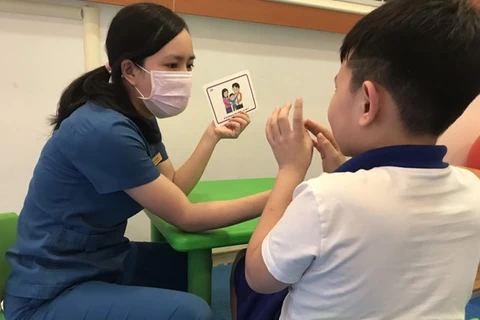
An autistic boy receives an intervention at the Speech Therapy Unit at the Medical General Clinic-Pham Ngoc Thach University of Medicine in HCM City.
 The multidisciplinary "interventions" from psychiatrists, neurologists, primary and special education specialists, speech therapists and his parents occurred at his home and at the Medical General Clinic - Pham Ngoc Thach University of Medicine.
Cao Phuong Anh at the clinic’s Speech Therapy Unit said the boy took part in the unit's Preschool and Speech Therapy classroom.
According to Hoang Van Quyen, a counsellor for the unit, three intervention models in the unit exist: one for early intervention for autistic children under five years old; another for nonverbal autistic children aged five to 10, and another for verbal autistic children aged five to 10 years.
“Autistic children face difficulties developing communication skills and other skills as well, so multidisciplinary intervention from psychiatrists, neurologists, paediatricians, ear, nose and throat doctors, nurses, primary and special education specialists, speech therapists and parents is very necessary,” he said.
The unit’s intervention models highlight the important role of autistic children’s parents.
“At the unit, parents watch psychiatrists, neurologists, primary and special education specialists, speech therapists and others, and are trained in these intervention ways. The experts explain intervention strategies for their children at each stage,” he said.
“They provide different strategies for each autistic child,” he added.
Anh said that many parents with autistic children wanted them to speak and integrate into society rapidly. But they should understand that intervention progress takes time and should be carried out in steps. Parents should be patient and follow guidance from specialists during the intervention.
“Autistic children need intervention in their pre-language skills to set up a base for communication and language and for social and emotional development. They also need an intervention to develop their playing skills and behaviour,” Anh said.
Quyen said the unit’s multidisciplinary intervention models would be expanded to other provinces and cities.
According to the General Statistics Office, the country had nearly 6.2 million people with disabilities aged more than 2 years, accounting for 6.5 percent of the population in 2019. Among these, nearly one million people have an autism spectrum disorder.
Compared to the past, many parents now have better awareness about these disorders and will bring their children to hospitals when they show signs related to the disorders.
Pham Thi Kim Tam, chairwoman of the Vietnam Autism Network, said: “However, many autistic children have to wait three to six months for an intervention because children’s hospitals do not have sufficient doctors and facilities.”
Moreover, interventions for autism spectrum disorders at hospitals are not covered by health insurance.
Many parents with financial resources can hire teachers to teach their children individually or in teams, or the children can study at special schools.
In the first year of life, most babies in Vietnam are taken to health centres in districts or hospitals for periodic health exams and vaccinations, but developmental milestones are not assessed.
Evaluation programmes for children’s developmental milestones at health facilities in the first year after birth would provide screening for autistic children and timely interventions if needed, according to Tam.
A woman from HCM City, who has a 17-year-old autistic child, said: “I think that the government should have a centre where autistic young people can be taken care of and raised. The part of the costs for this centre’s operation could be from the parents.”
The nearly 15-year intervention journey for her child had been very stressful, she said. "He now is studying at a rehabilitation centre for people with disabilities in the city.”
According to the US Centres for Disease Control and Prevention, autism spectrum disorder is a developmental disability caused by differences in the brain. Scientists do not know exactly what causes these differences for most people with ASD. However, some people with ASD have a known difference, such as a genetic condition. There are multiple causes of ASD, although most are not yet known./.
VNA