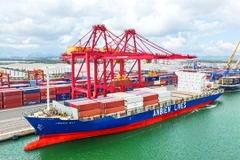
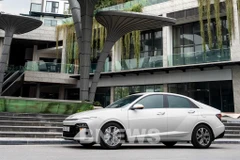
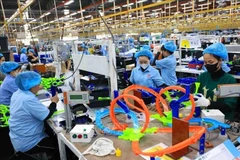
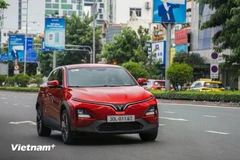
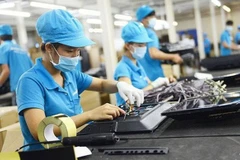
An auto assembly line at a plant of Truong Hai Auto Corporation (THACO) in central province of Quang Nam. (Photo quangnam.tintuc.vn)
 Hanoi (VNS/VNA) - Automobile producers are observing the complex changes ofthe second wave of the COVID-19 pandemic to adjust their businesses.
After the first half of the year facing sluggishness and stagnancy inproduction and business, domestic automobile manufacturers and assemblers werepleased the Government cut vehicle registration fees by 50 percent and ispreparing to extend the deadline for paying special consumption tax.
After the first half of the year facing sluggishness and stagnancy inproduction and business, domestic automobile manufacturers and assemblers werepleased the Government cut vehicle registration fees by 50 percent and ispreparing to extend the deadline for paying special consumption tax.
However, with the new COVID-19outbreak, automobile firms are expected to face new difficulties.
After the end of socialdistancing in April, most auto agents and businesses resumed operations.However, according to a survey conducted by the Ministry of Industry and Trade(MoIT), auto production and assembly capacity stayed at a very low level due tohigh inventory of up to 122.5 percent. The main reason was automobileconsumption is facing many difficulties due to the sharp decline in domesticpurchasing power.
Nguyen Trung Hieu, head of the Policy Department at the Vietnam AutomobileManufacturers Association (VAMA), told TienPhong (Vanguard) newspaper that COVID-19 had caused complicatedchanges, requiring auto producers to devise suitable plans.
Hieu said auto businesses in Da Nang and Quang Nam were affected first such asTruong Hai Auto Corporation (THACO) and Tan Chong Motor. THACO contributes upto 55 percent of State budget contributions for Quang Nam province. It was thereason the provincial People’s Committee said the province would not be able tocontribute to the State budget this year.
Ford Vietnam was one of the firms most affected by the first wave ofCOVID-19 in the auto industry. Its plant in northern Hai Duong province wasinvested 82 million USD for expansion at the beginning of this year and wasexpected to be complete in the middle of 2022. Due to the pandemic, since March27, production activities had to be halted for social distancing. Many foreignexperts have yet to come to Vietnam to work for the firm. After thepandemic subsided, the factory was back in operation in mid-July.
However, according to Ford's regulations in the US that apply globally,most office workers in Vietnam are working from home. The production,sales and service departments are still operating and must fully apply COVID-19prevention regulations, ensuring safety for everyone.
Talking about the decision to reduce registration fees by half, aFord representative said all the Government's support solutions are veryprecious to businesses. However, due to the global influence of the pandemic,the source of imported raw materials for production was interrupted whileshopping demand had dropped sharply due to cautious sentiment.
Previously, Ford Vietnam also planned to assemble the Escape model after fiveyears of absence from the market. However, the supply of raw materials has beendifficult to import. This model may not be released in time this year to takeadvantages of the registration incentives.
According to a representative of Honda Vietnam, the COVID-19 pandemic has madethe firm's business results in the financial year 2020 reduce by 8 percentfrom the same period last year.
However, due to the Government's support policies, on July 20, Honda Vietnam returnedto assembly and released the CR-V 2020 model after about three yearsimporting from Thailand for distribution.
Similarly, Mitsubishi Vietnam has returned to assemble at the factory in Binh Duongprovince and launched its best-selling model, the Xpander, after nearly twoyears of importing from Indonesia.
The moves showed auto firms have been expanding their production in the countrywhile offering different types of vehicles. Moreover, local assembly would helpcustomers save a lot of money from the policy of 50 percent reduction inregistration fees.
Le Dang Doanh, former director of the Central Institute for Economic Management(CIEM), forecast that with the complex changes of COVID-19, sectorsproducing unnecessary goods would face difficulties.
People would be cautious, leading to a decline in some items such as clothing,furniture, cars and electronic equipment. The real estate market wouldalso be affected, he said.
VAMA agreed, saying the automotive market would have negative growth of atleast 15 percent in 2020. If the pandemic continues, car production and salesin Vietnam may hit the lowest level in the past 10 years.
The MoIT proposed approving the Government’s resolution on solutions forthe development of the support industry soon. Regulations on specialconsumption tax for locally produced auto could be revised to provide preferentialtreatment for high localisation rate. Meanwhile, the value-added tax may berefunded soon to help businesses accumulate more capital.
Statistics from VAMA showed that in May, the auto market recorded an increaseof 62 percent in sales compared to April. In June, the total sales ofVAMA’s members reached 24,002 vehicles, up 26 percent compared to May. In Julywhen the Government's decision to slash registration fees in half started totake effect, auto sales improved slightly./.
After the end of socialdistancing in April, most auto agents and businesses resumed operations.However, according to a survey conducted by the Ministry of Industry and Trade(MoIT), auto production and assembly capacity stayed at a very low level due tohigh inventory of up to 122.5 percent. The main reason was automobileconsumption is facing many difficulties due to the sharp decline in domesticpurchasing power.
Nguyen Trung Hieu, head of the Policy Department at the Vietnam AutomobileManufacturers Association (VAMA), told TienPhong (Vanguard) newspaper that COVID-19 had caused complicatedchanges, requiring auto producers to devise suitable plans.
Hieu said auto businesses in Da Nang and Quang Nam were affected first such asTruong Hai Auto Corporation (THACO) and Tan Chong Motor. THACO contributes upto 55 percent of State budget contributions for Quang Nam province. It was thereason the provincial People’s Committee said the province would not be able tocontribute to the State budget this year.
Ford Vietnam was one of the firms most affected by the first wave ofCOVID-19 in the auto industry. Its plant in northern Hai Duong province wasinvested 82 million USD for expansion at the beginning of this year and wasexpected to be complete in the middle of 2022. Due to the pandemic, since March27, production activities had to be halted for social distancing. Many foreignexperts have yet to come to Vietnam to work for the firm. After thepandemic subsided, the factory was back in operation in mid-July.
However, according to Ford's regulations in the US that apply globally,most office workers in Vietnam are working from home. The production,sales and service departments are still operating and must fully apply COVID-19prevention regulations, ensuring safety for everyone.
Talking about the decision to reduce registration fees by half, aFord representative said all the Government's support solutions are veryprecious to businesses. However, due to the global influence of the pandemic,the source of imported raw materials for production was interrupted whileshopping demand had dropped sharply due to cautious sentiment.
Previously, Ford Vietnam also planned to assemble the Escape model after fiveyears of absence from the market. However, the supply of raw materials has beendifficult to import. This model may not be released in time this year to takeadvantages of the registration incentives.
According to a representative of Honda Vietnam, the COVID-19 pandemic has madethe firm's business results in the financial year 2020 reduce by 8 percentfrom the same period last year.
However, due to the Government's support policies, on July 20, Honda Vietnam returnedto assembly and released the CR-V 2020 model after about three yearsimporting from Thailand for distribution.
Similarly, Mitsubishi Vietnam has returned to assemble at the factory in Binh Duongprovince and launched its best-selling model, the Xpander, after nearly twoyears of importing from Indonesia.
The moves showed auto firms have been expanding their production in the countrywhile offering different types of vehicles. Moreover, local assembly would helpcustomers save a lot of money from the policy of 50 percent reduction inregistration fees.
Le Dang Doanh, former director of the Central Institute for Economic Management(CIEM), forecast that with the complex changes of COVID-19, sectorsproducing unnecessary goods would face difficulties.
People would be cautious, leading to a decline in some items such as clothing,furniture, cars and electronic equipment. The real estate market wouldalso be affected, he said.
VAMA agreed, saying the automotive market would have negative growth of atleast 15 percent in 2020. If the pandemic continues, car production and salesin Vietnam may hit the lowest level in the past 10 years.
The MoIT proposed approving the Government’s resolution on solutions forthe development of the support industry soon. Regulations on specialconsumption tax for locally produced auto could be revised to provide preferentialtreatment for high localisation rate. Meanwhile, the value-added tax may berefunded soon to help businesses accumulate more capital.
Statistics from VAMA showed that in May, the auto market recorded an increaseof 62 percent in sales compared to April. In June, the total sales ofVAMA’s members reached 24,002 vehicles, up 26 percent compared to May. In Julywhen the Government's decision to slash registration fees in half started totake effect, auto sales improved slightly./.
VNA