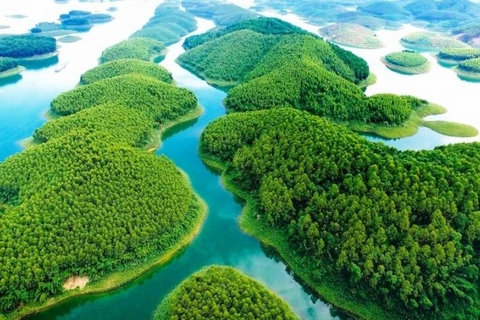
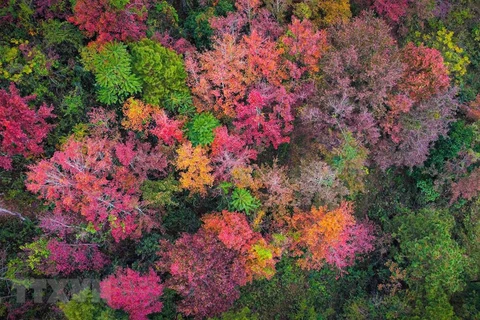
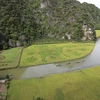
Ba Be Lake in the northeastern province of Bac Kan is an ideal eco-tourism destination with amazing landscapes and biodiversity (Photo: Vietnam travel)
 Hanoi (VNA) – As one of the 20 largest freshwater lakes in the world, Ba Be Lake in the northeastern province of Bac Kan is an ideal eco-tourism destination with amazing landscapes and biodiversity.
Lying at an altitude of more than 300 metres above sea level, it is considered a “green lung” in the vast Viet Bac forest and a complex of “river-lake-mountain”.
The park was established on November 10, 1992, under the Prime Minister’s Decision No.83/1992/QD-TTg. It is located 40 kilometres to the Ra market, spanning seven communes of Ba Be district.
It belongs to the ecosystem on limestone mountains formed in the late Cambrian period (over 200 million years ago).
 The lake has a surface area of about 500 hectares and a length of more than 8 kilometres (Photo: Dep.com.vn)
 Located in the heart of the Ba Be National Park, the lake has a surface area of about 500 hectares and a length of more than 8 kilometres. The widest area is nearly 2 kilometres and the deepest 35 metres.
It is called Ba Be because its bed is divided into three lakes: Pe Lam, Pe Lu and Pe Leng. Pe means lake in the language of the local ethnic group of Tay.
In March 1995, the World Lake Conference held in the US classified Ba Be Lake as one of the world's 20 special freshwater lakes that need investment and protection.
In 1996, the Ba Be National Park was recognised as a national historical and cultural relic site.
In 1997, the UNESCO Vietnam Committee proposed the United Nations Educational, Scientific and Cultural Organisation (UNESCO) recognise the park as a world natural heritage site.
 The Ba Be National Park is recognised as a national historical and cultural relic site (Photo: dep.com.vn)
 The total area of the park’s core area is 7,610 hectares, divided into four functional sub-areas: rocky mountain forest (3,226 hectares); habitat of rare animals, especially langurs; ecological restoration area (3,623 hectares); and specialised area ensuring activities of administrative management and scientific research (450 hectares). In addition, the park has 42,000 hectares of buffer zone.
The flora and fauna system in the Ba Be National Park is very rich and diverse in both numbers and types. According to recent scientific survey data, the Ba Be National Park is classified as type A in terms of biodiversity.
There are 1,268 species of plants belonging to 162 families and 673 genera; 450 vertebrates belonging to 99 families and 32 genera, including 81 species of animals, 234 species of birds, species of reptile amphibians, 50 species of fishes, 367 species of butterflies and other animals.
Many plant and animal species in the Ba Be National Park are particularly rare and valuable species recorded in the Vietnam Red Book. Particularly, there are 37 species in named in the Vietnam Red Book and 21 others in the Red Data Book of the International Union for Nature Conservation (IUCN) 2004.
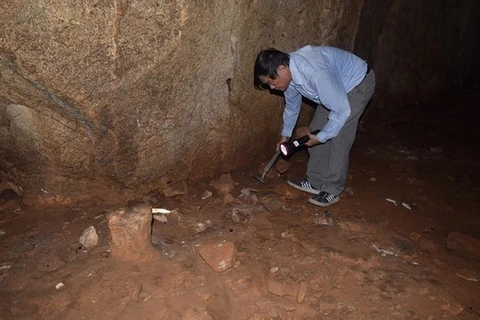
 Puong Cave (Source: dep.com.vn)
Many butterfly species in the park that have just been found for the first time in the Vietnamese butterfly fauna. Tonkin snub-nosed monkeys are classified as type A biodiversity by the IUCN.
The Ba Be National Park is not only rich in biodiversity but also well-known in Vietnam for unique natural scenes such as Na Phoong, Ao Tien, Puong and Tien caves, and Dau Dang waterfall.
In addition, this place is also known as a historical site from the time of national building and defence. In the 16th century, a general of the Mac dynasty used Puong cave as a base of resistance against the North’s feudal invaders.
 (Photo: dep.com.vn)
It could be said that the Ba Be National Park is an important natural region in the system of 25 national parks in Vietnam.
In the near future, Bac Kan province will make proper investment and planning to help the Ba Be ASEAN Heritage Garden be recognised by UNESCO as a world natural heritage site. Local authorities will pay due attention to the resettlement of locals living in the core area of the park./.