At Yamato Industries Vietnam Co., Ltd in Bac Binh (Source: VNA)
 Hanoi (VNA) - Enterprises in industrial parks (IPs) of the northern province of Bac Ninh aim to generate 1.2 quadrillion VND in industrial production value in 2020.
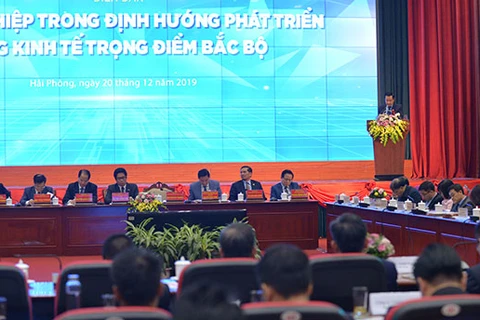
According to reports presented at a recent conference to review the operation of local IPs in 2019 and propose orientations for 2020, production and business activities of enterprises in Bac Ninh’s industrial parks maintained stability.
They exported 37.3 billion USD worth of products, and contributed 11.5 trillion VND (496.7 million USD) to the State budget, up 13 percent and 2 percent year-on-year, respectively.
Total newly registered and additional investment capital to projects in industrial parks hit 1.39 billion USD.
During the year, the IP management board has accelerated administrative reform and IT application, thus facilitating operation of investors and enterprises.
In 2020, Bac Ninh’s industrial parks aim to attract between 90-95 projects with total capital of about 1.1 billion USD.
IP-based enterprises are hoped to generate an export value of 36 billion USD, contribute 13 trillion VND (561.4 million USD) to the State budget, and create jobs for 4,000-5,000 labourers.
Vice Chairman of the provincial People’s Committee Nguyen Tien Nhuong praised the IP management board for its achievements in 2019, which he said have significantly contributed to the locality’s socio-economic development.
He asked the board to make stronger efforts in promoting administrative reform and improving the investment environment, thus making it easier for enterprises in IPs to expand their operation.
At the meeting, participants stressed the need to develop modern IPs to attract large-scale and hi-tech enterprises.
Industrial parks in Bac Ninh have played crucial role in the locality’s economic growth, contributing to promoting the economic structure transform, while improving the province’s capacity in production and technology transfer, enhancing production efficiency and engaging deeper into the global production chain.
Established on August 25, 1998 under the Prime Minister’s Decision 152, the IP management board of Bac Ninh has overcome various difficulties to complete all assigned tasks.
Particularly, strong performance in investment management and industrial park planning has helped Bac Ninh strongly thrive from a poor locality to one of the richest localities and a socio-economic development model with increasing role in the national economy.
Since 2000 when Bac Ninh launched its first industrial park of Tien Son, the province now has 16 concentrated industrial parks covering nearly 6,400 hectares.
Ten of them have been operational. The occupancy ratio of the parks has reached 88 percent of cleared land, much higher than the national average ratio.
The IPs attracted investment from 32 countries and territories.
Bac Ninh has been considered as a magnet for foreign direct investment (FDI) attraction with the rising pull of investment in recent years.
FDI has made significant contributions to the socio-economic development of the locality, helping to increase its gross regional domestic product (GRDP) of the locality.
The province is always one of the six leading localities nationwide in terms of FDI attraction. This is an important foundation for the province to continue to bolster socio-economic growth, heading towards becoming a centrally-run city in 2022.
Bac Ninh has always paid great attention to luring multi-sectoral and multi-national economic groups, according to the province’s leaders, who said that the presence of these groups has helped to form specualised industrial parks and clusters for the support industry. After several years of operation, some investors have decided to increase investment and expand production.
For the time to come, the province will focus its efforts on attracting investment to qualitative projects which can save resources and energy, use high technology, be environment friendly and yield high income.-VNA
VNA