Bau Truc – Perfect place for tourists to explore quintessence of Cham pottery

Bau Truc pottery village in the south central province of Ninh Thuan is viewed as a perfect destination for visitors to explore the quintessence of Cham pottery making and their unique culture.
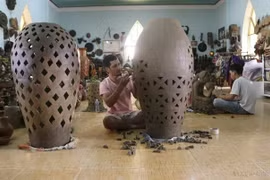
Bau Truc – Perfect place for tourists to explore quintessence of Cham pottery ảnh 1A Bau Truc potter turns clay into unique pottery items. (Photo: VNA)

Ninh Thuan (VNA) - Bau Truc pottery village in the south central province of Ninh Thuan is viewed as a perfect destination for visitors to explore the quintessence of Cham pottery making and their unique culture.

Bau Truc is one of the oldest pottery villages in Southeast Asia. Over 90 percent of some 500 families in Bau Truc village are making pottery. For the Cham ethnic minority people, ceramics are not only used as daily utensils, but more importantly, they are an intermedia for them to connect with gods.

Local potters believe that their craft was founded more than a thousand years ago by Poklong Chanh, a man who refused to become a mandarin in order to stay at his village teaching housewives how to take clay and shape and fire it into utensils and decorative items.

To show their gratitude toward the forefather of their craft, Bau Truc villagers built a temple dedicated to Poklong Chanh and pray for him during Kate, the Cham’s biggest festival held annually in the seventh lunar month.

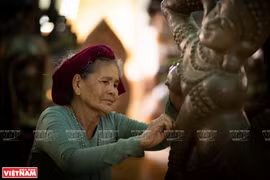
Truong Thi Gach, an 80-year-old potter who has been making ceramics her entire life, said her mother learnt the craft from her grandmother and then passed it down to Gach when she was 10. Gach is now teaching the craft to her children. In Bau Truc, only women make pottery while the men help in the firing process by collecting firewood and straw.

According to Gach, Bau Truc pottery is distinctive from any other type in the world because it is handmade at all stages. While other pottery is made from a rotating wheel, Bau Truc is not. Bau Truc potters use their feet to move around the clay mixture while using their hands to shape the pottery. Every single pottery item in Bau Truc is made by hand without using any molds.

The pottery making process involves many stages. Gach said that the first and most important of which is selecting the clay which is the secret behind the uniqueness of Bau Truc pottery.

She said the clay used to make Bau Truc pottery must be taken from the soil near the village river. The clay is then dried, and soaked in water to become soft. After that, it is mixed with sand and water, and then kneaded until it turns into a flexible and smooth mixture. That is when it can be used for shaping.

Bau Truc pottery is also fired in a different way. The firing process, which only uses wood and straw, takes from five to eight hours depending on the size of the product.

According to Cham tradition, a potter must choose a good date for firing the pottery and before starting the firing process, he must conduct an offering ritual dedicated to the gods and forefathers of the craft, praying for their support for turning out beautiful items.

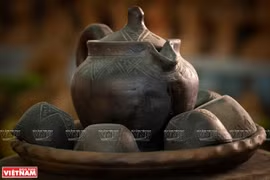
Bau Truc products characterize the life, culture and beliefs of locals. They range from simple home utensils such as a jar, pot, pan or kettle, to objects of worship, statues, reliefs and decorative patterns. The patterns on Bau Truc pottery ware mostly portray natural scenery and show the Cham’s beliefs.

Today, old Bau Truc village is a popular cultural and tourist attraction in Ninh Thuan. In 2008, the village set up its pottery cooperative which has become a place to showcase the art of Bau Truc pottery making. Visitors to the cooperative can select beautiful pottery items from thousands of products on display while at the same time, exploring how they are made.

For researchers, the Cham and their original cultural heritages remain mysterious and their pottery making is an example./.
VNA

See more

Local residents and tourists pose for photos at the Golden Bridge in Da Nang, adorned with national flags, during the National Day holiday on September 2. (Photo published by VNA)

Lonely Planet names Da Nang top holiday destination

According to the magazine, Da Nang offers an appealing combination of mountains, long stretches of beaches, fresh seafood and a relaxed pace of life. The city is considered an ideal choice for travellers seeking seaside relaxation while exploring the cultural and historical heritage of central Vietnam.

The winding beauty of Tham Ma Pass in Ha Giang. (Photo: VNA)

Vietnam’s best road trips as selected by Lonely Planet

With more than 61 million motorbikes on Vietnam's roads, intrepid bikers will find themselves in good company as they explore the country’s wonderfully diverse landscapes, with ample repair shops, gas stations and food stops along the way.

Turtle Tower in the heart of Hanoi. (Photo: VNA)

Hanoi aims to become one of Vietnam’s leading tourism hubs

Hanoi targets welcoming and serving between 47 million and 50.5 million tourist arrivals by 2030, including 13-15 million international visitors and 34-35.5 million domestic travellers. Tourism revenue is expected to reach 295-340 trillion VND (11.43 billion-13.17 billion USD), with the sector’s overall contribution accounting for around 7.5-8% of the city’s gross regional domestic product (GRDP).

The captivating beauty of Sa Pa during the rice harvest season. (Photo: VNA)

Vietnam ranks fourth among top autumn travel destinations for 2026

Lonely Planet highlights Hanoi as an appealing autumn destination, with cool weather making it a pleasure to explore its winding, invigorating streets. Dreamy Ha Long Bay is at its clearest and the warm waters are perfect for a dip, while Sa Pa and Tuyen Quang, including the former Ha Giang area, welcome visitors with golden terraced rice fields during the harvest season.

In mid-October, coastal destinations across Lam Dong begin welcoming winter tourists (Photo: VNA)

Lam Dong enhances appeal to long-stay international tourists

Local authorities are upgrading tourism infrastructure and services. Coastal destinations, including Hoa Thang, Phan Thiet, Tien Thanh and La Gi, are promoting local attractions and improving service quality to welcome international visitors.

Healing tourism destinations are often places that offer visitors a pure connection with nature. (Photo: VNA)

Lao Cai seeks breakthroughs with wellness tourism ecosystem

With its cool climate, mountain scenery and rich cultural and natural resources, the northern mountainous province of Lao Cai aims to turn its advantages into a high-quality tourism brand through smart resort services and health care experiences.

Located on Apollo Square in the heart of Sunset Town, Phu Quoc, Apollo Cafe is a distinctive venue designed by renowned architect Bill Bensley.

Coffee beneath an “upside-down” town: A surreal stop in Phu Quoc

With an entire town recreated on its ceiling, sweeping sunset views and a vantage point for watching fireworks after dark, Apollo Cafe in Phu Quoc offers more than a photogenic backdrop. Designed by Bill Bensley, the venue shows how a café can become an experience travellers deliberately build into their itinerary.

Phong Nha-Ke Bang National Park receives two honours at the World Travel Awards 2026 ceremony. (Photo: VNA)

Phong Nha-Ke Bang wins two World Travel Awards 2026 honours

Phong Nha-Ke Bang National Park was named Asia's Leading National Park 2026 and Vietnam's Leading Nature Destination 2026. The awards reaffirm the destination's international appeal, underpinned by its distinctive karst landscapes, spectacular cave and underground river systems, and rich biodiversity.

Visitors travel by boat to admire the cajuput forest landscape during the flood season at the Tram Chim tourism site in Dong Thap province. (Photo: VNA)

Dong Thap parlays flood season into tourism opportunity

At the Tram Chim tourism site, part of Tram Chim National Park in Tram Chim commune, visitors can try fishing with nets and hooks, setting traps and dismantling brush piles to catch field rats from August to November, the peak flood season.