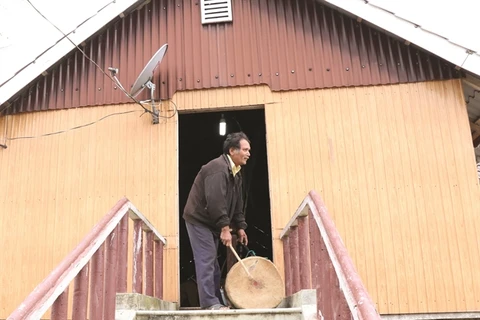
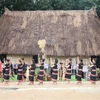
The house of a traditional drum craftsman in Doi Tam Village. (Photo: VNA)
 They are often used to offer a warm welcome to guests, signal when school begins or ends, and accompany musical performances at weddings, longevity celebrations, and funerals.
Depending on the event, drums could either create an atmosphere of joyful union or sad separation.
When festival drumbeats fill the air, farmers put on their best clothes and head out to celebrate. Drums have become a key part of many community activities held throughout the length and breadth of the country.
Though drums are readily found in traditional Vietnamese culture, those with the best quality are only made in a few areas, among which is ancient Doi Tam village in the northern province of Ha Nam.
Located at the foot of scenic Doi Mountain in Duy Tien district, the village is renowned not only for making drums for more than a thousand years but also for creating the largest 'thunder' drums in the country, with two of the biggest played at festivals celebrating the 1,000th anniversary of Thang Long – Hanoi capital in 2010.
Doi Tam is a long-standing traditional craft village that complements the typical features of northern Vietnamese culture via its drums.
All villagers, from old to young, know the legend of their ancestors - the two brothers Nguyen Duc Nang and Nguyen Duc Ban.
The legend says that when the two heard about Emperor Le Dai Hanh’s return to their village to hold a royal ploughing ceremony to promote agriculture, they immediately chopped down the biggest jackfruit tree in their garden and killed the biggest buffalo to get wood and leather to make a huge drum in welcome.
Thus, in the spring of the 7th year of Emperor Le Dai Hanh’s reign (987), an unforgettable ploughing ceremony was held in Doi Tam to the unique drum sounds from Nguyen brothers.
The resounding beat of their drum saw the two honoured as “Trang Sam” (Thunder Masters), in recognition of their skills in making the best large drums.
Throughout history, drum making has always played an important role in communal life in Doi Tam.
Its drums are special as they are used for a host of different purposes, such as worshipping, folk art performances, and transmitting information.
The village’s 700 households include 600 that are skilled in drum-making, with four recognised as master artisans.
Making a good drum requires great care and expertise in selecting and assembling materials. Precision is key in creating the right sound for each, and the task often involves secrets handed down through the generations.
Le Ngoc Hung, one of the artisans and also the owner of a major drum production workshop in Doi Tam, said his facility had produced tens of thousands of drums of all kinds for both local sale and export.
He emphasised the importance of selecting the best materials.
“The wood for the body of the drum must come from an old jackfruit tree with a curvature that matches the requirements of each type of drum,” he explained. “The buffalo skin used for the drumhead must be scraped clean and then stretched and dried, so it is tough and will not rot as time goes by.”
Beyond materials, he said, a superior-quality drum very much depends on the skill of the artisan, as different drums produce different sounds.
Hung is also focusing on training the younger generation in the village, to preserve the traditional craft.
The most important thing about drum making, he believes, is not the craftsmen’s reputation but their heart and soul.
Craftsmen not only need to be enthusiastic and creative and possess a sense of exploration, but also be keenly aware of the need to preserve the village craft by motivating the generation that follows.
Meanwhile, artisan Pham Chi Khang, chairman of the village’s Association of Doi Tam Drum Making and Trading, said that assembling the drum barrel is the most important stage.
“The biggest drum I ever made was a royal drum 3.1 metres high and 2.35 metres in diameter,” he recalled. “The largest drum in Southeast Asia was made by Doi Tam villagers. The larger the drum, the more precision required and the more time needed.”
If there is ever a flood, fire, or death in the village, a drum is used as a call to arms or to announce a period of mourning.
During Vietnam’s resistance wars against foreign invaders, the sound of a drum roused soldiers into action around the countryside.
A drum is also used as a mark of respect during cheo (traditional opera) or ca tru (ceremonial singing) performances, with a connoisseur hitting the side of the drum with a drumstick at appropriate moments to express his appreciation.
Tran Dinh Tien, head of the Culture and Information Section in Duy Tien district, said that, in the past, drums were also used in combat against foreign invaders.
“Drumming attracts people to participate in community activities,” he said. “The drum is an indispensable part of festivals because it rouses the spirits of the ancestors.”
Doi Tam produces many types of drums, ranging from those for cheo singing to those for festivals or schools, in sizes ranging from 20cm to 2m in diameter. Village craftsmen made the largest drum in the country, which is now at the Temple of Literature in Hanoi and is more than 2m in diameter, 2.65m in height, and 10 cubic metres in volume.
According to artisan Khang, the village produces about 25 different types of drums. Those for rituals or sacrifice rites are called spiritual or worship drums, and those used at community festivals are called festival drums, while those used at pagodas differ from those used in temples or communal houses.
“For example, a drum used in a communal house should be big,” he explained. “Its sound represents the tutelary god who rules the village. The drum in a temple, meanwhile, should be of medium size. And a pagoda drum can be small.”
A drum is made in three stages: leather tanning, barrel making, and drumhead stretching. Craftsmen use buffalo skin for the drumhead. They first shave the buffalo skin until it becomes quite thin, and then dry it in the sun. The barrel is made from jackfruit wood. Stretching the drumhead is the most difficult task, because it requires skill on the artisan’s part to assess the sound being created.
According to Khang, drum makers choose a certain pattern to suit each type of drum.
“The pattern will also depend on the drum’s purpose,” he said. “For example, clouds are often drawn on festival drums. For pagoda, temple, or communal house drums, common patterns include dragon-shaped clouds. Temple drums may also have phoenixes. The patterns on drums used in art troupes will have brocade designs or something similar to the motifs of bronze drums. Drums for cultural events, meanwhile, are decorated with cranes. The drumheads for festival drums must also, of course, have light rays breaking through to symbolise the world.”
The village has also formed a drumming team with dozens of members that perform at festivals nationwide.
In the decade since its establishment, the team has become widely known for its jubilant sound, which at times resembles troops setting off for battle.
There are 62 companies involved in drum production and trade in Doi Tam, which help improve local living standards.
Thanks to the traditional occupation, no one in the village is unemployed and local living standards have indeed been rising in recent years.
“In 2007, Doi Tam was one of the first 12 handicraft villages granted the title ‘Outstanding Craft Village of Vietnam’ by the Vietnam Craft Village Association,” Khang said.
“Other villages also make drums but they can’t match the characteristics of ours. Many unsuccessfully try to imitate our style.”/.
VNA