Binh Phuoc province develops OCOP products

Implementing the One Commune One Product (OCOP) Programme, many localities in the southern province of Binh Phuoc have effectively tapped into the potential and advantages of regional agricultural specialties to promote commodity production and unlock its rural potential.

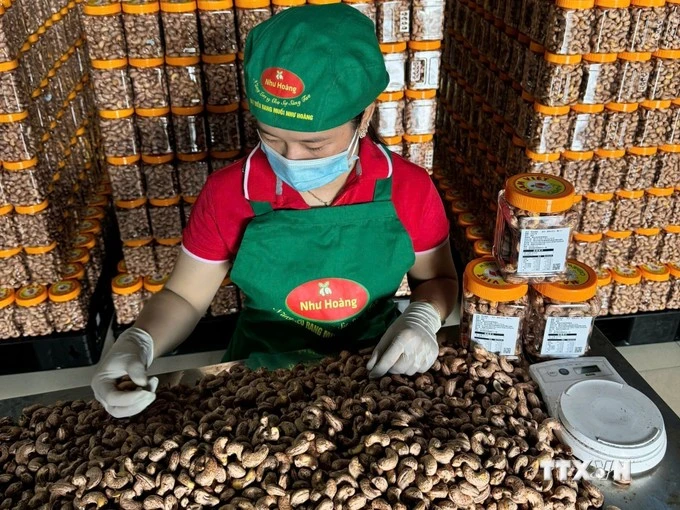
A worker packs salted roasted cashew products at an establishment in Tho Son commune, Bu Dang district, Binh Phuoc province. (Photo: VNA)

Binh Phuoc (VNA) – Implementing the One Commune One Product (OCOP) Programme, many localities in the southern province of Binh Phuoc have effectively tapped into the potential and advantages of regional agricultural specialties to promote commodity production and unlock its rural potential.

Nguyen Hoang Dat, of Phuoc Binh ward in Phuoc Long town, has successfully developed six processed products from locally grown cashews. In 2021, five of his products were certified 4-star OCOP products.

He said that Binh Phuoc is considered the capital of cashew in Vietnam thanks to favourable natural conditions and this advantage paves the way for the district to develop premium cashew brand.

In Bu Dang district, which boasts the largest area of cashew cultivation in the province, residents have shifted from growing rice and crops to cultivating high-value industrial plants and fruit trees.

Currently, the district has five OCOP-certified products, with three rated 4 stars and two rated 3 stars.Truong Van Thanh, a producer of salted roasted cashews from Tho Son commune, has held a 4-star OCOP certification for three years.

He noted that his product is sourced from locally grown nuts, purchased from members of the Nhu Hoang Agricultural Service Cooperative.

Head of the Bu Dang district’s Agriculture and Rural Development Department Nguyen Huy Long said that the district has recently collaborated with the provincial Department of Agriculture and Rural Development and relevant units to facilitate businesses, cooperatives, and household production facilities in bringing their products to OCOP sales centres and fairs.

Notably, businesses have actively participated in distributing OCOP products through agents in and out the province.In Bu Dang district, cashew cultivation occupies a significant area.

Leveraging this advantage, Bu Dang district has focused on selecting and supporting the development of OCOP products in its communes. The district aims to establish models for developing raw material areas linked with OCOP products along with agricultural and rural experiential tourism services.

dieu.PNG
Cashew products produced by an establishment in Tho Son commune, Bu Dang district. (Photo: VNA)

The relevant sectors at both the provincial and district levels are supporting and encouraging stakeholders to invest in innovation and apply scientific and technological advancements in production, processing, preservation, and packaging.

Additionally, they will also pay more attention to designing and packaging to better meet market demands.

According to Director of the provincial Department of Agriculture and Rural Development Pham Thuy Luan, the province encourages businesses, farms, cooperatives, and household businesses to implement digital transformation in agriculture, especially in the digitization of agricultural products and OCOP products towards forming a national database for the OCOP programme.

The province provides training to help OCOP entities acquire sales skills on e-commerce platforms and connect producers with distribution systems and consumers through e-commerce channels and social media.

Deputy Chairman of the Bu Dang district People's Committee Tran Van Phuong said that the district will continue enhancing communication efforts and raising awareness regularly through mass media to get more products to be certified as OCOP products.

In addition, the district will work to strengthen cooperation and production links between producers, cooperatives, and businesses, associated with the establishment and development of cashew processing factories to ensure a stable supply of high-quality raw materials, while also developing the intercropping of specialty crops in cashew plantations.

The district strives to develop the brand “Binh Phuoc Cashew” with a focus on specialty products with multiple values and diverse products.

As of now, Binh Phuoc has 136 products certified as OCOP products including three 5-star products, 55 4-star products, and 78 3-star products.

The province’s OCOP products include cashew nuts, black pepper, honey, turmeric powder, and dried jackfruit./.


VNA

See more

Downtown area in Ho Chi Minh City. (Photo: VNA)

Vietnam's golden gateway: FDI poised for gains in 2026

More than just volume, the quality of FDI entering Vietnam has improved. The nation is evolving from a base for basic assembly and processing into a genuine contributor to hi-tech manufacturing and R&D across global value chains.

Deputy Minister of Finance Do Thanh Trung speaks at the ceremony (Photo: VNA)

Project to advance growth, innovation, leadership for enterprises kicks off

AGILE is not only a testament to the long-standing and trusted strategic partnership between Vietnam and Canada, but also an important contribution to the Vietnamese Government’s efforts to promote innovation and sustainable growth within the private sector, thereby effectively mobilising private investment to realise inclusive and sustainable development goal.

At Regza Vietnam Electronics Co., Ltd. in Dong Nai province. (Photo: VNA)

FDI disbursement in January hits five-year high

Economists said that the continued growth in realised FDI reflects foreign investors’ sustained implementation and expansion of production and business activities in Vietnam. This is seen as an encouraging signal, underscoring investors’ confidence in Vietnam’s business environment and economic prospects.

In Q1 2026, Vietnam records 16 export commodities with turnover exceeding 1 billion USD. (Photo: VNA)

Exports face stiff test in bid to hit 550 billion USD

To achieve export growth of over 15% as directed by the Government, the MoIT said it will prioritise a set of core measures in 2026, including expanding production capacity, developing new export products, increasing domestic content and value added, accelerating the shift from processing to manufacturing, and proactively addressing trade barriers and defence measures.

Illustrative photo (Photo: VNA)

January CPI rises on stronger Tet holiday demand

CPI in January 2026 rose 0.05% month-on-month, with urban areas up 0.02% and rural areas up 0.09%. Of the 11 major commodity and service groups, nine recorded price hikes while two saw declines.

Vietnam is currently Cambodia’s third-largest trading partner worldwide, after China and the US, and its largest trading partner within ASEAN. (Photo: Ministry of Industry and Trade)

Party chief’s Cambodia visit to open up new phase of deeper, closer cooperation

To further unlock the potential of bilateral economic and trade cooperation, Vietnam and Cambodia should continue reviewing and effectively implementing signed agreements, facilitating trade and border connectivity, strengthening trade promotion in complementary sectors, reforming administrative procedures, upgrading border and logistics infrastructure, and enhancing coordination in combating smuggling and trade fraud.

Investors monitor stock market movements at the HoSE trading floor. (Photo: VNA)

VNX, FTSE Russell discuss Vietnam market upgrade

During the working session, the two sides shared updates on the performance of Vietnam’s stock market in 2025, focusing on market capitalisation, index trends, developments in the equities, bond and derivatives segments, and the continued expansion of the investor base.

Vietnamese products continue to gain traction at traditional markets and supermarkets across Ho Chi Minh City (Photo: VNA)

Vietnamese goods dominate Tet market in Ho Chi Minh City

Despite still-muted purchasing power, Vietnamese products continue to gain traction at traditional markets and supermarkets across Ho Chi Minh City, as consumers increasingly prioritise locally made goods, from fresh food and fast-moving consumer items to processed products, for their stable quality, reasonable prices and transparent origins.