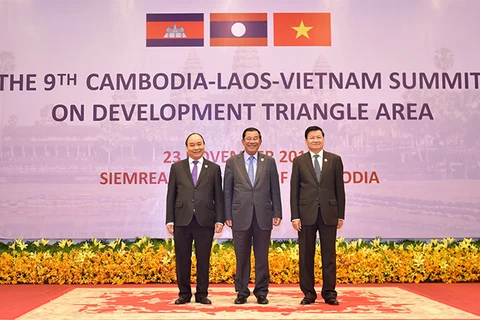
From left: Lao Prime Minister Thongloun Sisoulith, Cambodian Prime Minister Hun Sen, Vietnamese Prime Minister Nguyen Xuan Phuc, and Chinese State Councillor Wang Yi at the plenary session of GMS-6 on March 31 (Photo: VNA)
 Hanoi (VNA) – After three effective working days in Hanoi from March 29-31, the sixth Greater Mekong Subregion Summit (GMS-6) and the 10th Cambodia-Laos-Vietnam Summit on Development Triangle Area (CLV-10) wrapped up successfully, demonstrating the aspiration and determination of the GMS countries in building a Mekong subregion of peace, prosperity, and sustainable development for people.
Attending the events were representatives from the governments and localities of the GMS member nations, development partners, experts and businesses inside and outside the subregion.
Promoting “3C” Strategy in GMS
In his opening speech at the GMS-6, Prime Minister Nguyen Xuan Phuc of host Vietnam said that after a quarter of a century, the GMS cooperation has ceaselessly developed in both depth and width, affirming its own identity as a prestigious regional cooperation mechanism with a “3C” Strategy of Connectivity, Community and Competitiveness.
Hundreds of projects with a total capital of over 21 billion USD have been implemented in various fields from transport, energy and telecommunication to trade, agriculture and environment.
The GMS has become a dynamic and integrated region gathering the fastest growing economies in the world.
To promote the strong engagement of development partners, especially the private sector, in the GMS cooperation programme, Vietnam initiated the organization of the first-ever GMS Business Summit as part of the GMS-6 to strengthen dialogues between the State and businesses as well as connect GMS enterprises with global partners.
This initiative received high consensus from other GMS member nations and warm support from development partners including the Asian Development Bank (ADB), the World Bank (WB) and the Association of Southeast Asian Nations (ASEAN).
The GMS Business Summit attracted over 2,000 entrepreneurs at home and abroad, which showed their excitement to do business in the GMS countries and their trust in the governments’ open policies and tremendous cooperation opportunities in the GMS and CLV regions.
Furthermore, Asia has been emerging as a driving force for the global economic growth in the 21st century.
At the GMS-6, leaders of the subregion agreed to set major cooperation orientations in the middle term and activate the building of a long-term cooperation vision in the GMS.
The subregion’s leaders adopted three important documents including the Joint Statement of the sixth GMS Summit affirming the countries’ political commitment and determination to increase the role of the cooperation mechanism; the Hanoi Action Plan for 2018-2022 defining major collaboration orientations and measures in key fields in the coming time; and the Regional Investment Framework 2022 providing a list of more than 220 projects worth about 66 billion USD.
They also look to build a post-2022 cooperation vision in the long run and realise the Sustainable Development Goals of the UN 2030 Agenda given significant changes in the region and the world. The GMS cooperation programme needs to define a long-term vision to build a prosperous and integrated subregion and ensure sustainable, harmonious and balanced development as well as promote inclusive growth in the region. It must also ensure that all people enjoy benefits from the globalisation and the fourth Industrial Revolution.
The GMS was established in 1992 as an initiative of the Asian Development Bank (ADB). The GMS Programme is the most complete cooperation programme that involves Vietnam, Laos, Cambodia, Thailand, Myanmar, and China’s Yunnan and Guangxi provinces. It aims to facilitate and promote win-win economic cooperation among the GMS countries.
Vietnam has actively taken part in developing initiatives for enhanced cooperation in the GMS to boost economic growth, strengthen economic connectivity and aid poverty reduction efforts in the region.
Vietnam signed the GMS Cross-Border Transport Facilitation Agreement (CBTA) in 1999 and has ratified all CBTA’s annexes, enabling the reduction of amount of time spent in crossing border for vehicles, goods and passengers and facilitating trade. Since 2012, Vietnam and China have facilitated each other’s vehicles crossing shared borders on the Kunming – Hanoi – Hai Phong and Hanoi – Nanning – Shenzhen routes.
The same year, Vietnam, Thailand and Laos signed a Memorandum of Understanding to expand roads connecting the capital cities of the three countries with two large sea ports – Laem Chabang (Thailand) and Hai Phong (Vietnam) on the East-West Economic Corridor (EWEC).
In terms of energy, Vietnam has taken part in the Regional Indicative Master Plan on Power Interconnection in the GMS, paving the way for the country to bolster electricity trading and push for the establishment of institutions to ensure power security within the region. By attending meetings of the GMS Regional Power Trade Coordination, Vietnam has got updates on the GMS countries’ markets and energy-related plans and greatly benefited from ADB’s technical support.
The country has played an active role in the GMS’s trade and investment promotion events and enhancing regional partnership in agriculture, tourism, and telecommunications. It has also contributed to the subregion’s effort in controlling cross-border infectious diseases, such as SARS, bird flu, HIV/AIDS, malaria, and tuberculosis which are priorities of the regional cooperation in health care.
Attending the events were representatives from the governments and localities of the GMS member nations, development partners, experts and businesses inside and outside the subregion.
Promoting “3C” Strategy in GMS
In his opening speech at the GMS-6, Prime Minister Nguyen Xuan Phuc of host Vietnam said that after a quarter of a century, the GMS cooperation has ceaselessly developed in both depth and width, affirming its own identity as a prestigious regional cooperation mechanism with a “3C” Strategy of Connectivity, Community and Competitiveness.
Hundreds of projects with a total capital of over 21 billion USD have been implemented in various fields from transport, energy and telecommunication to trade, agriculture and environment.
The GMS has become a dynamic and integrated region gathering the fastest growing economies in the world.
To promote the strong engagement of development partners, especially the private sector, in the GMS cooperation programme, Vietnam initiated the organization of the first-ever GMS Business Summit as part of the GMS-6 to strengthen dialogues between the State and businesses as well as connect GMS enterprises with global partners.
This initiative received high consensus from other GMS member nations and warm support from development partners including the Asian Development Bank (ADB), the World Bank (WB) and the Association of Southeast Asian Nations (ASEAN).
The GMS Business Summit attracted over 2,000 entrepreneurs at home and abroad, which showed their excitement to do business in the GMS countries and their trust in the governments’ open policies and tremendous cooperation opportunities in the GMS and CLV regions.
Furthermore, Asia has been emerging as a driving force for the global economic growth in the 21st century.
At the GMS-6, leaders of the subregion agreed to set major cooperation orientations in the middle term and activate the building of a long-term cooperation vision in the GMS.
The subregion’s leaders adopted three important documents including the Joint Statement of the sixth GMS Summit affirming the countries’ political commitment and determination to increase the role of the cooperation mechanism; the Hanoi Action Plan for 2018-2022 defining major collaboration orientations and measures in key fields in the coming time; and the Regional Investment Framework 2022 providing a list of more than 220 projects worth about 66 billion USD.
They also look to build a post-2022 cooperation vision in the long run and realise the Sustainable Development Goals of the UN 2030 Agenda given significant changes in the region and the world. The GMS cooperation programme needs to define a long-term vision to build a prosperous and integrated subregion and ensure sustainable, harmonious and balanced development as well as promote inclusive growth in the region. It must also ensure that all people enjoy benefits from the globalisation and the fourth Industrial Revolution.
The GMS was established in 1992 as an initiative of the Asian Development Bank (ADB). The GMS Programme is the most complete cooperation programme that involves Vietnam, Laos, Cambodia, Thailand, Myanmar, and China’s Yunnan and Guangxi provinces. It aims to facilitate and promote win-win economic cooperation among the GMS countries.
Vietnam has actively taken part in developing initiatives for enhanced cooperation in the GMS to boost economic growth, strengthen economic connectivity and aid poverty reduction efforts in the region.
Vietnam signed the GMS Cross-Border Transport Facilitation Agreement (CBTA) in 1999 and has ratified all CBTA’s annexes, enabling the reduction of amount of time spent in crossing border for vehicles, goods and passengers and facilitating trade. Since 2012, Vietnam and China have facilitated each other’s vehicles crossing shared borders on the Kunming – Hanoi – Hai Phong and Hanoi – Nanning – Shenzhen routes.
The same year, Vietnam, Thailand and Laos signed a Memorandum of Understanding to expand roads connecting the capital cities of the three countries with two large sea ports – Laem Chabang (Thailand) and Hai Phong (Vietnam) on the East-West Economic Corridor (EWEC).
In terms of energy, Vietnam has taken part in the Regional Indicative Master Plan on Power Interconnection in the GMS, paving the way for the country to bolster electricity trading and push for the establishment of institutions to ensure power security within the region. By attending meetings of the GMS Regional Power Trade Coordination, Vietnam has got updates on the GMS countries’ markets and energy-related plans and greatly benefited from ADB’s technical support.
The country has played an active role in the GMS’s trade and investment promotion events and enhancing regional partnership in agriculture, tourism, and telecommunications. It has also contributed to the subregion’s effort in controlling cross-border infectious diseases, such as SARS, bird flu, HIV/AIDS, malaria, and tuberculosis which are priorities of the regional cooperation in health care.
Promoting all-round CLV cooperation
The 10th Cambodia-Laos-Vietnam Summit on Development Triangle Area (CLV-10) reviewed the implementation of a master plan on regional socio-economic development for 2010-2020 period and mapped out cooperation orientations in the coming time, especially embracing trilateral economic links.
This was the first time leaders of the Asian Development Bank (ADB), the World Bank (WB) and the Association of Southeast Asian Nations (ASEAN) had participated in the summit.
The CLV leaders recognised progresses in the trilateral cooperation over the past time in wide-ranging fields from infrastructure to trade facilitation. They stressed the importance of the CLV cooperation in maintaining peace and stability in the region, supporting socio-economic development in each country, and helping 13 border provinces narrow development gaps.
At the summit, the CLV leaders reiterated their commitment to promoting comprehensive cooperation between the three countries, contributing to the building of integrated, sustainable and prosperous economies in the development triangle area, which is an indispensable part of the ASEAN Community Vision 2025.
They emphasised on the need to strengthen connectivity between the three economies to increase their competitiveness and effective involvement in regional and global value chains and cope with common challenges.
The leaders discussed the expansion of the CLV Development Triangle Area to the entire three nations, yet only the 13 border provinces, and agreed to entrust ministers and experts to study this issue.
The three PMs approved a master plan for CLV connectivity until 2030, which covers major orientations for boosting infrastructure, institutional, economic and people-to-people exchange connectivity.
The CLV Development Triangle Area was established in 1999, covering Vietnam’s Kon Tum, Gia Lai, Dak Lak, Dak Nong provinces; Laos’ Sekong, Attapeu and Saravan provinces; and Cambodia’s Stung Treng, Rattanak Kiri, and Mondul Kiri.
In 2009, the three countries agreed to add Vietnam’s Binh Phuoc province, Cambodia’s Kratie province, and Laos’ Champasak province to the area. Its cooperation focuses on the fields of security, external affairs, transport, industry, agriculture, trade, investment and environmental protection.
The establishment of the CLV Development Triangle Area aims to strengthen solidarity and cooperation between the three countries to ensure security and political stability, reduce poverty and develop economy in the region.
The CLV cooperation focuses on security, external affairs, transport, industry, agriculture, trade, investment, social affairs and environmental protection.
The successful hosting of the GMS-6 and CLV-10, one of the country’s most important multilateral external events in 2018, demonstrates Vietnam’s increasing role and position in the region as well as its active contributions to regional cooperation mechanisms.-VNA
This was the first time leaders of the Asian Development Bank (ADB), the World Bank (WB) and the Association of Southeast Asian Nations (ASEAN) had participated in the summit.
The CLV leaders recognised progresses in the trilateral cooperation over the past time in wide-ranging fields from infrastructure to trade facilitation. They stressed the importance of the CLV cooperation in maintaining peace and stability in the region, supporting socio-economic development in each country, and helping 13 border provinces narrow development gaps.
At the summit, the CLV leaders reiterated their commitment to promoting comprehensive cooperation between the three countries, contributing to the building of integrated, sustainable and prosperous economies in the development triangle area, which is an indispensable part of the ASEAN Community Vision 2025.
They emphasised on the need to strengthen connectivity between the three economies to increase their competitiveness and effective involvement in regional and global value chains and cope with common challenges.
The leaders discussed the expansion of the CLV Development Triangle Area to the entire three nations, yet only the 13 border provinces, and agreed to entrust ministers and experts to study this issue.
The three PMs approved a master plan for CLV connectivity until 2030, which covers major orientations for boosting infrastructure, institutional, economic and people-to-people exchange connectivity.
The CLV Development Triangle Area was established in 1999, covering Vietnam’s Kon Tum, Gia Lai, Dak Lak, Dak Nong provinces; Laos’ Sekong, Attapeu and Saravan provinces; and Cambodia’s Stung Treng, Rattanak Kiri, and Mondul Kiri.
In 2009, the three countries agreed to add Vietnam’s Binh Phuoc province, Cambodia’s Kratie province, and Laos’ Champasak province to the area. Its cooperation focuses on the fields of security, external affairs, transport, industry, agriculture, trade, investment and environmental protection.
The establishment of the CLV Development Triangle Area aims to strengthen solidarity and cooperation between the three countries to ensure security and political stability, reduce poverty and develop economy in the region.
The CLV cooperation focuses on security, external affairs, transport, industry, agriculture, trade, investment, social affairs and environmental protection.
The successful hosting of the GMS-6 and CLV-10, one of the country’s most important multilateral external events in 2018, demonstrates Vietnam’s increasing role and position in the region as well as its active contributions to regional cooperation mechanisms.-VNA
VNA