PM puts forth proposals to develop new-generation GMS economic corridors

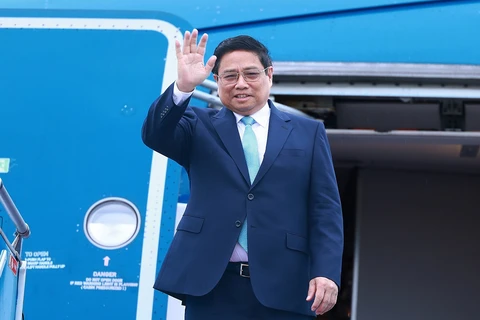
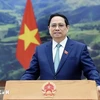
Vietnamese Prime Minister Pham Minh Chinh joined leaders of Cambodia, Laos, Myanmar, Thailand and China as well as heads of the Asian Development Bank (ADB) and regional and international organisations at the 8th Greater Mekong Sub-region (GMS) Summit which opened in Kunming city in China’s Yunnan province on November 7.

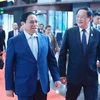
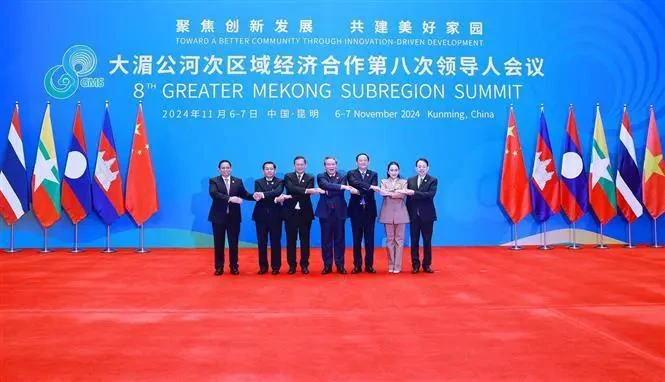
Chinese Premier Li Qiang (C) welcomes heads of delegations to the 8th Greater Mekong Sub-region (GMS) Summit (Photo: VNA)

Kunming (VNA) – Vietnamese Prime Minister Pham Minh Chinh joined leaders of Cambodia, Laos, Myanmar, Thailand and China as well as heads of the Asian Development Bank (ADB) and regional and international organisations at the 8th Greater Mekong Sub-region (GMS) Summit which opened in Kunming city in China’s Yunnan province on November 7.

Looking back on the development journey of the GMS over the past 30 years, the leaders highly valued the significant contributions of this cooperation mechanism to the development of the Mekong sub-region, particularly in the areas of transport infrastructure, energy, telecommunications, and enhancing industrial and agricultural production capacities.

Over 12,500km of roads and 1,000km of railways have been constructed, while nearly 3,000MW of electricity has been generated, and more than 2,600km of power transmission lines have been built, helping to provide electricity to over 165,000 households. Since 2021, the GMS has mobilised nearly 133 billion USD to implement more than 500 development projects in the sub-region.

The North-South and East-West Economic Corridors have truly become models of cross-border economic cooperation and connectivity, contributing to the promotion of regional trade and investment, and linking remote areas with seaports, airports, and major economic centres.

With a deep understanding of the wide-ranging and multi-dimensional impacts of the technological revolution, the 8th GMS Summit has chosen the theme "Towards a Better Community through Innovation-driven Development."

Opening the summit, Chinese Premier Li Qiang emphasised that innovation is a key driver of economic growth. He expressed China's willingness to share innovation outcomes, promote the connection of hard and soft infrastructure, and enhance sub-regional linkages through policy coordination, standard harmonisation, people-to-people exchanges, and facilitating mobility. He was also committed to offering multi-entry, five-year Mekong-Lancang visas for businesses and experts from member countries.

vna_potal_thu_tuong_pham_minh_chinh_du_hoi_nghi_thuong_dinh_hop_tac_tieu_vung_me_cong_mo_rong_lan_thu_8_7690911.webp
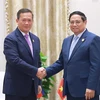
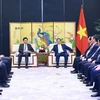
Chinese Premier Li Qiang (R) welcomes Vietnamese Prime Minister Pham Minh Chinh to the 8th GMS Summit (Photo: VNA)

The participating leaders stressed the need to strengthen cooperation to harness remarkable advancements in science and technology for green transition and digital transformation in the Mekong Sub-region. They agreed to establish a GMS Innovation System with the three key pillars of digitalisation, green transition, and connectivity.

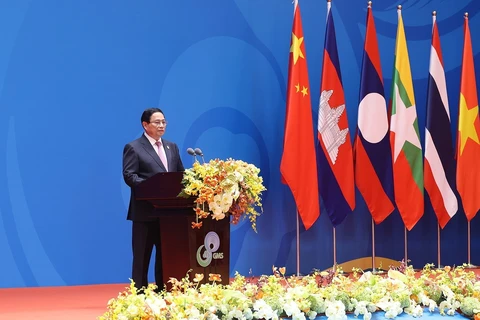
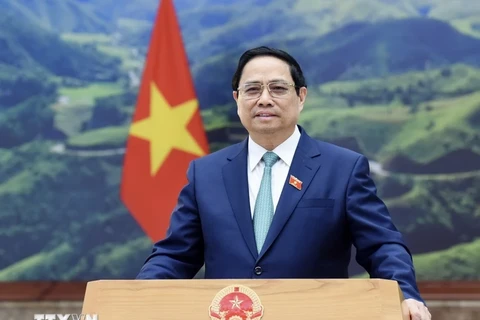
At the summit, PM Chinh highlighted the lessons drawn in the 32 years of GMS cooperation and appropriate directions for the mechanism in this new development period. He also underlined its strategic role in the sub-region’s international integration and development, along with five valuable lessons learnt from its success.

The first lies with conducting equal, widespread consultations, and strengthening consensus among members for shared benefits, while the second is developing result-oriented cooperation strategies and programmes that align with the real needs of each country and the sub-region.

Putting people at the centre of cooperation and promoting economic connectivity in tandem with environmental protection form the third lesson.

The fourth lesson is to combine each member's efforts with the support of the ADB and development partners, and the fifth lesson is turning challenges into motivation for progress.

Facing challenges, more effort, determination, and solidarity are required to build a collective strength that drives cooperation and development forward, he stressed.

The Vietnamese leader emphasised that as it evolves and develops, the GMS must continually innovate, keep pace with global trends, and meet the development demand of the sub-region.

With this mindset, he suggested that it is time for the GMS to focus on developing new-generation economic corridors centered on innovation, going beyond the traditional economic corridor model.

Based on this, he proposed three key components of these new-generation economic corridor:

Firstly, a corridor of technology and innovation should be built to foster multi-stakeholder, multi-sector, and multi-phase connectivity, focusing on supporting countries in addressing gaps in institutional frameworks, policies, technological capacity, and innovation resources, including human and financial resources.

Secondly, an economic growth corridor will revitalise traditional growth drivers while also fostering new ones.

Alongside infrastructure projects in transport, industrial production, and agriculture, the GMS should expand investments to create corridors in semiconductors, artificial intelligence, new materials, and clean energy; build digital platform; broaden the digital market; and improve digital skills for businesses and labourers, he noted, adding that a substantial and effective transformation is needed to facilitate the smooth flow of capital, goods, and services within the GMS region.

Thirdly, this should be a green, sustainable and inclusive corridor which ensures a balance between economic growth and environmental protection, with people put at the centre and being both the subject and the driving force, resources, and goal of development. The GMS should further strengthen cooperation programmes on the environment and ecosystems, disaster management, and climate change response. It should also place a particular emphasis on collaborating with the Mekong River Commission in managing and using the shared Mekong-Lancang river system in an effective, sustainable, equitable, and reasonable manner, while promoting the application of technology in integrated transboundary water resources management, Chinh stated.

The Vietnamese Government leader emphasised the need for GMS members to stay united and coordinate in responding to challenges. He expressed his confidence that with the perspective of "valuing time, valuing intellect, innovating to break through, creating to reach farther, integrating to move forward, and uniting for greater strength", this summit will contribute to realising the vision and goals of the GMS.

Vietnam will continue to work closely with member countries and development partners to jointly build a GMS that is innovative, dynamic, and has sustainable and prosperous development, he added.

GMS members adopted the Joint Statement and the GMS Innovation Strategy for Development 2030. They also noted six documents related to climate and the environment, digitisation, investment, gender equality, health care, and the digitalisation of trade documents, which will be implemented in the coming time.

Earlier, within the framework of GMS cooperation, a forum of governors and mayors of provinces and cities along the Economic Corridor took place on November 6. This event, initiated by China and held regularly in Kunming, aims to promote long-term and stable exchanges and cooperation between local governments and businesses from the six GMS member countries./.
VNA

See more

Top leader highlights promising Vietnam–Russia maritime cooperation

Top leader highlights promising Vietnam–Russia maritime cooperation

Welcoming the two sides’ identification of orientations for maritime cooperation in 2026–2030, General Secretary and President To Lam called on relevant agencies of both countries to urgently translate them into highly feasible programmes and projects, avoiding a situation in which agreements remain merely at the level of orientations and policies.

President of the Vietnamese National Assembly Tran Thanh Man (R) meets with Chairman of the Korea-Vietnam Parliamentary Friendship Group Moon Jin Seok in Seoul on September 8. (Photo: VNA)

NA President meets RoK-Vietnam Parliamentary Friendship Group chief

President of the Vietnamese National Assembly Tran Thanh Man said the Vietnamese delegation was the first foreign one to make an official visit at the invitation of NA Speaker of the Republic of Korea (RoK) Cho Jeong Sik, with representation from the Party, NA, Government and localities.

National Assembly President Tran Thanh Man (R) receives Mongolian Ambassador to Vietnam Ganbaatar Hulan in Hanoi on August 26, 2026. (Photo: VNA)

Vietnam, Mongolia work to deepen bilateral ties in substantive, effective, sustainable manner

This is the second visit by a top Vietnamese legislator to Mongolia since the two countries established diplomatic relations in 1954, and the first official visit by NA President Man to Mongolia in his capacity. The visit demonstrates Vietnam’s high regard for bilateral relations and the important role of parliamentary diplomacy in the countries’ overall relations.

Hugues Tertrais, Honorary Professor at Paris 1 Panthéon-Sorbonne University and former Director of the Centre for Contemporary Asian History (Photo published by VNA)

Historical foundation, future momentum for Vietnam–France ties

The historical dialogue between Vietnam and France had at times been very tense, but this process helped the two sides understand and respect each other better. Greater mutual understanding built over time has created conditions for cooperation at many levels today, a French scholar has said.

General Secretary of the Communist Party of Vietnam Central Committee and President To Lam and his spouse meet with officials and staff of the Vietnamese Embassy and representatives of the Vietnamese community in Russia in Moscow on September 7, (Photo: VNA)

General Secretary and President To Lam meets Vietnamese community in Russia

In particular, the Politburo recently issued Resolution No. 23-NQ/TW on overseas Vietnamese affairs, General Secretary and President To Lam, emphasising that in the time ahead, the Party and State will continue to improve institutions, and adopt comprehensive, open and breakthrough mechanisms and policies to connect with, attract and effectively mobilise the resources of overseas Vietnamese, particularly intellectuals, experts, entrepreneurs, scientists and young people.

Vietnamese Ambassador to France Trinh Duc Hai (R) grants an interview to the Vietnam News Agency (Photo: VNA)

Fresh impetus for Vietnam - France cooperation on new journey

Vietnam-France relations have been nurtured over generations through historical, cultural, educational and scientific ties, as well as extensive people-to-people exchanges. Despite the ups and downs of history, the two countries have successfully built a relationship of friendship, equality and mutual respect, looking towards the future together.

Dr. Benoît de Tréglodé, Director (Africa - Asia - Middle East) at the Institute of Strategic Research (IRSEM) under the French Ministry of Armed Forces. (Photo: VNA)

Vietnam-France cooperation hoped to be expanded

Vietnam and France should also build a forward-looking, mutually beneficial partnership in which stronger economic and industrial ties serve as an indispensable foundation, said Dr. Benoît de Tréglodé, Director (Africa - Asia - Middle East) at the Institute of Strategic Research (IRSEM) under the French Ministry of Armed Forces.

General Secretary of the Communist Party of Vietnam Central Committee and President To Lam (R) and Chairman of the Communist Party of the Russian Federation Gennady Zyuganov at the meeting in Moscow on September 7 (Photo: VNA)

Top Vietnamese leader meets Russian Communist Party chief

To deepen the two parties' ties at bilateral and multilateral levels, the top Vietnamese leader proposed both sides effectively follow the agreement on further expanding and deepening inter-Party relations, especially by increasing high-level delegation exchanges and promptly sharing information on each Party's key activities.

Party General Secretary To Lam (right) receives AAFV Chairman Nguyen Hai Nam during his visit to France in 2024. (Photo: VNA)

Top leader’s upcoming visit to renew vitality of Vietnam-France friendship

Chairman of the France-Vietnam Friendship Association (AAFV) Nguyen Hai Nam said the trip demonstrates that France is truly a special partner of Vietnam in Europe. France can serve as a gateway for Vietnam to access the European Union (EU), while Vietnam can be France’s entry point for deeper engagement with the Association of Southeast Asian Nations (ASEAN).

General Secretary of the Communist Party of Vietnam Central Committee To Lam and his spouse, Ngo Phuong Ly, arrive at Vnukovo international airport in Moscow on September 7 afternoon (local time). (Photo: VNA)

General Secretary and President To Lam begins state visit to Russia

As scheduled, the top Vietnamese leader will receive Chairman of the Communist Party of Russia Gennady Ziuganov, the Russian War Veterans’ Association and the Russia-Vietnam Friendship Association, and have a meeting with staff of the Vietnamese Embassy and representatives of the Vietnamese community in Russia.

President of the Vietnamese National Assembly Tran Thanh Man (right) and Chairman of the Democratic Party of Korea Kim Min Seok meet in Seoul on September 7. (Photo: VNA)

Vietnam's top legislator meets with Democratic Party of Korea leader

Lauding the friendship and sound cooperation between the Communist Party of Vietnam and the DPK in recent years, NA President Tran Thanh Man called on both sides to continue effectively following their 2019 cooperation agreement, and foster political trust and mutual understanding by maintaining all-level delegation exchanges and meetings.