Cashew processors face difficulties with raw material imports

Domestic cashew processing enterprises have been facing difficulties due to a new regulation that requires additional checks on raw materials imported from African ports.
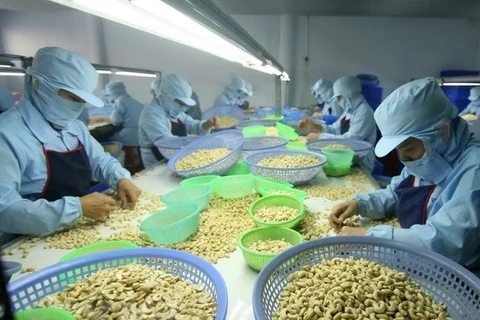
Cashew processors face difficulties with raw material imports ảnh 1Cashew processed for exports (Photo: VNA)

Hanoi (VNS/VNA) - Domestic cashewprocessing enterprises have been facing difficulties due to a newregulation that requires additional checks on raw materials imported fromAfrican ports.

Dang Hoang Giang, Vice President and Secretary Generalof the Vietnam Cashew Association (Vinacas), said: "The domestic industryis facing difficulties this year, and new regulations has pushed upproduction costs."

They needed more time and money to obtaincustoms clearance, according to the association.

The enterprises also had to send more staff totrack their shipments, causing congestion at ports and reducing thecompetitiveness of enterprises and the industry, it said.

In mid-March, Vinacas President Pham Van Congsent a letter to the Department of Plant Protection to propose solutions forthe new regulations that aimed to prevent the Trogoderma SP worm fromentering the country.

Hoang Trung, Director of the Ministry ofAgriculture and Rural Development’s Department of Plant Protection, said thedepartment had directed the Plant Quarantine Sub-department of Region 2that in April if no batches were infected, the sub-department would permitbusinesses to move shipments directly to their warehouses.

If any batches were found to be infected, thequarantine sub-department would propose stopping shipments from the relevantcountries, Trung said.

Since the beginning of the year, the departmenthad checked all shipments arriving at the country’s ports. The process took7-10 days compared to 2-3 days in the past.

Vinacas has asked the Plant ProtectionDepartment to resume quick inspections at the dock and further checks wherenecessary at warehouses.

This was the peak time for buying and importingraw cashew for processing, so if the new regulation was not adjusted, it wouldseriously hit the domestic cashew industry, Giang said.

Trung said since 2013, the department has foundnumerous shipments from Africa containing the Trogoderma SP worm. The worm isclassed as dangerous and is on a list of tightly-controlled pests in manycountries.

Previously, the quarantine process for importedgoods needed four hours at border gates and 10 hours at seaports and airports.

“We have continued to find the worms in importedcashew shipments so enterprises must work with quarantine agencies to stop thispest from entering the country. Vietnamese goods would face many difficultiesand eradicating the worms would cost a lot.”

“If quarantine agencies do not find worms in thenext 5-7 batches, we will permit businesses to ship them to warehouses and thencheck the remaining batches, creating favourable conditions,” Trung said.

According to the ministry, imports of raw cashewnuts in the first quarter of this year reached 224,000 tonnes worth 389 millionUSD. The imports surged by 6.2 percent year on year in volume but reduced 19.5 percentin value.

In the first quarter, Cambodia was the largestsupplier of cashews for Vietnam, accounting for 33.2 percent of total importvalue, up about 10 times year-on-year. The second largest import value was fromthe Ivory Coast with 47 million USD, up about 2 times. The third was fromIndonesia with 24.2 million USD, up 1.8 times.

Vietnam’s raw cashew imports are forecast toreach more than 1 million tonnes this year. The nation has imported rawmaterials for many years because of its reduction in cashew growing areaand output.-VNS/VNA
VNA

See more

Toy production at a Hong Kong-invested factory (Photo: VNA)

Vietnam targets deeper market penetration in Hong Kong in 2026

Vietnam-Hong Kong trade hit 62.3 billion USD in the first 11 months of 2025, soaring 73.1% annually. Vietnamese exports to Hong Kong amounted to 36.8 billion USD, a 90.6% hike, ranking fourth among Hong Kong’s import sources, while imports from Hong Kong stood at 25.5 billion USD, up 52.9% and ranking third.

Vietnam’s start-up market enters restructuring phase

Vietnam’s start-up market enters restructuring phase

In 2026, venture capital inflows into Vietnam’s start-up ecosystem are expected to recover gradually, though in a more selective manner. VinVentures forecasts that capital will focus on start-ups that have survived the rigorous screening of 2024–2025, possess clear business models, strong commercialisation capacity, and the ability to generate real cash flows.

Workers process tra (pangasius) for export (Photo: VNA)

Vietnam–Singapore trade continues to thrive

For the year as a whole, Vietnam retained its position as Singapore’s 10th largest trading partner. Bilateral trade reached a record high of nearly 40 billion SGD, up 26.2% from the previous peak of 31.67 billion SGD recorded in 2024.

Eric Van Vaerenbergh, an energy expert and lecturer at the Brussels Engineering School (ECAM) (Photo: VNA)

Belgian expert optimistic about Vietnam’s economic outlook

Vietnam should move from a growth model based mainly on expanding capital and labour to one driven by productivity improvements. He said that this requires enhancing the quality of the workforce, particularly engineers, technicians, and managers in industrial sectors.

Workers at the VSIP Hai Phong industrial and urban complex, which specialises in producing electronic components for office equipment. (Photo: VNA)

Roadmap aims to improve business climate and boost competitiveness

By the end of 2026, Vietnam aims to rank among the world’s top 50 performers in the United Nations Sustainable Development Goals, advance at least three places in the International Property Rights Index, and climb at least one position in the Global Innovation Index.

Vietnam is strengthening its position in the technology value chain, becoming a major manufacturing hub for complete consumer electronics products. (Photo: VNA)

ESG standards offer opportunities to reposition Vietnam’s electronics firms

The 2025-2027 period will be a critical turning point, as exporters to the European market will be required to strictly comply with ESG standards, including net-zero emissions roadmaps, labour standards, corporate governance and transparency requirements. As a key export sector, the electronics industry is being directly and strongly affected by this shift.

A production line for camera modules and electronic components at the factory of MCNEX VINA Co. Ltd, a Republic of Korean-invested company in Phuc Son Industrial Park, Ninh Binh province. (Photo: VNA)

Science, technology, innovation as engines of economic growth

To ensure that science and technology truly act as a powerful growth engine, experts emphasised the need for the Government to put in place supportive mechanisms and policies that encourage enterprises to invest in research and development, while strengthening cooperation among the State, research institutions and the business sector.