Central island gets face lift thanks to solar power

Life in An Binh Island, also known as Be Island, in Ly Son island district, the central province of Quang Ngai has changed since solar power was introduced.
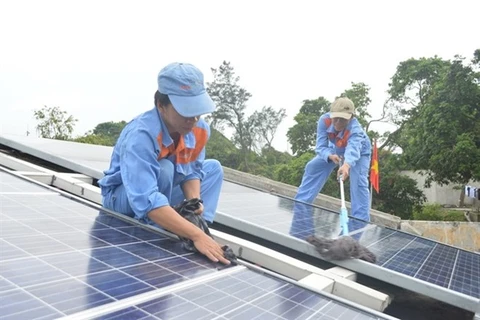
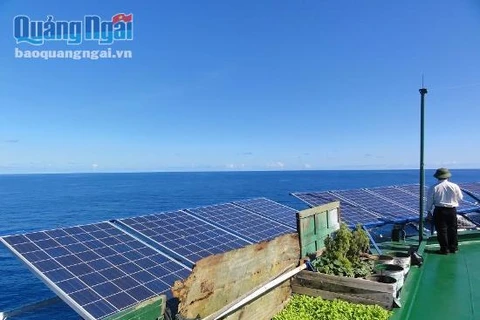
Central island gets face lift thanks to solar power ảnh 1The solar power panel system in An Binh island. (Photo: VNA)

Quang Ngai (VNA) – Life in An Binh Island, alsoknown as Be Island, in Ly Son island district, the central province of QuangNgai has changed since solar power was introduced.

Together with a system of diesel power generators, the AnBinh Power Plant has put into use a solar power facility, comprising 300 IREXsolar panels with total capacity of 96kW, 100kW grid-connected inverters and72kW battery inverters.

Thanks to the combined system of diesel and solar powergenerators which produce about 700 kWh daily, more than 100 local families havestable and constant access to power. Previously, the island only had electricity forsome of the day.

Now, their quality of life has improved as many familieshave more electrical appliances in their homes, particularly televisions.

Owners of restaurants on the island are among thehappiest. They used to not dare to buy refrigerators to store food due toelectricity shortages, but now many have purchased large-capacity fridges toprovide better services to tourists.

The system has also helped cut electricity costs.According to Nguyen Van Hong from An Binh seawater desalination plant, it usedto cost the plant about 2.1 million VND (92.4 USD) per day using diesel powerbut with the new system, the cost was cut by more than two-thirds to only600,000 VND (26.4 USD) per day.

The solar system also allowed the plant to operate forlonger hours to ensure water supply for the locals, he added.

Be Island has had a facelift, especially in tourism,thanks to solar power, said Huynh Luy, Secretary of the Party Committee of AnBinh Commune. Before, tourists normally only visited the island for a day; nowthey can stay for several days as homestay services and other facilities havedeveloped. The local average income has been raised to more than 21 million VND(924 USD) per person per year.-VNA
VNA
See more

Defendants at the court (Photo: VNA)

Ho Chi Minh City court opens trial over Agribank lending scandal

The investigation revealed that multiple credit files were incomplete or riddled with inaccurate information, while some pledged assets lacked proper legal standing yet were accepted and grossly overvalued. As a result, the loans became high-risk and largely unrecoverable, leading to losses surpassing 1 trillion VND.

Hanoi introduces 53 electric buses from April 18 (Photo: VNA)

Hanoi to add 53 electric buses from April 18

According to the plan, all buses operating within Ring Road 1 will use green energy by July 1, 2026. The requirement will expand to Ring Road 2 by January 1, 2028, and to Ring Road 3 by 2030.

Illustrative image (Photo: VNA)

National, local traffic safety committees to be dissolved from June 1

Under the dicision, ministries and ministerial-level agencies will assume responsibility for tasks previously performed by the committee, in line with their mandates under the Law on Government Organisation, the Law on Road Traffic Order and Safety, the Law on Roads and other relevant legal frameworks, ensuring that traffic safety and order are maintained without disrupiton.

Visitors explore technology showcases at the exhibition held during the Da Nang Startup and Innovation Festival (SURF 2025). (Photo: VNA)

About 10,000 students expected at National Startup Day 2026

This year marks the rollout of the “Student Startup Support Programme for 2026 – 2035”, approved under Decision No. 336/QD-TTg, which places emphasis on practical outcomes, real products, real testing, real partnerships, and measurable impact.

Hong Quang High School pilots teaching mathematics in English starting from the 2025–2026 academic year. (Photo: VNA)

National foreign language proficiency framework issued

The circular establishes a unified benchmark for foreign language proficiency across the national education system, providing a foundation for curriculum design, teaching, testing, assessment, and certification. It is expected to help learners better map out their language development pathways while enabling educational institutions to improve training quality and strengthen articulation between different levels of education.