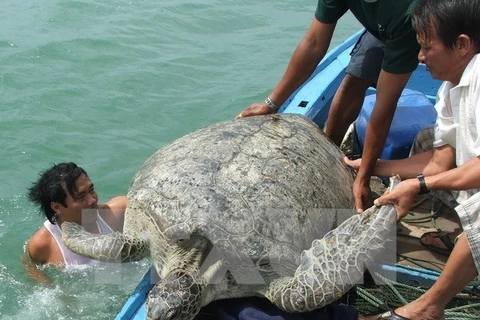
A section of Cham Island beach will be demarcated for turtle conservation (Photo: vietnamnet.vn)
 Quang Nam (VNA) - A 40sq.m beach and water area on Cham Island will be restored and demarcated to protect and conserve the green turtle (Chelonia mydas) species.
A decision to this effect has been taken by the management board of the island’s Marine Protected Area (MPA).
Le Xuan Ai, a researcher, told Vietnam News that a scientific study will be undertaken in the area for three years (2017-2019) under the green turtle conservation project to ensure prolonged restoration of the endangered species.
Ai, who has 30 years of experience in studying conservation of the turtle in the Con Dao Island National Park in Ba Ria-Vung Tau province, said the Cham Island MPA was the most favourable site in the central Vietnam for the project.
“We are eyeing Bai Bac (north beach) of the Cham Island for building a convenient site for turtles to lay and hatch eggs. We will offer in-situ and ex-situ conservation of the green turtle at the Cham Island in co-operation with Con Dao National Park in coming years.
“Green turtle eggs will be taken from Con Dao Island – where we’ve succeeded in conserving the turtle species for years – and hatched on beaches in Cham Island. Meanwhile, we’ll also restore a safe habitat for turtles to lay eggs as they used to in previous decades, on the beaches of central Vietnam,” he said.
He added that baby turtles (hatchlings) often return to the beach – where it was born and grew up – to lay eggs when it reaches maturity.
Ai said beaches in central coastal Vietnam including Thua Thien-Hue, Da Nang, Quang Nam and Quang Ngai were favoured destinations for turtle reproduction, but rapid urban development, speedy construction of beach resorts and hotels as well as exploitation of seafood and pollution had destroyed their habitat.
He said coral reefs, safe and quite beaches and clean environment must be “seriously restored” to revive turtle populations in central Vietnam.
He said the well-protected sea area of Cham Island had optimum conditions for the turtle conservation project, including strict rules on species protection, fresh and quiet environment, as well as limited human activities.
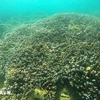
In 2014, a small colony of young coral reef was found growing back in the coastal area of Tam Hiep Islet – in Cham Island, 20km off the coast of Hoi An city.
According to the island’s MPA management board, the small polyped stony corals had reproduced young corals on a rock off the coastal area in Bai Lang Port.
Biologists and scientists said the coral reef revival was a result of effective protection of the environment in the area, including the non-use of plastic bags and the 3-R (reduce, reuse and recycle) programmes that began implementation in 2011.
Over 4,800 colonies of coral had grown on an area of 4,000sq.m since 2012. According to Chu Manh Trinh, an expert, islanders gradually recognised the importance of protecting coral reefs in the sea area.
He said that local people have almost stopped dumping garbage and nylon bags, creating a clean and safe environment for the coral reef to grow again.
He added that this young coral reef is the beginning of a reef ecosystem in the area.
The Cham Island, 20km off the coast of Hoi An city, is home to 1,500ha of tropical forests and 6,700ha of sea featuring a wide range of marine fauna and flora, including many endangered species such as salangane (swallows), the long-tailed monkey and the crab-eating macaque (Macaca fascicularis).
The islands are also home to 1.26sq.km of coral reefs. The islands are the only location in Vietnam effectively promoting the non-use of plastic bags and the 3-R (reduce, reuse and recycle) programmes.
The 3,000 inhabitants of the islands, which include eight islets with vast ecological diversity, hosts around 100,000 tourists annually, of which 10 per cent are foreigners.
Last year, the MPA of Cham Island and the Centre of Biodiversity Conservation, GreenViet, inked a Memorandum of Understanding (MoU) on the protection of flora and fauna in the islands’ forests.
Under the MoU, a survey of the current flora and fauna will be carried out and a detailed database and biodiversity map covering Cham Island-Hoi An city – a world biosphere reserve recognised by UNESCO in 2009 – will be set up.
Cham Island hosts around 100,000 tourists annually, 10 percent of whom are foreigners.-VNA
A decision to this effect has been taken by the management board of the island’s Marine Protected Area (MPA).
Le Xuan Ai, a researcher, told Vietnam News that a scientific study will be undertaken in the area for three years (2017-2019) under the green turtle conservation project to ensure prolonged restoration of the endangered species.
Ai, who has 30 years of experience in studying conservation of the turtle in the Con Dao Island National Park in Ba Ria-Vung Tau province, said the Cham Island MPA was the most favourable site in the central Vietnam for the project.
“We are eyeing Bai Bac (north beach) of the Cham Island for building a convenient site for turtles to lay and hatch eggs. We will offer in-situ and ex-situ conservation of the green turtle at the Cham Island in co-operation with Con Dao National Park in coming years.
“Green turtle eggs will be taken from Con Dao Island – where we’ve succeeded in conserving the turtle species for years – and hatched on beaches in Cham Island. Meanwhile, we’ll also restore a safe habitat for turtles to lay eggs as they used to in previous decades, on the beaches of central Vietnam,” he said.
He added that baby turtles (hatchlings) often return to the beach – where it was born and grew up – to lay eggs when it reaches maturity.
Ai said beaches in central coastal Vietnam including Thua Thien-Hue, Da Nang, Quang Nam and Quang Ngai were favoured destinations for turtle reproduction, but rapid urban development, speedy construction of beach resorts and hotels as well as exploitation of seafood and pollution had destroyed their habitat.
He said coral reefs, safe and quite beaches and clean environment must be “seriously restored” to revive turtle populations in central Vietnam.
He said the well-protected sea area of Cham Island had optimum conditions for the turtle conservation project, including strict rules on species protection, fresh and quiet environment, as well as limited human activities.
In 2014, a small colony of young coral reef was found growing back in the coastal area of Tam Hiep Islet – in Cham Island, 20km off the coast of Hoi An city.
According to the island’s MPA management board, the small polyped stony corals had reproduced young corals on a rock off the coastal area in Bai Lang Port.
Biologists and scientists said the coral reef revival was a result of effective protection of the environment in the area, including the non-use of plastic bags and the 3-R (reduce, reuse and recycle) programmes that began implementation in 2011.
Over 4,800 colonies of coral had grown on an area of 4,000sq.m since 2012. According to Chu Manh Trinh, an expert, islanders gradually recognised the importance of protecting coral reefs in the sea area.
He said that local people have almost stopped dumping garbage and nylon bags, creating a clean and safe environment for the coral reef to grow again.
He added that this young coral reef is the beginning of a reef ecosystem in the area.
The Cham Island, 20km off the coast of Hoi An city, is home to 1,500ha of tropical forests and 6,700ha of sea featuring a wide range of marine fauna and flora, including many endangered species such as salangane (swallows), the long-tailed monkey and the crab-eating macaque (Macaca fascicularis).
The islands are also home to 1.26sq.km of coral reefs. The islands are the only location in Vietnam effectively promoting the non-use of plastic bags and the 3-R (reduce, reuse and recycle) programmes.
The 3,000 inhabitants of the islands, which include eight islets with vast ecological diversity, hosts around 100,000 tourists annually, of which 10 per cent are foreigners.
Last year, the MPA of Cham Island and the Centre of Biodiversity Conservation, GreenViet, inked a Memorandum of Understanding (MoU) on the protection of flora and fauna in the islands’ forests.
Under the MoU, a survey of the current flora and fauna will be carried out and a detailed database and biodiversity map covering Cham Island-Hoi An city – a world biosphere reserve recognised by UNESCO in 2009 – will be set up.
Cham Island hosts around 100,000 tourists annually, 10 percent of whom are foreigners.-VNA
VNA