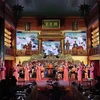
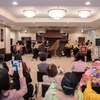
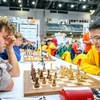
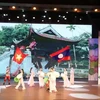
The troupe from the Philippines will perform a folk dance called Tinikling (Photo courtesy of the organisation board)
 Hanoi (VNS/VNA) - Eight art troupes from different countries are participating in the International Children’s Festival in the ancient city of Hoi An, the central province of Quang Nam.
Under the theme Colourful Cultural World, the festival is held by the Vietnam National Television (VTV) with the purpose of cultural exchange and strengthening understanding and solidarity among children of the different countries.
The participating countries include the Republic of Korea, Indonesia, Russia, Thailand, the Philippines, Sri Lanka, China and host Vietnam.
“The children will get to know the culture of the homeland and discover the richness and multicoloured culture of different countries at the festival,” said Pham Hong Tuyen, one of the organisers.
The festival will include many outdoor actives and performances. The children will experience Vietnamese culture in Hoi An such as ao dai tailoring, visiting the Japanese Bridge on the Hoai River and watching as artisans make lanterns and pottery.
The highlight of the festival will be a gala which will be aired live on VTV’s channel 1 at 7pm on May 31.
The gala will see impressive performances by international and Vietnamese troupes such as jazz music by Korean group Junior Bigband, a Kalinka dance by the Russian troupe and music by the children's choir from Sri Lanka.
The Thai children's art troupe is from Joselp Nakhon Sawan School, which has recently won six championships in different music competitions in the country. They will perform a beautiful classical mask dance which is usually only performed at royal banquets.
The Philippine troupe will bring a folk dance known as Tinikling — the most popular dance named after a long-legged bird in the Philippines.
Sangar Seni Citra Budaya Bogor art troupe from Indonesia will perform a Jati Maung dance — a story about tigers that transports the audience into a forest and focuses on animal protection.
Vinschool art troupe will tell the story of the festival and typical culture of each region in Vietnam through dances.
The beginning of the gala night will see the release of lanterns and a carnival with the theme East Meets West on Hoi River to recall the busy trade scene of ancient Hoi An.
There will be a fireworks display at the end of the gala at Light Square in Vinpearl Nam Hoi An.
The festival is held annually to celebrate International Children’s Day on June 1 to strengthen the friendship and solidarity of countries in the region through cultural activities and exchanges between children.
At its first iteration in 2016, the festival gathered children from ASEAN countries. It expanded last year to draw the participation of the Republic of Korea, Russia, China and Japan.-VNS/VNA
Under the theme Colourful Cultural World, the festival is held by the Vietnam National Television (VTV) with the purpose of cultural exchange and strengthening understanding and solidarity among children of the different countries.
The participating countries include the Republic of Korea, Indonesia, Russia, Thailand, the Philippines, Sri Lanka, China and host Vietnam.
“The children will get to know the culture of the homeland and discover the richness and multicoloured culture of different countries at the festival,” said Pham Hong Tuyen, one of the organisers.
The festival will include many outdoor actives and performances. The children will experience Vietnamese culture in Hoi An such as ao dai tailoring, visiting the Japanese Bridge on the Hoai River and watching as artisans make lanterns and pottery.
The highlight of the festival will be a gala which will be aired live on VTV’s channel 1 at 7pm on May 31.
The gala will see impressive performances by international and Vietnamese troupes such as jazz music by Korean group Junior Bigband, a Kalinka dance by the Russian troupe and music by the children's choir from Sri Lanka.
The Thai children's art troupe is from Joselp Nakhon Sawan School, which has recently won six championships in different music competitions in the country. They will perform a beautiful classical mask dance which is usually only performed at royal banquets.
The Philippine troupe will bring a folk dance known as Tinikling — the most popular dance named after a long-legged bird in the Philippines.
Sangar Seni Citra Budaya Bogor art troupe from Indonesia will perform a Jati Maung dance — a story about tigers that transports the audience into a forest and focuses on animal protection.
Vinschool art troupe will tell the story of the festival and typical culture of each region in Vietnam through dances.
The beginning of the gala night will see the release of lanterns and a carnival with the theme East Meets West on Hoi River to recall the busy trade scene of ancient Hoi An.
There will be a fireworks display at the end of the gala at Light Square in Vinpearl Nam Hoi An.
The festival is held annually to celebrate International Children’s Day on June 1 to strengthen the friendship and solidarity of countries in the region through cultural activities and exchanges between children.
At its first iteration in 2016, the festival gathered children from ASEAN countries. It expanded last year to draw the participation of the Republic of Korea, Russia, China and Japan.-VNS/VNA
VNA