Hanoi (VNA) - Co Loa now is serving as not only a cultural relic and evidence of ancient Vietnamese’ creativeness and technical level, but also an ideal destination for visitors.
Not only associated to the Vietnamese nation’s legends like the selection of the capital by King An Duong Vuong, the creation of a multiple-shot crossbow or a moving love, Co Loa Ancient Citadel is a unique tourist attraction of Hanoi.
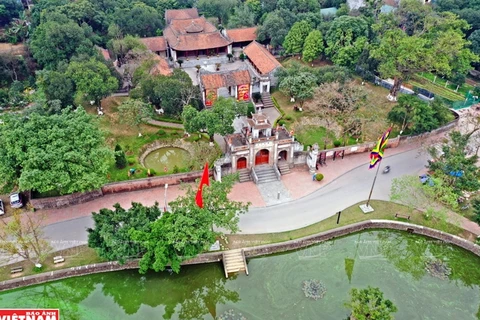
 Shrine dedicated to King An Duong Vuong, built in 1687 under King Le Hy Tong’s reign and renovated in 1689, often referred to as Thuong (Upper) Shrine. (Photo: VNA)
 Trong Thuy – My Chau well at entrance of An Duong Vuong Shrine. (Photo: VNA)
Described as the largest ancient citadel in Vietnam, Co Loa historical relic covers about 500 ha, built at an order by King An Duong Vuong in the third century BC as the capital of the then Au Lac (now Vietnam), in Hanoi’s outlying district of Dong Anh.
Legend has it that the citadel consists of nine spirals, hence the ancient name of Snail Citadel. Under the ravage of time and wars, there are currently only three spirals with ancient traces.
The perimeter of the outer spiral measures 8 km with tall walls, from 4 to 5 m or even 8 to 12 m at some places, and moats. Meanwhile, the middle spiral’s perimeter is about 6.5 km, built in a similar way like the outer but stronger; and the inner covers about 2 sq. km serving as residence of the royal court.
The citadel takes various names like Loa (Snail) Thanh, Con Lon Thanh, Tu Long Thanh, Cuu Thanh, Viet Vuong Thanh , Kha Lu Thanh and Co Loa Thanh. In the 10th century, it became the capital for the second time when Ngo Quyen was the king of the country.
 Main entrance of An Duong Vuong Shrine with its almost all ancient architectural sketches. (Photo: VNA)
 Ancient architectural sketches in Co Loa relic. (Photo: VNA)
 Statue of Cao Lo, a talented warrior under King An Duong Vuong who created a multiple-shot crossbow. (Photo: VNA)
The Co Loa relic complex now houses many historical, architectural and art relics like the upper shrine dedicated to King An Duong Vuong, the one to Warrior Cao Lo, and the one to Princess My Chau; and the Bao Son Pagoda. Insides those constructions, visitors can have a look at objects excavated in the citadel, including bronze statues and arrows, and sophisticatedly decorated earthenware and stone utensils.
Not only a cultural heritage, Co Loa Ancient Citadel these days is standing as evidence of the creativeness, culture and the technical levels of the ancient Vietnamese in the national defence against foreign aggression.
Besides, it is also serving as an ideal destination for visitors from all corners of the country who wish to have a deeper look into cultural values and familiar images of a peaceful northern village. For local villagers, Co Loa Ancient Citadel still holds an important role in their spiritual life and cultural activities.
Every year, on the sixth day of the first lunar month, Co Loa villagers hold a solemn festival to commemorate the constructors of the citadel and to express gratitude to King An Duong Vuong, the founder of the Au Lac feudal state./.
 Two small wells, called dragon’s eyes, on two sides of main entrance to King An Duong Vuong Shrine. (Photo: VNA)
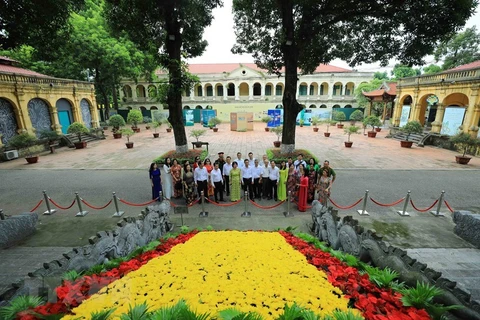
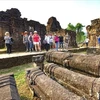
 Visitors to Co Loa Ancient Citadel. (Photo: VNA)
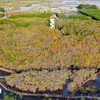
  An excavation hole on outer wall in 2012. (Photo: VNA)
 Co Loa bronze drum unearthed in 1982 in Ma Tre area, Cho hamlet, southwest of the southern gate of Co Loa Ancient Citadel, dated back more than 2,000 years ago. (Photo: VNA)
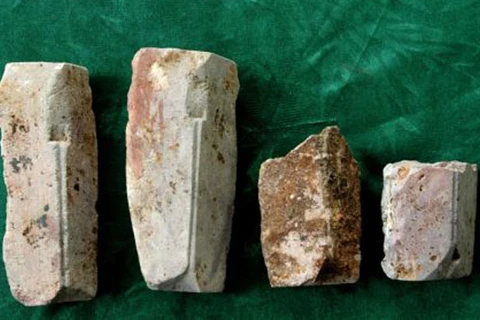
 Stone axes unearthed in Bai Men, Co Loa, dated back from 3,000 to 3,500 years ago. (Photo: VNA)
 A replica of multiple-shot crossbow, created by Cao Lo. (Photo: VNA)