Ethnic minorities should involve in the restoration of traditional festivals. (Photo: VNA)
Hanoi (VNA) – Ethnic minority groups play a vital role in the restoration of traditional festivals or rituals, according to experts.
A case in point is a project on the restoration of Kong Long Khong festival of the Ba Na ethnic group in KBang district, the Central Highlands province of Gia Lai, conducted by Vietnam National Institute of Culture and Arts Studies (VICAS) in 2019.
According to Cao Trung Vinh, an expert of the project, despite the fact that the festival has been restored continuously by local administration since 2005, it does not receive an enthusiastic response from the ethnic minority community.
“People are only invited by local authorities to participate in festival activities such as processions and playing gongs,” he pointed out.
This, somehow, fails to meet the expectation of the Ba Na community, and the commune authorities also admit that they feel tired of holding the festival as they do not have enough human and other resources, Vinh went on.
He attributed the people’s lukewarm attitude to the fact that local authorities have omitted many parts of the ceremony and only focused on gong performance on stage.
The loss of traditional culture also reduces the number of gong troupes, he said, adding that in 2015-2016 when the VICAS research team carried out the survey, the commune had only six while the figure was 11 in 2005.
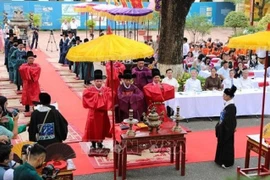
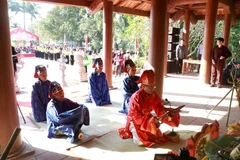
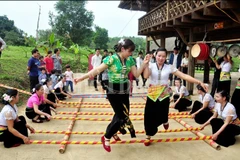
 Reenactment of rituals at the Vietnam National Village for Ethnic Culture and Tourism in Hanoi’s Son Tay town is performed by ethnic minority groups themselves. (Photo: VietnamPlus)
In his remarks at a forum entitled “Vietnamese Ethnic Culture - Resources for national development” which took place on April 15 at the Vietnam National Village for Ethnic Culture and Tourism, Professor Bui Quang Thanh said ethnic minority communities should be given autonomy, namely the right to restore their own cultural-spiritual relics.
He cited the reconstruction of the more than 160 Guol houses for the Co Tu ethnic group in the central province of Quang Nam as an example.
Because most of them are built of concrete, these houses are not utilised even though villages are still in urgent need of a place for community cultural activities.
The reason is that for locals, these are not sacred spaces, he said.
For ethnic communities, to have a sacred space, they do not simply pay attention to the supply of materials, funding and skilled workers for the construction, Thanh said, elaborating that those materials must be selected by the people themselves, carved with their own hands and erected in line with local rituals, customs and traditions.
Role of ethnic minority groups should be enhanced
According to experts, ethnic minorities should be the centre of their cultural activities. This will not only help reduce pressure on the government, but also enhance their role and responsibility for cultural values, they added.
Letting the community organise the Kong Long Khong festival in KBang district over the past three years has promoted its effectiveness, Vinh said.
He held that the ethnic minority communities should be tasked with the organisation of traditional festivals relating to them because they are the real subjects of the events.
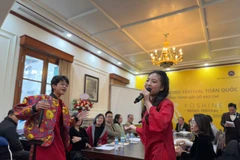
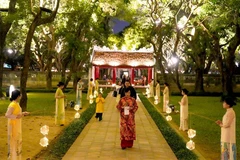
 Illustrative image. People are the subject of festivals while the State's cultural management agencies should take the managerial and supervisory roles. (Photo: Vietnam Plus)
Echoing Vinh’s point of view, Thanh affirmed that people's aspiration is to give the community the right to restore their own cultural-spiritual relics. However, at the same time, the government still takes managerial and supervisory roles.
Only by doing so will cultural products receive the consensus and active response from the community, he said./.