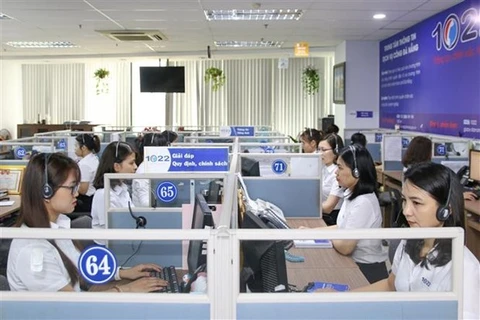
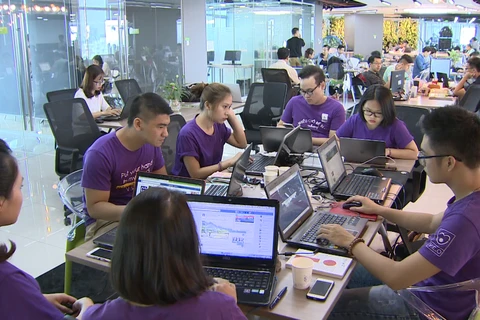
A conference session entitled “Developing smart banking in the process of Industrialisation and Modernisation until 2030, with a vision to 2045” held on November 18. (Photo: VietnamPlus)
 Hanoi (VNA) – The average cash transaction has seen a significant decline compared to before COVID-19 broke out, and the figure is expected to drop in the incoming time, according to a recent report by Visa.
The pandemic has sped up the digital transformation process as a majority of consumers prefer cashless payment. About 78 percent of consumers will continue to use digital payment methods even after COVID-19 is brought under control, turning it into a longtime habit, said Visa Country Manager for Vietnam and Laos Dang Tuyet Dung.
She made the remark at a conference session regarding the development of smart banking in industrialisation and modernisation until 2030, with a vision to 2045 held on November 18 by the Party Central Committee’s Economic Commission and relevant agencies.
Less cash in the wallet
Dung continued that a report of Visa shows that the average cash transaction of consumers witnessed a remarkable decline compared to before COVID-19 emerged and the trend will continue in the future.
At least three among five Vietnamese consumers said that they keep less cash in their wallet than before because they grew accustomed to using cards and cashless payment methods.
The rate of card users stands at 65 percent and that of e-wallets 70 percent, according to the report.
Visa estimated that prior to COVID-19, out of 10 transactions, 6.8 were cash ones, and the figure was down to 5.4 recently.
The community and society are projected to benefit from the shift to cashless payment against the backdrop of the pandemic. The risks of thievery and stealing have declined, and so has the spread of the pandemic.
Dung forecast that consumers have a tendency to settle their invoices and supermarket bills via cashless payment and during international travel (once the sector recovers in the post-pandemic period).
As a result, firms in e-commerce and payment may maintain their operations in the coming time, even when social distancing and preventive measures are fully lifted, she remarked, adding that Government agencies will facilitate e-commerce payment as they have seen efficiency in the field.
Technology takes the reign
Phung Duy Khuong, Deputy General Director and head of the Private Banking Division of the Vietnam Prosperity Joint‑Stock Commercial Bank (VPBank), underscored that technology has a role to play in changing consumer behaviours in the COVID-19 period.
Habits and financial activities see frequent changes with the development of the information technology sector, he stated. As of the end of this year, 70 million Vietnamese people aged 15 and above will have become digital customers.
To prove benefits brought by digital transformation, Khuong cited an example in online procedures of loans for house buyers.
In the traditional method, asset evaluation lasts about two days, coupled with various fees. Customers are also asked to travel to the banks to complete the process and then wait for some two weeks.
However, in the digitalised method, automatic assessment will produce results free of charge immediately. Customers only need to fill in their information and they receive guidance to finish the dossier. The work only takes one week.
Loan approval and contract compilation are done automatically, thus saving time and costs and avoiding disruptions in bank operation. Banks can serve customers amid COVID-19 related social distancing measures, Khuong said.
Efforts required to promptly complete policies
At the event, deputy head of the Party Central Committee’s Economic Commission Nguyen Duc Hien underlined that Resolution No.52-NQ/TW dated September 27, 2019 states digital economy development is among three major tasks in the implementation of policies and regulations. Of them, finance-banking is defined as a priority and pioneer.
To fulfil digital transformation targets set in the Resolution, issues regarding institutions and policies must be addressed. Regulations should not focus only on traditional payment methods, but also in the completion of policies as well as creation of an environment of competitiveness and cooperation between commercial banks, fintech companies and tech giants.
 Dr Nguyen Duc Hien, deputy head of the Party Central Committee’s Economic Commission, speaks at the event (Photo: VietnamPlus)
 Novel financial models require relevant agencies to soon complete legal regulations, especially the Law on E-Transaction. The process facilitates the financial sector in particular and smart bank development at large, Hien said./.