“Dien Bien Phu in the Air” victory celebrated in Hanoi

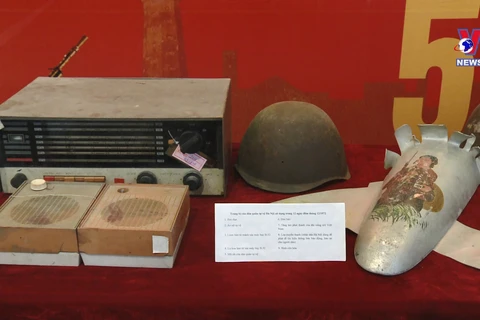
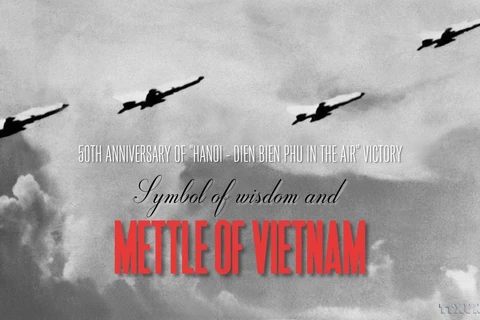
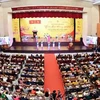
A ceremony was held in Hanoi on December 26 by Hanoi and the Ministry of National Defence to mark the 50th anniversary of the “Hanoi – Dien Bien Phu in the Air” victory.
“Dien Bien Phu in the Air” victory celebrated in Hanoi ảnh 1At the ceremony (Photo: VNA)
Hanoi (VNA) – A ceremony was held inHanoi on December 26 by Hanoi and the Ministry of National Defence to mark the50th anniversary of the “Hanoi – Dien Bien Phu in the Air” victory.

In December 1972, US launched a strategic aerial bombing operation called “Linebacker II”in Hanoi and Hai Phong. In this operation, the US military mobilised thegreatest force since World War II: 193 of the 400 B-52 bombers that the US hadat that time; 1,077 of the 3,043 tactical aircraft (including a squadron ofabout 50 F-111 fighters); six of the 24 aircraft carriers; more than 50 tankeraircraft, other types of service planes, and 60 warships of all kinds from theUS Seventh Fleet in the Pacific. 

Throughout 12 days and nights, US planes dropped more than 100,000 tonnes of bombs onto Hanoi, Hai Phong and a number of localities in northern Vietnam.

Vietnamese defence forces and people of the North resisted strongly, shooting down 81 aircraft, including 34B-52s, and killing or catching hundreds of US pilots. The heavy losses forced the USadministration to stop bombardments on areas to the north of the20th parallel, invite Vietnam to return to the negotiations in Paris, andprepare for the signing of the agreement on ending the war and restoring peacein Vietnam.

The Paris Agreement, signed on January 27, 1973,laid the foundation for the complete liberation of the south and reunificationof the country.
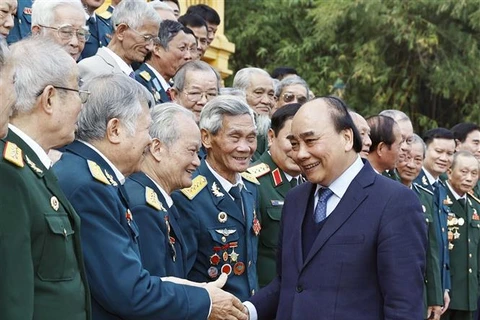
“Dien Bien Phu in the Air” victory celebrated in Hanoi ảnh 2An art performance at the event (Photo: VNA)
Speaking at the ceremony, Secretary of the municipalParty Committee Dinh Tien Dung affirmed that the victory has always been abright symbol of the indomitable will and the pride of the Vietnamese nation,people and army.

It was one of the most glorious feats of arms in thecountry’s history of fighting foreign invaders in the Ho Chi Minh era, hecontinued, stressing that the entire Party, people and army are resolved topreserve and promote the tradition during the cause of national constructionand defence.

Hanoi’s Party organisation, people and armed forces haveupheld the valuable lessons learned from the struggle for national liberationand reunification, including those from the “Dien Bien Phu in the Air”campaign, to serve the city’s development, as well as national construction anddefence, the official said.

Delegates at the event recalled the 12 days andnights of the campaign, and enjoyed special art performances celebrating thevictory.

Prior to the ceremony, a delegation of the PartyCommittee, People’s Council and People’s Committee, Vietnam Fatherland FrontCommittee, departments and agencies of Hanoi paid tribute to victims of the 1972 bombing at a monument on Kham ThienStreet./.


VNA

See more

The Red River Scenic Boulevard Axis is designated as one of nine key development corridors of Hanoi. (Photo: VNA)

Hanoi details multi-billion-USD Red River scenic boulevard axis project

Under the capital’s master plan with a 100-year vision, the Red River Scenic Boulevard Axis is designated as one of nine key development corridors of Hanoi. It is envisioned as a central green spatial corridor, while also functioning as an economic, commercial, service, cultural, creative, and urban development axis along the Red River.

Defendants at the appellate trial in Hanoi on May 20 (Photo: VNA)

Appeal trial opens in food safety bribery case

The total amount of bribes received by the defendants in the case exceeded 94 billion VND, with former Director of the Vietnam Food Safety Authority (FSA) Nguyen Thanh Phong alone pocketing 43.9 billion VND.

Vietnamese Ambassador to the US Nguyen Quoc Dung speaks at the seminar. (Photo: VNA)

Vietnam – US partnership expands in culture preservation, promotion

The May 18 seminar, themed “Reframing Vietnam,” at the National Museum of Asian Art (NMAA) under Smithsonian Institution in Washington, D.C., is expected to generate fresh momentum and frameworks for cooperation among cultural agencies, museums, art funds and experts from the two countries, helping bring Vietnam’s cultural image closer to American and international public in the time to come.

Visitors to an exhibition and test-drive programme for electric vehicles organised in Cau Giay ward, Hanoi, on May 16 by the municipal People's Commitee and relevant agencies. (Photo: VNA)

Hanoi proposes subsidies to accelerate shift to electric vehicles

Under a draft resolution currently open for public feedback by the municipal People’s Committee, residents with permanent or temporary residence registration in Hanoi for at least two consecutive years, who own petrol-powered motorbikes registered before the resolution takes effect, will be eligible for support when purchasing electric motorbikes priced at 10 million VND or more.

The copyright crackdown is broadly viewed as an inevitable step in Vietnam’s cultural industry development. (Illustrative photo: VNA)

Healthy digital content market in the making

The sharper crackdown is rapidly redrawing how online entertainment is distributed and consumed, while gradually reshaping public awareness and responsibility toward copyright protection.

A view of Place Ho Chi Minh in Persan, France. (Photo: VNA)

Place preserving memories of President Ho Chi Minh in France

Although there is little publicly available documentation confirming exactly when Place Ho Chi Minh was established, French urban historians suggest that most streets and public spaces named after the Vietnamese leader in France emerged between the 1960s and 1980s, during the height of anti-war movements and solidarity campaigns supporting Vietnam across working-class towns and left-leaning suburbs around Paris.

Vietnamese Ambassador to Bangladesh Nguyen Manh Cuong speaks at the seminar. (Photo: VNA)

President Ho Chi Minh’s thought on national unity remains relevant today

President Ho Chi Minh's ideology of national unity continues to carry profound significance amid growing global challenges, including conflicts, social divisions and economic instability. His message of solidarity, consensus and placing national interests above sectional differences remains a valuable lesson for many developing nations.