Diplomatic sector effectively serves national defence, development: Minister

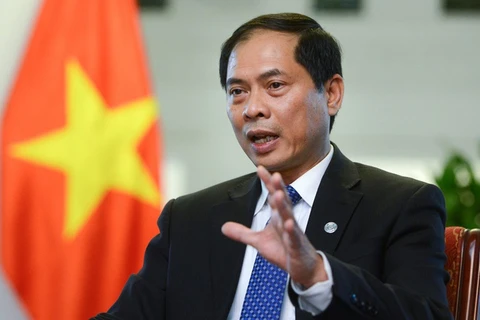
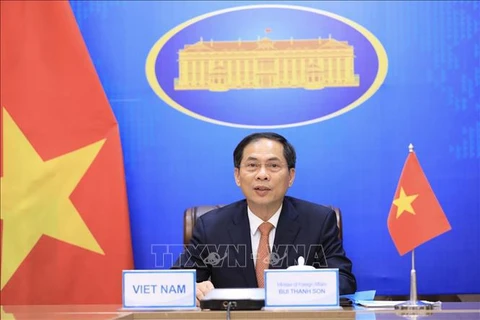
The diplomatic sector has made great contributions to the cause of national defence, construction and development throughout the country’s history over the past more than seven decades, Minister of Foreign Affairs Bui Thanh Son wrote in an article on the occasion of the ministry's 76th founding anniversary (August 28, 1945-2021).
Diplomatic sector effectively serves national defence, development: Minister ảnh 1Dien Bien Phu Victory in 1954 forced French colonists to sign the Geneva Peace Agreement and end colonial regime in Vietnam (File photo: VNA)
Hanoi (VNA) – The diplomatic sector has made greatcontributions to the cause of national defence, construction and development throughout thecountry’s history over the past more than seven decades, Minister of Foreign Affairs BuiThanh Son wrote in an article on the occasion of the ministry's 76th founding anniversary (August 28, 1945-2021).

He noted that the Ministry of Foreign Affairs of Vietnam wasfounded 76 years ago together with the establishment of the Democratic Republicof Vietnam, with the first Minister of Foreign Affairs being Ho Chi Minh, who was also thePresident of the then Provisional Government.

Right after its foundation in the context that the country wasfacing enemies from both inside and outside, the sector focused on protectingthe young revolutionary administration and prolonging the valuable peaceful periodfor the preparation of forces for a long-term resistance period.

Upholding the principle of peace, nationalindependence and socialism, the sector became a strategic front in thetwo resistance wars, mobilising the support from socialist countries andpeace-lovers in the world for the just struggle for national freedom, accordingto Son.

In close coordination with political and military struggles,the diplomatic sector gained important successes at the negotiations in Geneva in1954 and Paris in 1973, opening up great opportunities for the nation to headto the reunification day, the minister wrote.

During the post-war period with numerous difficulties and challenges,the Vietnamese diplomatic sector optimised the support and help from socialistcountries and international friends to the cause of national reconstruction, developmentand defence.

Diplomacy became a tool to clear the way for the country togenerally remove blockage and embargo and set up relationships withneighbouring countries, world powers and many partners, opening up a new context forexternal relations to effectively serve the country’s comprehensivereform process, Son affirmed.

Regarding the sector’s contributions to the country’s “Doi Moi” (Renewal)and international integration, Son underlined that with an external policy ofindependence, self-reliance, peace, cooperation, development,multilateralisation and diversification, and active and proactive internationalintegration for the interests of the nation, the sector has taken the lead inconstructing peace, protecting the Fatherland and attracting resources for thecountry’s development, and improving Vietnam's position.

So far, Vietnam has established diplomatic ties with 189countries, including 17 strategic partners and 13 comprehensive partners. The nation also set up economic partnerships with more than 230 economies around the world andsigned 15 free trade agreements (FTA), including many new generation deals.

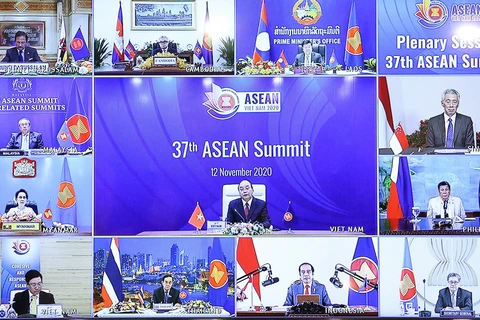
Vietnam has successfully hosted many large-scale internationalevents and completed many international missions such as the role of anon-permanent member of the United Nations Security Council in the 2008-2009and 2020-2021 tenures, the host of the ASEAN Summits in 1998, 2010 and 2020,the Asia-Europe Meeting Summit in 2004, the Asia-Pacific Economic Cooperation(APEC) Leaders Meetings in 2006 and 2017, the World Economic Forum (WEF) on East Asia in 2010and the WEF on ASEAN in 2018, and the US-DPRK Summit in 2019, he noted.

Son stressed that since the COVID-19 pandemic broke out anddeveloped complicatedly in the world and inside the country, the diplomaticsector, together with other ministries and sectors, enhanced “medicaldiplomacy” and "vaccine diplomacy” to optimise the timely and efficient supportof the international community in vaccine, medical supplies and medicine, thus joininghands with the whole country in controlling the pandemic and boostingsocio-economic development at the same time.

These outstanding achievements of the diplomatic sector have significantly contributed to thecountry's great successes of historical significance over the past 35 years ofrenewal, proving the sound foreign policy of the Party, theminister concluded./.


VNA
See more

NA Chairman Tran Thanh Man speaks at the conference (Photo: VNA)

Conference mulls over legislative roadmap for 16th NA’s term

In his keynote speech, NA Vice Chairman Nguyen Khac Dinh presented the conclusion as a strategic vision for legal reform in the new development period. It spells out concrete goals, nine major orientations, six bundles of tasks and solutions, and assigns specific duties to the relevant bodies.

Prime Minister Le Minh Hung departs Hanoi on June 16, 2026 to attend the ASEAN–Russia Commemorative Summit and conduct bilateral activities in Kazan, Russia from June 16 to 18. (Photo: VNA)

PM departs for ASEAN – Russia Commemorative Summit

PM Hung’s participation in this summit once again reflects Vietnam’s consistent foreign policy of independence, self-reliance, resilience, peace, friendship, cooperation and development, as well as the diversification and multilateralisation of external relations in line with the spirit of the 14th National Party Congress.

Deputy Defence Minister Senior Lieutenant General Nguyen Truong Thang and the Vietnamese delegation are briefed by a French partner on a combat helicopter model at Eurosatory 2026. (Photo: VNA)

Vietnam promotes defence cooperation at Eurosatory 2026

During the event, the Vietnamese delegation met with major French defence firms, including Airbus and UNAC, to discuss technology transfer, human resource training, technical support and defence industry development. Vietnam also invited international partners to participate in the Vietnam International Defence Expo 2026, scheduled to be held in Hanoi this December.

Party General Secretary and State President To Lam receives Danish Ambassador to Vietnam Nicolai Prytz in Hanoi on June 15, 2026. (Photo: VNA)

Top Vietnamese leader receives outgoing Danish Ambassador

Party General Secretary and State President To Lam emphasised that the friendship nurtured over decades, coupled with shared development visions, particularly in the green economy, maritime economy and circular economy, as well as growing connections in culture, sports, tourism and people-to-people links, will continue to serve as a solid foundation for deeper and more productive relations between Vietnam and Denmark.

Party General Secretary and State President To Lam speaks at the working session with the education sector in Hanoi on June 15. (Photo: VNA)

Top leader urges education sector to make fundamental shift in mindset

Implementation of Resolution 71 must be carried out with strict discipline, regular inspections and continuous monitoring. The Ministry of Education and Training should establish a transparent system for tracking implementation through specific and regularly updated indicators. Each objective must be translated into concrete tasks, resources, timelines and responsible agencies.

Prime Minister Le Minh Hung (R) receives Russian Ambassador to Vietnam Gennady Bezdetko in May 2026. (Photo: VNA)

Vietnam - bridge in advancing ASEAN–Russia relations

Prime Minister Le Minh Hung’s upcoming visit to Russia from June 16–18 for the ASEAN–Russia Commemorative Summit marking 35 years of dialogue relations highlights Vietnam’s commitment to the ASEAN–Russia Strategic Partnership and its role in strengthening cooperation between the bloc and Russia.

A bird's eye view of Hanoi capital (Photo: VNA)

📝 OP-ED: Democracy and happiness – core values for building public trust

At the heart of the model is the principle that all policies must be designed for the people, rooted in the people’s aspirations and dedicated to serving their interests. Citizens will play an active role in governance through access to information, participation in decision-making, oversight of public affairs and equitable access to development outcomes. In this context, democracy and happiness of the people are not only development goals but also the most accurate benchmarks for evaluating the effectiveness of local governance and the capacity of grassroots authorities to serve their communities.