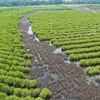
Tri An Reservoir (Photo: VNA)
 Dong Nai (VNS/VNA) - The People’s Committee of the southern province of Dong Nai has called on relevant agencies and the public to take proactive measures to ward off a freshwater shortage as drought and saltwater intrusion in rivers cause an increasing shortage.
It instructed authorities around the province to keep a close eye on the weather and water bodies to estimate availability for production and domestic needs.
They also need to find ways to prevent saltwater intrusion, it said.
Based on the water availability in their localities, they should switch crops and restructure agriculture and comply with relevant agencies’ recommendations to mitigate possible damages caused by drought and saltwater intrusion, it said.
It wanted them to take the initiative to adopt necessary methods to store water, strengthen forecasts of water levels in reservoirs and mobilise funds to build and upgrade freshwater supply systems.
The province's Environmental Protection Sub-department said it would check the quality of water in the four main aquaculture regions to provide information and warnings, if required, to local authorities and farmers to reduce losses.
The province has 32,000 hectares of aquaculture farms.
The water storage in irrigation reservoirs in Dong Nai is down to 63.8 percent of capacity. Water levels in rivers and streams are also low, at less than 72 percent of their levels a year ago. The salinity rate is around 5.5 grammes per litre, according to the People’s Committee.
According to the province’s Centre for Hydro-Meteorological Forecasting, rainfall will be scant from March to June and temperatures until June will be 0.5-1.5 degrees Celsius higher than normal.
Ho Chi Minh City has not yet been affected by saltwater intrusion.
Tri An Reservoir in Dong Nai province will discharge water to clear salinity in rivers. It stores a large volume of water and responds to drought and saltwater intrusion in the lower sections.
More farmers in the south-central province of Ninh Thuận are using automatic irrigation systems to water their crops, saving water and improving production efficiency.
The automatic irrigation systems with spray or drip methods have helped farmers cope with water shortages caused by drought in the province, which has the least rainfall in the country.
Nguyen Thanh Quang spent 30 million VND (1,290 USD) to install a spray irrigation system in his 5,000sq.m of grape orchard in Ninh Hai district’s Vinh Hai Commune last year. He has no longer had to worry about the shortage of irrigation water for his orchard in the ongoing dry season.
In previous dry seasons, many grapevines in his orchard died because of the lack of irrigation water, he said.
The spray irrigation system can maintain soil humidity suitable for the growth of grapes and help grape roots develop well, he said.
The spray irrigation system can also be used to spray fertiliser directly on grape roots, reducing the loss of fertiliser caused by traditional irrigation methods.
Farmers normally irrigate a large quantity of water for crops in traditional methods which can wash away fertiliser for crops.
The cost of buying an automatic irrigation system for each 1,000sq.m of farming area is 5-12 million VND (210-510 USD) and the system can save 20-40 percent of irrigation water compared to traditional irrigation methods, according to farmers.
An automatic irrigation system requires a water pump, a water tank, water lines and irrigation valves. To irrigate crops, farmers only need to open the automatic irrigation system and the irrigation task will be automatically done, saving time and labour.
Farmers in the province use automatic irrigation systems for various crops, including grapes, asparagus, aloe, peanut and vegetables.
Tu Van Phuc of Ninh Phuoc district’s An Hai commune said drought has occurred in his area in recent years and to secure irrigation water for his 5,000sq.m asparagus field, he installed an automatic irrigation system in 2018.
The automatic irrigation system has released proper amount of irrigation water to keep soil humid for asparagus, he said.
Ninh Thuan is strengthening restructuring of agricultural production activities to cope with the impact of drought and authorities have encouraged rice farmers to switch to drought-resistant crops in drought-prone areas.
Pham Dung, head of the province’s Plant Protection and Cultivation Sub-department, said the strengthening of restructuring agriculture and the application of efficient irrigation methods are feasible solutions for using water reasonably and efficiently during drought.
The province has about 1,500ha of crops which apply efficient irrigation methods, he said.
The province has encouraged farmers to apply efficient irrigation methods and has provided them with techniques for installing such systems for various crops.
Only 53.7 percent of farming areas in Ninh Thuan have secured irrigation water, according to the province’s Department of Agriculture and Rural Development.
The province's farmers have turned nearly 6,500ha of ineffective rice to other high value crops like grapes, jujube, grapefruits, asparagus and aloe in recent years.
The province is expected to have a total of 86,000ha farming rice and various types of crops this year./.
VNA