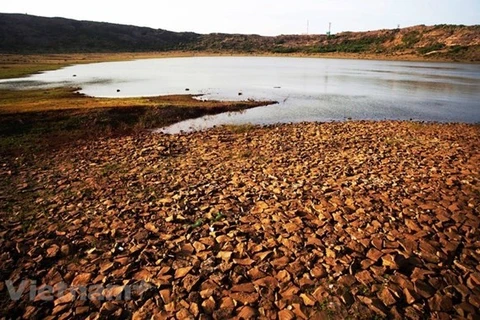
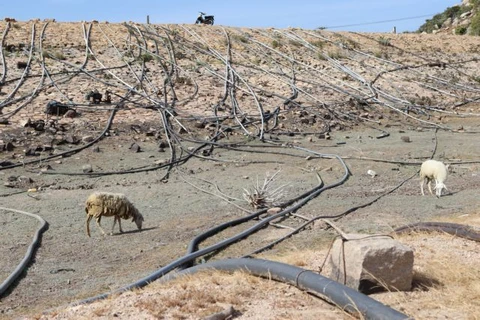
Drought, saltwater intrusion threatens farming, local life in Mekong Delta

Saline intrusion has occurred earlier than normal in the Mekong Delta and is expected to affect a greater area this year, according to the Ministry of Agriculture and Rural Development (MARD).
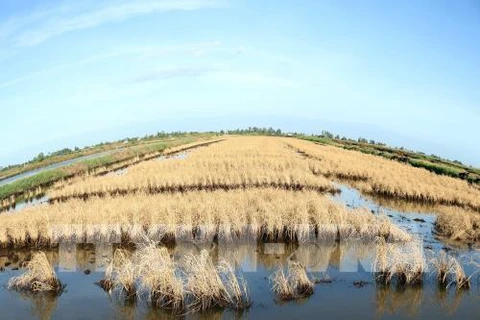
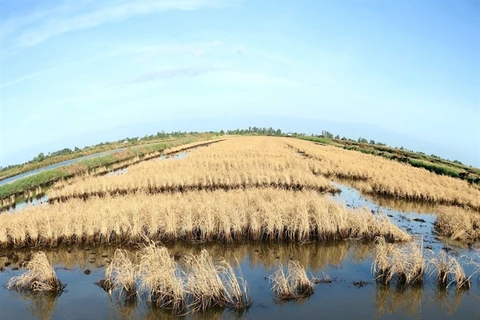
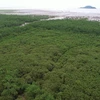
Drought, saltwater intrusion threatens farming, local life in Mekong Delta ảnh 1A rice field affected by drought and saltwater intrusion in Vi Thuy district, the Mekong Delta province of Hau Giang (Photo: VNA)


Hanoi (VNA)
– Saline intrusion has occurred earlier than normal in the Mekong Delta and is expected to affect a greater area this year, according to the Ministry of Agriculture and Rural Development (MARD).

In a report submitted to the Prime Minister on February 13, the ministersaid saltwater intrusion is at a peak now since the beginning of the dryseason. Saltwater has gone up 100-110km up the Vam Co river, 20-22km furtherthan the salinity intrusion in normal years and 4-6 km further than level atthe same time in 2016, the year with record salinity intrusion.

In the western coastal region, the salinity intrusion in Cai Lon riverhas reached 61km inland, 12km further than average, and 5km more than the levelat the same time in 2016.

Saltwater intrusion will seriously affect local agricultural production anddaily life of residents. It is forecast that the situation will not improveuntil the end of April.

The MARD noted that it had worked with local administrations toaccelerate the pace of construction projects to cope with salinity intrusion. Fiveprojects were put into operation in December 2019 and January 2020, protecting83,000 ha of land from  saltwaterintrusion and helping with curb the impact of saltwater for 300,000 hectares. 

Several other projects are still underway, which will ensure bettercontrol of saltwater intrusion, such as the irrigation systems in north Ben Tre,Cai Lon-Cai Be rivers and Long Xuyen Quardruple.

About 94,000 ha of rice fields in nine coastal provinces are likely tobe affected by drought and saltwater if water supply runs short in the firsthalf of March. Localities are working to store water and put measures in placeto cope with the threat.

The ministry has recommended that farmers delay the sowing of Summer-Autumn rice until saltwater intrusion subsides.

Besides, 79,700 households are facing water shortage for daily life.Localities are drilling more wells and drafting plans to supply water forresidents.

The ministry said it will call on international organisations andprivate companies to help provide water tanks and water treatment devices for peopleaffected by water shortage.

The MARD asked the Prime Minister to consider including funding formeasures countering drought and saltwater intrusion in the resolution of theGovernment’s regular February meeting.

The PM has continued to require ministries and agencies to assistlocalities in addressing the problem of saline intrusion to minimise losses inagricultural production and ensure water for local people’s daily life./.
VNA

See more

White-rumped langurs are rescued and conserved at the Endangered Primate Rescue Centre (EPRC) in Cuc Phuong National Park. (Photo: VNA)

Ninh Binh establishes Kim Bang white-rumped langur conservation area

Covering a total area of 3,182ha, the conservation area comprises 3,016.81ha of natural forest, 64.25ha of plantation forest and 100.94ha of land without forest, with no water surface area. It is located in the Ly Thuong Kiet, Tam Chuc and Nguyen Uy wards of Ninh Binh province.

The forum takes place in Hanoi on August 25, 2026. (Photo: VNA)

Vietnam, RoK promote cooperation to deliver on net-zero commitments

Sectors such as semiconductor manufacturing, nuclear power, science and advanced technologies are playing an increasingly important role in national competitiveness and economic development of each country. They also offer considerable room for Vietnam and the RoK to expand professional exchanges, share experience and promote cooperation, particularly among their energy experts.

Storm Narra's projected path as of 7:00 on August 22. (Photo: National Centre for Hydro-Meteorological Forecasting)

Storm brings heavy rains to northern Vietnam

Storm Narra, the fourth to hit the East Sea this year, brought strong winds and heavy rains to northern Vietnam on early August 22, with some areas forecast to receive more than 500mm of rain as the storm moves slowly over the northern waters of the East Sea.

A view of the meeting between Phu Tho authorities and a visiting delegation from Germany's KfW Development Bank in the province on August 20, 2026. (Photo: VNA)

Phu Tho, German bank discuss wastewater treatment plan for Da River's left bank

The project is being implemented in the former Hoa Binh city, now Hoa Binh ward. It has a total investment of 688.7 billion VND (26.38 million USD), including 507.3 billion VND in ODA and 181.4 billion VND in counterpart funding. Major components include a wastewater treatment plant, pumping stations, a collection network, and connection infrastructure.

Construction workers reinforce steel and pour concrete to cover the underground drainage channel, helping collect rainwater and tackle flooding in Da Nang. (Photo: VNA)

A new “shield” against climate change

Smart urban areas are no longer simply about technology; they are becoming a tool that enables authorities to forecast risks, adapt quickly and protect their residents.

Vietnam is exerting efforts to cope with climate change. (Illustrative photo: VNA)

Vietnam approves carbon credit pact with Singapore under Paris Agreement

Signed on September 16, 2025, the Implementation Agreement on carbon credits collaboration under Article 6 of the Paris Agreement on climate change affirms Vietnam and Singapore’s pioneering role and commitment to close cooperation in the international carbon market, making a substantive contribution to global climate response.

A view of Vo Cuong ward, Bac Ninh province (Photo: VNA)

Bac Ninh earmarks over 1.7 billion USD for environmental protection

By 2030, Bac Ninh aims to ensure that all operating industrial clusters and industrial parks have centralised wastewater treatment systems meeting standards, while at least 95% of wastewater in Grade-I urban areas and 70% in Grade-II urban areas is collected and treated to required standards.