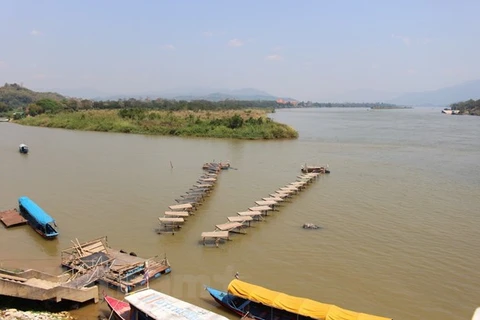
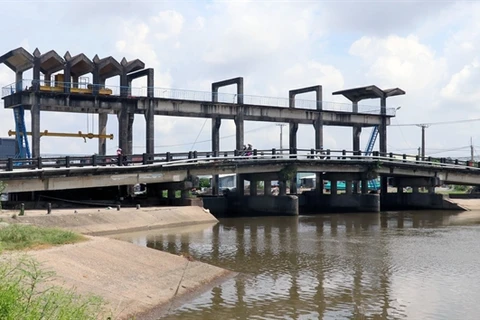
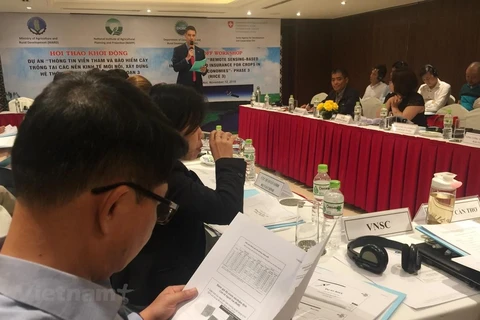
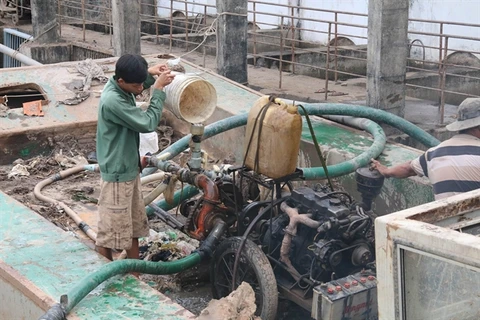
Subsidence and overexploitation of underground water have been popular in Mekong Delta region (Photo: VNA).
 Hanoi (VNA) - The Mekong Delta region of Vietnam, an area that helps feed about 200 million people, is predicted to sink underwater by 2100.
In the past 25 years, Mekong Delta and the communities, cities and rice fields that depend on it, have faced grave risks of higher tides, alluvium sediment starvation, saline intrusion, fresh water shortage, and serious landslides.
According to Dr. Philip Minderhoud from the Utrecht University, the delta, home to almost 18 million people and produces half of Vietnam’s rice output, is only around 1-2 metres above the sea level. And if heavy extraction of ground water and sand mining continue, the land will probably sink into the sea by 2100.
Rising tides, loss of naturally replenishing alluvium sediment
The scientist, head the “Rise and Fall: strategies for the subsiding and urbanizing Mekong Delta facing increasing salt water intrusion” project, said that the area is currently only 80 centimetres above the local sea level, approximately two metres lower than international researchers previously thought.
Scientific evidence also proves that compared to a climate-change driven sea level rise of 3-5 millimetres a year, there is a land subsidence of 2-3 centimetres in many coastal areas due to ground water extraction, loading of urban infrastructure and intensive drainage of the shallow subsurface.
The rapid growth of subsidence makes the salinization, flooding and coastal landslide in the delta event more urgent, Minderhoud said.
Tides and salinity in the Mekong Delta are increasing rapidly. The increase in the tidal amplitude is 40 percent over the last 10 years due to the fact that river beds are on average 2-3 metres deeper because of alluvium sediment starvation.
According to Minderhoud, the decreasing alluvia sedimentation loads of the Mekong River as a result of upstream dam building, together with the excessive sand mining downstream in the delta, is seen as a major driver for deepened river bed and eroded river banks.
Besides, overexploitation of underground water and construction along riverbanks have made the subsidence situation become more serious, let alone changes in tidal amplitude and river bed’s depth that increase the salinity level in the delta.
No subsidence was observed in Mekong Delta before 1990s. However, today, when one stands at the seaside, he may mistake the lower land for rising sea level, the scientist said.
Minderhoud attributed changes in tidal amplitude to climate change, adding that tidal amplitude rose significantly during 2008-2018, and human activities are driving short-term impact that far outstrips current climate change effects.
 River bank erosion in Dong Thap province (Photo: VNA)
 Underground water exhausted, high costs predicted for future
Besides intense subsidence and increase in tidal amplitude and saline intrusion, Minderhoud said that ground water is being extracted excessively for local production.
This could result in depletion of aquifers, while the recharge for water stocking is very little due to impermeable layers in the subsoil. As a consequence of extraction, the water from salty aquifers intrudes into the freshwater reserves.
With current subsidence, for each cubic metre of fresh ground water that is extracted from the aquifers, another 12 cubic metres of fresh water will get too salty for consumption. Therefore, if there is no good control, the fresh groundwater reserve in the Mekong Delta region will last for only 100 years. Besides, the subsidence level will be more serious, the Dutch researcher said.
According to the expert, if the ground water extraction continues to grow 2 percent each year, the Mekong Delta will sink under the sea level by 2100.
If pumping keeps its speed like today, local people will have to pay high costs for water treatment and preservation of agricultural lands, Minderhoud stressed.
Resolving subsidence problems
Minderhoud believed that it’s time for Vietnam to outline urgent action plan to handle the root cause of the problems, namely ground water exploitation and sand mining.
Upgrading flood breaking system, good delta planning, plantation of mangrove forests, and building comprehensive irrigational systems in the region are highly recommended.
They are not only aimed at environmental protection but also socio-economic benefit and water security. If the problems are not solved today, the region will have to spend a lot in the future, he warned.
Meanwhile, Dutch Ambassador to Vietnam Elsbeth Akkerman affirmed that the fertile Mekong Delta region is experiencing critical subsidence, increase of tidal amplitude and alluvium sediment starvation. Competent agencies and authorities need to work together to settle the issues.
Sand mining and ground water extraction should be put into consideration in the delta planning, she said, suggesting that the Vietnamese Government take timely actions to prevent more serious situations.
As a low-lying country, the Netherlands stands ready to accompany Vietnam to adopt a systematic approach towards sustainable development in Mekong Delta.
The Netherlands can further support the Vietnamese initiatives with experiences and expertise to implement the new planning law, create a new coordination mechanism, and design a Delta Fund and transform agricultural practices./.
Besides intense subsidence and increase in tidal amplitude and saline intrusion, Minderhoud said that ground water is being extracted excessively for local production.
This could result in depletion of aquifers, while the recharge for water stocking is very little due to impermeable layers in the subsoil. As a consequence of extraction, the water from salty aquifers intrudes into the freshwater reserves.
With current subsidence, for each cubic metre of fresh ground water that is extracted from the aquifers, another 12 cubic metres of fresh water will get too salty for consumption. Therefore, if there is no good control, the fresh groundwater reserve in the Mekong Delta region will last for only 100 years. Besides, the subsidence level will be more serious, the Dutch researcher said.
According to the expert, if the ground water extraction continues to grow 2 percent each year, the Mekong Delta will sink under the sea level by 2100.
If pumping keeps its speed like today, local people will have to pay high costs for water treatment and preservation of agricultural lands, Minderhoud stressed.
Resolving subsidence problems
Minderhoud believed that it’s time for Vietnam to outline urgent action plan to handle the root cause of the problems, namely ground water exploitation and sand mining.
Upgrading flood breaking system, good delta planning, plantation of mangrove forests, and building comprehensive irrigational systems in the region are highly recommended.
They are not only aimed at environmental protection but also socio-economic benefit and water security. If the problems are not solved today, the region will have to spend a lot in the future, he warned.
Meanwhile, Dutch Ambassador to Vietnam Elsbeth Akkerman affirmed that the fertile Mekong Delta region is experiencing critical subsidence, increase of tidal amplitude and alluvium sediment starvation. Competent agencies and authorities need to work together to settle the issues.
Sand mining and ground water extraction should be put into consideration in the delta planning, she said, suggesting that the Vietnamese Government take timely actions to prevent more serious situations.
As a low-lying country, the Netherlands stands ready to accompany Vietnam to adopt a systematic approach towards sustainable development in Mekong Delta.
The Netherlands can further support the Vietnamese initiatives with experiences and expertise to implement the new planning law, create a new coordination mechanism, and design a Delta Fund and transform agricultural practices./.
VNA