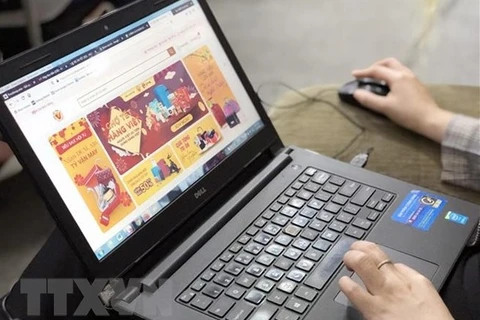
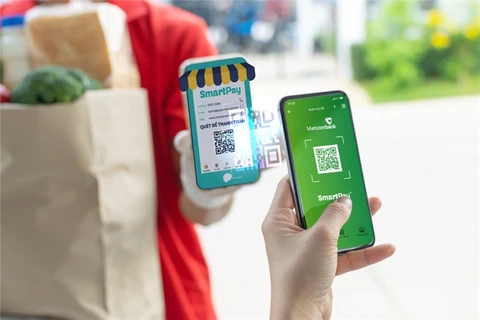
E-commerce has proved to be an increasingly useful tool for enterprises to surmount difficulties and grasp chances (Illustrative photo: VNA)
 Hanoi (VNA) – The Fourth Industrial Revolution is taking place around the world with a boom in digital technology, creating great opportunities for but also challenges to the development of each country, enterprise, and person.
Vietnam’s digital economy has been growing at the fastest pace in ASEAN, about 38 percent annually compared to the region’s average of 33 percent since 2015. The country expects the digital economy will make up 20 percent of its GDP and at least 10 percent in each sector.
Vietnam’s digital economy posts fastest growth in region
In a recent interview granted to the Vietnam News Agency, Deputy Minister of Industry and Trade Nguyen Sinh Nhat Tan said local e-commerce has been thriving, playing an important role in economic development as well as in the future of Vietnam’s digital economy. E-commerce development is an inevitable trend in the country, and the COVID-19 pandemic serves as a catalyst for this trend to proceed faster and more strongly.
 Deputy Minister of Industry and Trade Nguyen Sinh Nhat Tan addresses the launch of the e-commerce week and the Vietnam Online Shopping Day (Online Friday) on November 26, 2021 (Photo: VNA)
 Despite the pandemic’s adverse impacts in 2020, e-commerce in Vietnam still made great strides to become one of the fastest growing markets in Southeast Asia.
According to the Vietnam E-commerce White Book, e-commerce expanded by 18 percent in 2020 to reach 11.8 billion USD, making the country the only in Southeast Asia to post a double-digit growth rate in this regard. Estimates by some major businesses in the world like Google, Temasek, and Bain & Company indicate that the digital economy of Vietnam is likely to top 52 billion USD and rank third in ASEAN by 2025.
Amid the resurgence of COVID-19 in 2021, e-commerce has proved to be an increasingly useful tool for enterprises to surmount difficulties and grasp chances generated by new demand in the market. Local consumers are strongly shifting from the traditional in-person shopping to online method via electronic platforms.
A survey by the Ministry of Industry and Trade showed that Vietnam had 49.3 million online shoppers in 2020, compared to 32.7 million in 2016.
Hanoi and Ho Chi Minh City are among the largest cities in terms of digital economic development in the region. In HCM City alone, there are currently 567 e-commerce platforms, over 20,680 websites, and 134 apps. Although the lingering COVID-19 pandemic has hindered the flow of goods, many e-commerce platforms and websites still posted fast growth.
Thanks to the digital economy, business activities have become vibrant, from advertising on social networks (Facebook, Instagram), entertainment (Netflix, Pinterest), transport (Uber, Grab, GoViet) to wholesale and retail (Lazada, Shopee).
Vietnam has emerged as one of the largest regional recipients of investment into the companies operating on IT platforms and the internet such as MoMo, Sendo, and Topica, helping turn it into an attractive destination for domestic and foreign investors.
Transboundary e-commerce - useful distribution channel for enterprises to expand market
E-commerce helps people purchase items from international markets via the internet and become “global consumers”. It also assists individuals and businesses to introduce and deliver their products to international buyers.
The engagement in the online export - import system and stages of transboundary e-commerce will generate opportunities for Vietnamese firms to perfect their products, improve capacity, and make Vietnamese brands popular among consumers around the world.
To help boost the sale of Vietnamese goods via transboundary e-commerce, the Vietnam E-commerce and Digital Economy Agency (iDEA) has launched the Vietnam National Pavilion on JD.com, an international e-commerce platform. Its partners like Vinanutrifood, Viettel Post, VPBank, and Visa also unveiled practical policies related to marketing, transport, and lending interest rates to support Vietnamese manufacturers to carry out this programme.
 Director of the Vietnam E-commerce and Digital Economy Agency (iDEA) Dang Hoang Hai (Photo: VNA)
 The Ministry of Industry and Trade has been developing and applying an array of measures such as a certified e-contract authority, guaranteed payment infrastructure for e-commerce, and a platform for managing the e-commerce product flow, which will serve as important bases for the ministry to assist e-commerce platforms and businesses using e-commerce, thus facilitating the healthy, transparent, and sustainable development of the market.
Talking about transboundary e-commerce, iDEA Director Dang Hoang Hai said it is relatively new to enterprises in Vietnam but also the start of a long journey with much needing to be done by both authorities and companies.
He expressed his belief that thanks to joint efforts by the ministry and others, central agencies, localities, and the business community, Vietnamese pavilions on foreign e-commerce platforms will be opened soon and prove effective.
Highlighting the benefits from transboundary e-commerce, Nguyen Thi Diem Hang, Chairwoman of the Board of Director of the Vietnam Organic Nutrition Food JSC (Vinanutrifood), said joining the national pavilion helps popularise the image and brand of Vietnam in the global market. It also supports Vietnamese firms to seek exporting and importing partners and build up foreign consumers’ trust in Vietnamese goods.
Developing healthy e-commerce market in Vietnam
Grasping trends and good practices of digital transformation in trade will help promote innovation in Vietnamese enterprises. On November 22, 2021, the Prime Minister issued a decision approving a plan to step up the IT application and digital transformation in trade promotion during 2021 - 2030.
However, the ministry’s Competition and Consumer Authority pointed out that e-commerce growth has also been accompanied by the surge in wrongdoings related to consumers’ interests. Data show that there are about 500 - 2,000 complaints from consumers every year, mostly about leaks of buyers’ information and scams by sellers.
To create a legal framework for protecting consumers in the e-commerce market, the Government issued a decree that amended and supplemented another on e-commerce released in 2013.
According to the new decree, sellers must publicise information about products as well as business licences and related certificates when doing business on e-commerce platforms. Besides, business activities on social networks like Facebook, Zalo, and Instagram were also placed under management.
 The launch of the e-commerce week and the Vietnam Online Shopping Day (Online Friday) on November 26, 2021 (Photo: VNA)
 The ASEAN Agreement on Electronic Commerce, signed in Hanoi on January 22, 2019 and taking effect on December 2 last year, set up common principles and rules for facilitating e-commerce development in the region and enhancing the rule enforcement capacity.
The deal implementation is expected to help revive the regional economy in the post-pandemic period.
Deputy Minister Tan said in the “new normal” context, e-commerce has increasingly shown its indispensable role in society when enterprises and organisations must swiftly apply digital transformation solutions to their business and management activities like switching to multi-channel retailing and using smart order management and logistics tools.
With huge market potential and the Party and State’s favourable policies, e-commerce is expected to be a contributor to the economic recovery in Vietnam when the country is moving to safely adapt to the COVID-19 pandemic.
E-commerce has been present in almost all production and business sectors, helping boost economic development. However, it is still facing a number of challenges related to consumers’ trust in items sold online, delivery and payment methods, and information security. Given this, the Government and relevant agencies should take appropriate actions to protect consumers and fuel e-commerce in the time ahead./.
Related stories: Digital transformation goes mainstream in Vietnam
Cashless society gets closer as Vietnam digital banking gathers pace